

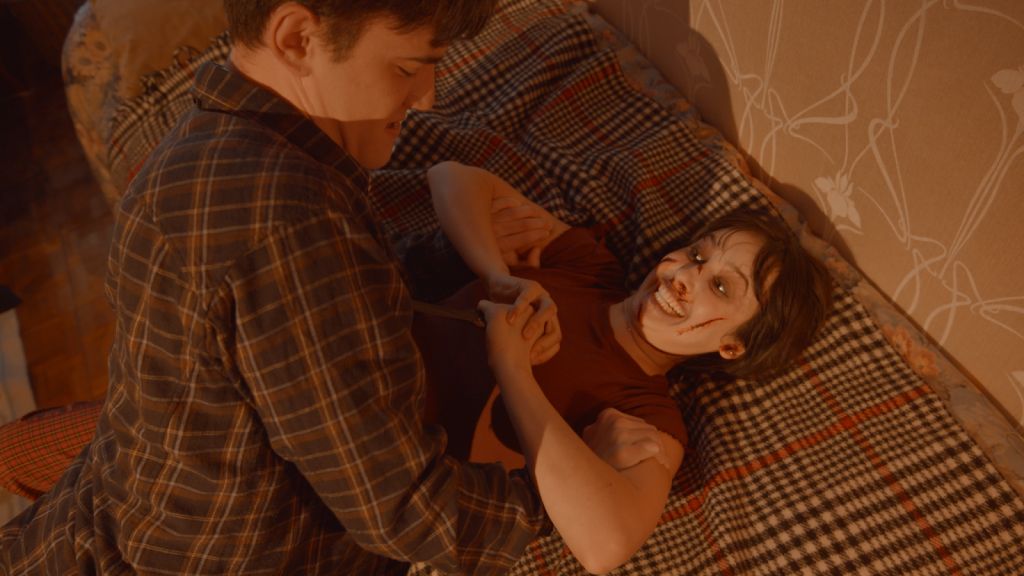
In an era dominated by rapid-fire editing, relentless jump scares, and CGI-laden horror spectacles, Possession of Mara emerges as a rare anomaly. It is a film that dares to breathe, to unspool its dread slowly, and to let its characters’ humanity take center stage. The result is a work that feels less like a contemporary release and more like an unearthed relic from horror’s golden age of the 1970s and 1980s. Drawing comparisons to Rosemary’s Baby and The Exorcist is inevitable, but rather than mimicry, the film absorbs their lessons: atmosphere over spectacle, suggestion over bluntness, psychology over shock.
At the heart of the narrative is Mara, a young woman whose encounter with despair opens her to forces beyond her understanding. Aubrey Bence’s performance is quietly devastating—she radiates fragility in moments of stillness, then erupts with anguish when the weight of possession becomes unbearable. What makes her portrayal so compelling is its restraint. Rather than caricatured screaming or exaggerated terror, Mara conveys horror as something internalized, a corrosion of the soul that seeps outward in whispers, trembling hands, and vacant stares. It is a performance that evokes empathy as much as fear, allowing the audience to share in her torment.
Counterbalancing her despair is Christopher (Alec Barnett), the man who intervenes at the brink of her self-destruction. His character could have easily slipped into cliché—the archetypal savior figure—but the actor imbues him with a layered sincerity. There is an innocence in his gestures, a fumbling uncertainty in his attempts to help, which makes his devotion all the more affecting. His journey from reluctant caretaker to deeply invested companion anchors the film emotionally, and his vulnerability ensures that the story’s romance never dilutes its horror, but rather intensifies it.

The Devil , brought to life by Vlad Len, with unnerving precision, provides the film’s most chilling presence. Far from the bombast of traditional screen demons, this performance thrives in stillness and suggestion. Every smirk, every pause, every moment of controlled menace unsettles. What is terrifying here is not fire and brimstone, but inevitability—the sense that Mara’s fate is not only sealed but perversely cherished by the being who pursues her. It is an interpretation that recalls the understated but terrifying villainy of classic horror antagonists, where less is infinitely more.
Supporting this core dynamic are two standout performances that lend depth and texture to the story. Christopher’s best friend Matthew played by Archie Meisner emerges as a protective force, a steadying presence whose concern feels deeply rooted in shared history. His portrayal avoids melodrama; instead, his loyalty and quiet defiance add a layer of realism to the narrative. Audiences believe in his friendship, and by extension, believe in Christopher’s vulnerability.
Equally notable is Hildegard, played by Yale Schy, the medium Christopher consults at the Golden Gate Spiritualist Church. In many ways, she is the soul of the film—a beacon of compassion amid encroaching darkness. The actress embodies warmth and spiritual gravitas, offering guidance that is both practical and profoundly humane. Her scenes are striking because they create a tonal counterpoint to the film’s suffocating dread, suggesting that faith and empathy can coexist alongside terror. Hildegard’s presence lingers long after the film ends, a reminder that horror is not merely about evil but also about the resilience of human kindness.
Visually, Possession of Mara reinforces its retro sensibilities. The cinematography by Leo Moring favors shadows, slow pans, and lingering close-ups over quick cuts. The camera seems less interested in shock than in unease, creating tableaux that could be mistaken for frames from an era long past. The sound design is similarly meticulous, weaving silences with understated audio cues that prick at the subconscious.
What ultimately elevates Possession of Mara is its refusal to conform to modern horror’s easy thrills. It is not simply a possession story; it is an exploration of despair, devotion, and the blurred line between love and damnation. Its performances—especially those of Mara, Christopher, and the Devil—carry the weight of the narrative, while its supporting cast provides grounding and grace.
This is not a film for the impatient viewer. It asks for surrender to its rhythm, for an openness to slow-burning terror. But for those willing to invest, Possession of Mara is a haunting, rewarding experience—a work that honors the spirit of horror’s past while carving a place for itself in the present. Check out Doctor Zee’s work at www.doczeefilms.com

