

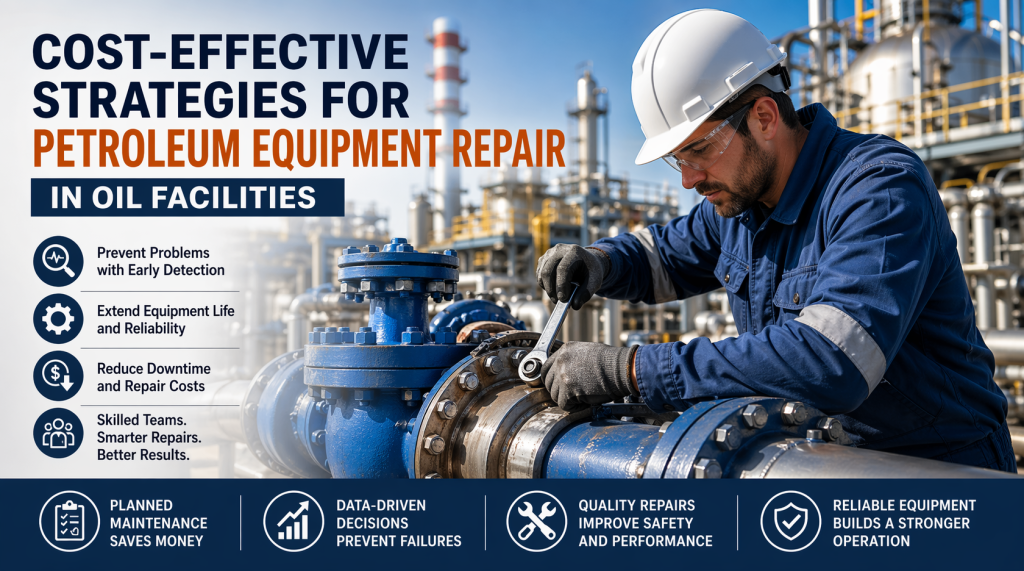
Oil facilities work under constant pressure to protect uptime, safety, and budgets. One equipment failure can interrupt production, inflate labor costs, and increase operational risk.
A disciplined approach to petroleum equipment repair makes that possible. Cost-effective repair starts with planning, accurate diagnostics, skilled technicians, and timely intervention. When facilities move beyond reactive maintenance and adopt a clear repair strategy, they extend equipment life, control spending, and reduce costly disruptions.
Why Repair Costs Rise So Quickly
Repair costs often climb for predictable reasons. Equipment in oil facilities operates under heavy loads, corrosive conditions, extreme temperatures, and continuous duty cycles. Those conditions accelerate wear. The real financial problem begins when minor defects are ignored until they become major failures.
Emergency repairs are especially expensive. They often require overtime labor, urgent parts delivery, and unplanned shutdowns. A small seal issue or vibration problem that could have been managed early may later result in a damaged assembly, longer downtime, and full replacement.
Another reason costs rise is weak prioritization. Not every repair affects production in the same way. Without ranking assets by criticality, teams may overspend on low-impact equipment while giving too little attention to the machines that matter most.
Build Around Preventive and Predictive Maintenance
The most affordable repair is often the one that never becomes severe. Preventive maintenance remains one of the strongest ways to control long-term repair costs. Regular inspections, lubrication checks, seal changes, and calibration routines help identify wear before it spreads.
Predictive maintenance adds another layer of savings. Vibration analysis, thermal imaging, oil analysis, pressure monitoring, and performance trending allow teams to act based on actual equipment condition. Instead of shutting down a unit too early or too late, they can intervene when data shows decline.
This method reduces unnecessary labor and avoids replacing parts that still have useful life.
A practical maintenance program should focus on:
- equipment with the greatest effect on production
- assets that fail repeatedly
- parts exposed to heat, contamination, or corrosion
- systems where small faults can become safety risks
With early detection in place, petroleum equipment repair becomes more controlled, more affordable, and less disruptive to the facility.
Strengthen Diagnostics Before Replacing Parts
One of the fastest ways to waste money is to order parts before confirming the real cause of failure. In oil facilities, the same symptom can point to several different problems. A pressure drop, for example, may come from a worn pump, blocked line, leaking seal, or calibration error. If technicians chase the symptom instead of the cause, the issue returns.
Better diagnostics reduce the repair scope and improve first-time fix rates. That means combining technician knowledge with inspection findings, sensor data, maintenance history, and manufacturer guidance. When teams understand common failure patterns, they solve problems faster and avoid unnecessary replacements.
Facilities can improve diagnostics by following a few simple habits:
- record the exact operating condition before disassembly
- review earlier service records for repeat failures
- compare current readings with normal baseline performance
- involve technicians familiar with the equipment’s history
Standardize Repair Workflows Across Teams
Repair quality improves when the process is consistent. In many facilities, different shifts or technicians may handle the same issue in different ways. That inconsistency leads to missed steps, variable quality, and expensive rework.
Standardized repair workflows help align the team. Clear procedures for inspection, disassembly, part evaluation, repair approval, testing, and restart reduce confusion and shorten downtime. They also make it easier to train new staff and compare internal work with outside vendor performance.
A useful workflow does not need to be complicated. It simply needs to answer the same questions every time:
- What failed?
- Why did it fail?
- Can the part be repaired safely and reliably?
- Would replacement be more economical over time?
- What checks are required before restart?
When those steps are followed, petroleum equipment repair becomes a managed process instead of a rushed reaction.
Invest in Technician Skill and Practical Training
Many repair budgets are drained by skill gaps rather than by the equipment itself. Even quality parts can fail early if alignment, sealing, torque, contamination control, or testing is handled poorly. In oil facilities, precision matters because mistakes often affect both uptime and safety.
Training is one of the most effective cost-saving tools available. A capable technician can diagnose faults faster, perform reliable repairs, and prevent repeat failures. That reduces downtime and limits spending on parts that were never the real solution.
Training should cover both technical and practical judgment areas, including failure thresholds, material compatibility, shutdown procedures, and root-cause thinking. Cross-training also helps because critical knowledge is not trapped with one specialist or one shift.
Use Refurbishment and Recovery Strategically
Replacing every damaged component with a new one is not always the smartest financial move. In many situations, refurbishment offers a dependable and lower-cost option. Pumps, valves, motors, seals, and mechanical assemblies can often be restored when wear is identified early and the repair standard is high.
The key is careful evaluation. Some parts are ideal for refurbishment because their main structure remains sound. Others should be replaced because repair would only postpone another breakdown. The right decision depends on operating conditions, equipment criticality, and expected service life after repair.
A cost-conscious team should compare:
- refurbishment cost against replacement cost
- expected performance after repair
- lead time for a new component
- downtime risk if repair is delayed
- warranty and quality control from the service provider
This is where a trusted specialist becomes valuable. An experienced provider of petroleum equipment repair can advise whether a component should be rebuilt, upgraded, or replaced. The right call saves money across the full life of the asset, not just during one shutdown.
Manage Inventory and Vendors With More Precision
Even strong repair teams overspend when spare parts and vendor planning are weak. Poor inventory control causes duplicate purchasing, rush shipping charges, and delays while common parts are sourced at the last minute. Overstocking creates a different problem by tying up money in shelves of slow-moving items.
A smarter system uses selective stocking. Critical spares for high-risk equipment should remain available on site, while less urgent items can be sourced through dependable vendor agreements. Maintenance and procurement teams should regularly review which parts truly justify storage.
Digital inventory records also matter. When part numbers, compatible models, service intervals, and supplier history are tracked in one place, teams make faster purchasing decisions and avoid stocking the wrong items. That simple visibility reduces waste and helps planners connect repair activity with future budgeting, with fewer delays during urgent maintenance periods.
Strong supplier planning should focus on:
- response speed and technical support
- testing capability and repair quality
- familiarity with oil facility equipment
- clear pricing and service records
- dependable performance over time
When inventory and supplier decisions match operational priorities, repair spending becomes more stable and easier to manage.
The Smarter Path Ahead
Cost-effective repair in oil facilities is not about cutting corners. It is about making better decisions earlier. Facilities that reduce repair expenses successfully do so by preventing avoidable failures, diagnosing problems accurately, standardizing work, developing technician capability, and using refurbishment wisely.
The long-term value of petroleum equipment repair comes from treating it as part of performance management rather than as a last-minute response. When repairs are planned with discipline, facilities protect uptime, extend equipment life, and keep maintenance costs under control.
For operators facing tight margins and constant operational pressure, that shift matters. Repair should function as a planned business priority, supported by data, trained people, and sound judgment. When that mindset takes hold, maintenance stops being a recurring financial burden and becomes a practical source of strength.
