

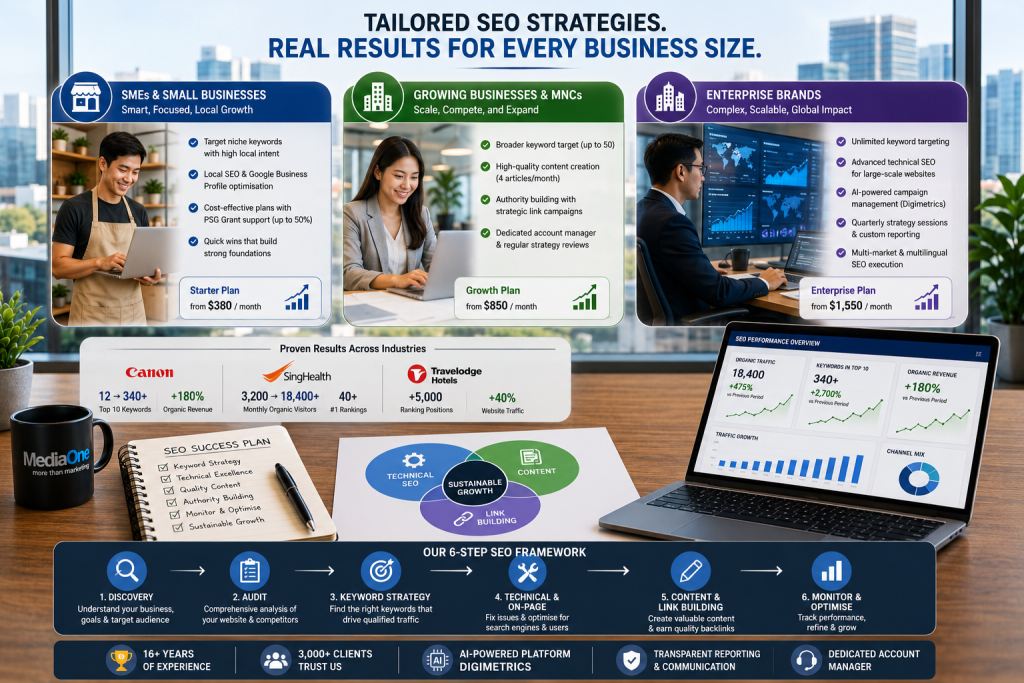
There is a question I get asked fairly often by business owners who are new to SEO, and it goes something like this: “We are a small company. Is SEO even worth it for us, or is it really something only bigger businesses can afford to do properly?”
I understand where the question comes from. SEO has a reputation, not entirely undeserved, for being expensive and slow. And when you look at case studies featuring Canon Singapore or SingHealth or Travelodge Hotels, it is easy to assume the kind of results being described belong to a different league entirely. The sort of thing that requires a large team, a large budget, and years of runway before anything meaningful happens.
That assumption is worth examining. Because the truth is more interesting.
The fundamentals of what makes SEO work do not change based on the size of the business doing it. The signals Google evaluates are the same whether your website has ten pages or ten thousand. What changes is the scale of the challenge, the complexity of the execution, and the resources required to do it well. A smart, focused strategy for a small business competing in a local Singapore market looks nothing like an enterprise campaign targeting multiple countries and languages simultaneously. But both are winnable if the approach is calibrated correctly.
What an SME Strategy Actually Looks Like
The biggest mistake small businesses make with SEO is trying to compete directly with established players on their strongest keywords right out of the gate. It is a bit like a new restaurant opening and immediately trying to outrank the most reviewed place in the city on every search term. You are not going to win that battle early. But you do not have to.
The smarter play for an SME is specificity. Narrower keywords with clearer local intent that larger competitors are either ignoring or not optimizing for properly. A furniture company does not need to rank for “furniture Singapore” against companies that have been building domain authority for a decade. They might very reasonably rank for specific product categories, specific neighborhoods, specific styles, or specific customer needs that are underserved in the current search landscape.
Local SEO is particularly powerful here. Google Business Profile optimization, near-me search visibility, local keyword targeting, and review signals. These are levers that give smaller businesses genuine competitive surface area against larger ones, because the larger players are often optimizing for national or broad terms and paying less attention to the hyperlocal layer.
For Singapore SMEs specifically, the PSG Grant reduces the financial barrier significantly. Up to fifty percent of the cost of an SEO engagement can be subsidized for eligible businesses, which changes the ROI calculation in a meaningful way. Starting from $850 per month on a standard plan, or as low as $380 on the subscription model, the entry point is within reach for businesses that are not operating at scale.
The Middle Ground: Growing Businesses That Need More Than the Basics
There is a category of business that falls between a small local operator and a true enterprise, and it is honestly the most interesting to work with from an SEO perspective. Established enough to have some domain history and existing organic traffic. Ambitious enough to want significant growth. But not so large that the campaign needs to coordinate across multiple markets, business units, and internal stakeholders simultaneously.
For this tier, the growth plan structure makes sense. Fifty target keywords give enough breadth to compete meaningfully across a category. Content creation at four articles per month builds topical authority over time without overwhelming an internal team that probably has other things to do. Link-building campaigns start establishing domain credibility that opens up more competitive keyword territory as the campaign matures.
The dedicated account manager matters more at this stage than people often expect. When a business is growing, the SEO strategy needs to keep pace with changes in the product range, the target market, and the competitive landscape. That requires a relationship, not just a reporting dashboard. Someone who understands the business well enough to flag when a new competitor has started targeting your best keywords or when a shift in your service offering should change the content priorities for the next quarter.
Enterprise SEO Is a Different Problem Entirely
Spend any time working on enterprise-level SEO and it becomes clear very quickly that the challenges are not just larger versions of the same challenges smaller businesses face. They are categorically different problems.
A website with tens of thousands of pages has crawl budget problems that simply do not exist for smaller sites. When Googlebot visits your site, it has a finite amount of crawling it will do before moving on. A poorly structured large site can burn through that budget on low-value pages and leave important content underindexed. That is an architecture problem, not a content problem, and fixing it requires a different kind of technical intervention.
Large organizations also have internal coordination problems that small businesses do not. Multiple teams contributing to the website. Developers making technical changes without informing the SEO team. Marketing campaigns are creating new pages that conflict with existing SEO structure. Legal and compliance requirements that limit what content can say. The SEO strategy for an enterprise has to work within all of that, and the account management involved is substantially more complex than what a small business campaign requires.
The Canon Singapore campaign is instructive. Going from 12 keywords in the top ten to 340, and growing organic revenue by 180 percent, required coordinating across a technology brand’s product categories, seasonal campaigns, competitive keyword landscape, and technical site requirements simultaneously. That is not a campaign you manage with a standard package. It requires a team that understands enterprise site architecture, has experience with highly competitive commercial keywords, and has the AI tooling to monitor and adjust at a scale that manual processes cannot handle.
The Framework Stays the same; the execution changes.
Here is what is actually consistent across all three tiers, and this is the part worth paying attention to.
The six-step process that governs how MediaOne SEO agency approaches a campaign applies whether the client is a two-person Singapore startup or a regional enterprise brand. Discovery, audit, keyword strategy, technical and on-page execution, content and link building, monitoring, and optimization. That sequence does not change. What changes is the depth and complexity of each step, the number of people required to execute it well, and the volume of ongoing work needed to maintain and build on the results.
An SME campaign running on the starter plan will have a more focused keyword set, less content output, and a lighter link-building program than an enterprise campaign. But the thinking behind how those elements are prioritized and sequenced is identical. The same framework that helped SingHealth grow from 3,200 to 18,400 monthly visitors is the same framework guiding a small accounting firm’s effort to rank for local services in a specific Singapore district.
That consistency matters because it means the quality of the strategic thinking is not reserved for the large clients with the largest budgets. The campaign at every tier benefits from sixteen years of pattern recognition across 3,000 businesses, proprietary AI tooling that would be impractical for a small agency to build independently, and a team structure that covers technical, content, and link building as genuinely integrated functions rather than separate services.
Choosing the Right Entry Point
The practical question for most businesses reading this is not Is SEO right for my size of business? What is the right entry point given where I am now and what I am trying to achieve?
For a brand new business with no domain history and limited budget, the subscription model at $380 per month gives access to the same team and the same approach without the commitment of a full retainer. Cancel any time and scale up when results justify it. That is a sensible way to validate the channel before making a larger commitment.
For a business that has been operating for a few years, has some organic traffic, and wants to grow it materially, the growth plan gives the resources needed to compete properly. Fifty keywords, content creation, link building, and a dedicated account manager who understands the business well enough to keep the strategy current as things change.
For an enterprise brand competing in a high-stakes digital market, the enterprise plan provides unlimited keyword targeting, AI-powered campaign management, and quarterly strategy sessions that keep the campaign aligned with broader business objectives rather than just tracking rankings month to month.
The size of the business shapes the entry point and the scale of the execution. It does not determine whether SEO is worth doing. That question has the same answer regardless of whether you are an SME, an MNC, or somewhere in between: if your customers are searching for what you offer, you should be visible when they do. MediaOne SEO has been helping businesses of every size achieve exactly that across Singapore and beyond for over sixteen years.
