

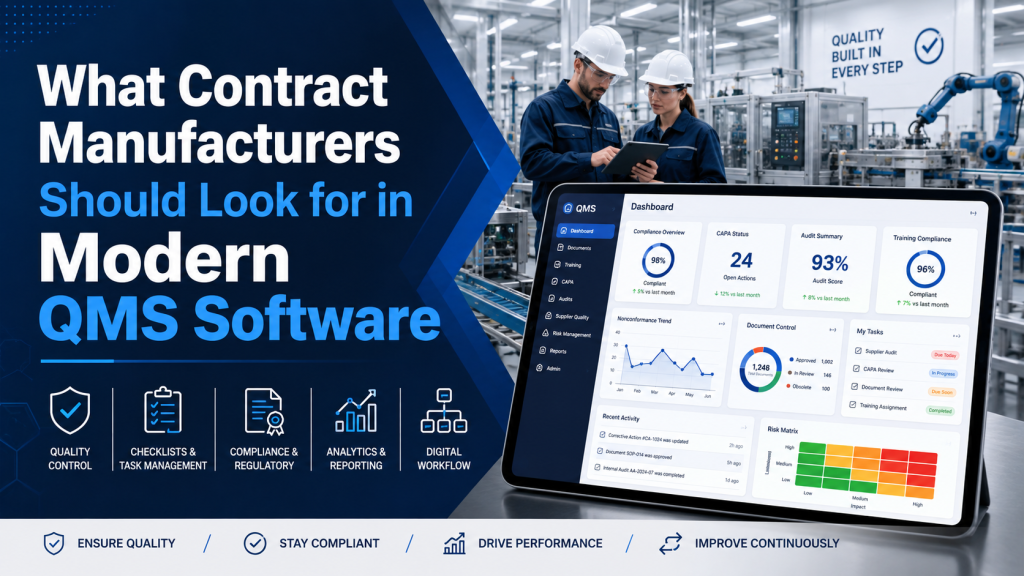
Contract manufacturers operate in a demanding environment. They may produce components or finished goods for several customers, each with different specifications, documentation expectations, approval processes, and quality requirements. They need to manage suppliers, employee training, process changes, nonconformances, corrective actions, and internal audits without slowing production.
As the business grows, relying on spreadsheets, shared folders, and email chains can make quality management harder. Responsibilities are less visible, and preparing for customer or certification audits takes more time. Modern QMS software can help contract manufacturers create a more connected system, but choosing the right platform requires more than comparing feature lists.
The best solution is one that supports daily manufacturing work, fits the size of the company, and provides enough structure to maintain quality without creating unnecessary complexity.
Look for Strong Document and Record Control
Contract manufacturers often manage a large number of controlled documents. These may include procedures, work instructions, customer specifications, inspection plans, forms, quality policies, and production records.
The software should make it easy to control revisions, approvals, access, and document history. Employees need confidence that they are using the current version of a procedure or specification. Managers should also be able to see who approved a document and when a change became effective.
Poor document control creates real manufacturing risk. An outdated instruction can lead to incorrect production steps, failed inspections, rework, or customer complaints.
A practical QMS should reduce the chance of outdated documents remaining in circulation while making approved information easy for employees to find.
Make Customer-Specific Requirements Easier to Manage
Contract manufacturers rarely work with one standard set of requirements. One customer may demand additional inspection records, another may require a specific corrective action format, and another may have unique supplier or traceability expectations.
The QMS should help teams organize these obligations without creating separate, disconnected systems for every account.
Quality, production, engineering, purchasing, and management may all need access to related information. A connected system helps reduce the risk that requirements are understood by one department but missed by another.
Manufacturers evaluating QMS software for US contract manufacturers should therefore consider how well the platform can bring documents, records, risks, supplier information, corrective actions, training, and audits into one practical quality environment.
Evaluate Nonconformance and Corrective Action Workflows
Problems happen even in well-managed facilities. Incoming materials may fail inspection, a production process may drift, or a customer may report a defect. The important question is how consistently the organization responds.
Modern manufacturing QMS software should make it easy to record nonconformances, assign responsibility, document containment, investigate causes, and track corrective actions.
The process should also support verification. Completing an action does not automatically mean the problem has been solved. Teams need to confirm whether the corrective action reduced or eliminated recurrence.
For contract manufacturers, this history is particularly valuable because customers may ask how a specific issue was investigated and what was done to prevent it from happening again.
Consider Supplier Quality Management
Contract manufacturers depend heavily on outside suppliers for materials, components, tooling, services, and subcontracted processes. Supplier quality can therefore have a direct effect on production performance and customer satisfaction.
A useful QMS system for manufacturing should support supplier approvals, evaluations, performance records, issues, and corrective actions. The goal is to provide a clear view of supplier reliability over time.
When supplier information is spread across purchasing spreadsheets, quality files, and email conversations, patterns can be missed over time. A supplier may repeatedly cause small issues that only become obvious when the data is reviewed together.
Better supplier visibility allows manufacturers to address recurring problems earlier and make more informed sourcing decisions.
Check How the System Supports Employee Training
Contract manufacturing environments can change quickly. New customers, new products, revised procedures, and updated equipment may require employees to learn new methods.
Training records should therefore be easy to connect with job roles and controlled documents. If a procedure changes, managers should be able to determine which employees need updated training.
Quality management system software for manufacturing should help maintain evidence of completed training without turning the process into a separate administrative burden.
This is especially useful during audits. Instead of searching through paper records or separate spreadsheets, the company can demonstrate how employee competence is managed as part of the wider quality system.
Look for Practical Risk and Opportunity Management
Quality management is not only about reacting to problems. Contract manufacturers also need to identify risks before they affect production or customers.
Risks can involve supplier capacity, equipment reliability, employee competence, customer concentration, process changes, inspection capability, or material availability.
A modern manufacturing QMS should give teams a practical way to record, assess, assign, and review risks.
For example, before launching a new customer program, a manufacturer may evaluate whether existing inspection resources are sufficient or whether additional training is required.
Make Internal Audits Easier to Plan and Follow
Internal audits help manufacturers understand whether processes are being followed and whether the quality system is producing the intended results.
The QMS should support audit planning, findings, assigned actions, and follow-up. It should also make it easy to review recurring findings across departments.
For contract manufacturers pursuing or maintaining ISO 9001 compliance, organized audit records are particularly useful. They demonstrate that the company is evaluating its own processes rather than relying only on external audits to identify weaknesses.
A strong audit process also creates opportunities for improvement before problems become customer-facing issues.
Prioritize Management Visibility
Quality data has limited value if leaders cannot see what it means. Management should be able to understand whether corrective actions are overdue, supplier performance is declining, training is incomplete, or audit findings are recurring.
A connected QMS manufacturing platform can make this information easier to review during management meetings.
Leadership visibility matters because many quality problems require decisions about staffing, equipment, supplier relationships, priorities, or investment. These decisions often sit outside the quality department.
The system should help management focus on patterns and actions instead of spending meetings trying to locate information.
Avoid Enterprise Complexity That the Team Will Not Use
Contract manufacturers should be careful not to assume that the most expensive or feature-heavy platform is automatically the best option.
Large enterprise systems can be powerful, but they may also require extensive configuration, specialist administrators, long implementations, and significant training. A small or midsize manufacturer may end up paying for capabilities that employees rarely use.
The best QMS software for manufacturing should match the company’s actual processes. It should be structured enough to support compliance and control, but simple enough that employees can use it consistently.
Before selecting a platform, manufacturers should consider usability, implementation effort, scalability, support, and total cost, not just the number of available modules.
Choose a QMS That Can Grow With Customer Expectations
Contract manufacturers operate in a business where quality expectations can change quickly. Winning a larger customer may introduce stricter documentation requirements, more audits, additional supplier controls, or new training responsibilities.
The QMS should therefore support growth without forcing the company to rebuild its quality system every time business conditions change.
A connected platform can provide a stronger foundation because document control, training, supplier management, corrective actions, risks, audits, and management review remain part of the same system.
For contract manufacturers, the real value of QMS software is not simply replacing paper or spreadsheets. It is creating a quality environment that makes responsibilities clearer, records easier to retrieve, and problems easier to follow from discovery to resolution.
Choosing a platform that fits the company’s size, customer base, and operational needs can help the business maintain stronger quality control while remaining flexible enough to compete, grow, and respond to changing customer expectations.
