

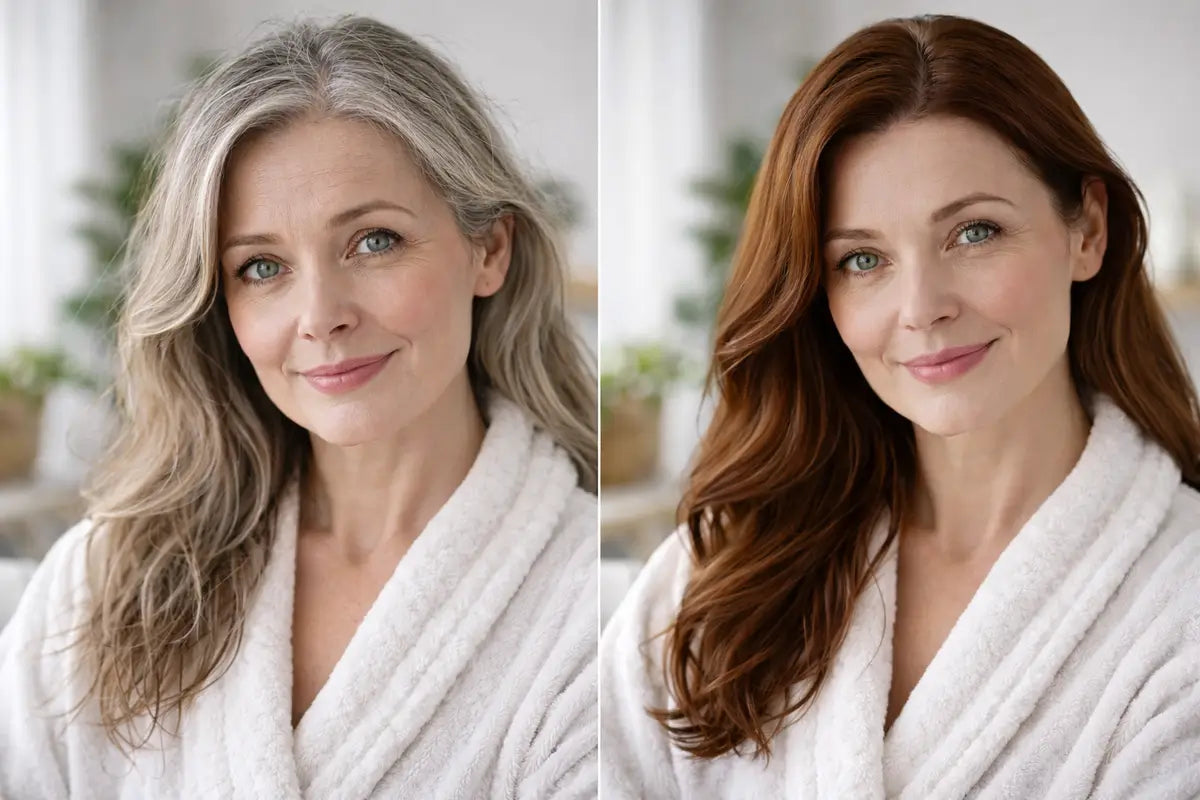
Grey hair is a diva. It’s coarser than the rest of your hair, more resistant to whatever you throw at it, and, crucially, it carries no pigment underneath for a plant dye to blend into. That’s the reason henna hair dye lands so differently on greys, and it’s why a lot of first-timers end up staring at the bathroom mirror in genuine confusion.
Let’s get the awkward bit out of the way. Pure henna, on its own, isn’t going to give you a subtle chestnut or a mushroom brown. What it’ll give you is copper. Bright, unmissable, glow-in-the-sunlight copper. Somewhere between a new penny and a satsuma, depending on the powder and how long you leave it on.
Some people love that. Others get a nasty shock. The difference usually comes down to what someone told them to expect before they cracked open the tin.
How Grey Hair Reacts to Henna Differently
Every other hair on your head has melanin sitting quietly in the cortex, doing the work of colour. Pigmented hair absorbs the copper stain and tones it down. A brunette using henna gets a warm red glint. Nobody looks orange.
Greys don’t have that natural buffer. When henna hair dye deposits on a grey strand, there’s nothing underneath to soften the effect. What you see is what the lawsone molecule actually is. And the lawsone molecule is orange.
The proportion of grey on your head matters too, more than a lot of guides will admit. A quarter grey comes through as coppery ribbons woven through your natural colour. Mostly grey reads unmistakably fiery.
The Real Colour Range Henna Delivers on Greys
The blend inside the tin does most of the work. The marketing on the front is often optimistic.
| Blend | Result on Grey Strands | Best For |
| Pure henna, nothing else | Bright copper, red, sometimes burgundy | Anyone happy going warm |
| Henna, then indigo, two steps | Brown to nearly black | Deeper, natural coverage |
| Henna and indigo blended, one step | Warm chestnut | A softer, brownish finish |
| Henna with cassia | Strawberry blonde on the greys | Lighter, sunnier tones |
Two-step is where most people who want proper brown coverage end up. Henna first, wait, rinse, then indigo. The indigo grabs onto the copper base and shifts it into brown or black territory. Skip the henna step, and indigo alone won’t hold on grey hair. You’ll wash it down the plughole within a week.
Quick heads-up on darker blends. The first rinse can leave your greys looking a touch greenish. Do not panic. Give it a day or two, and as the pigment oxidises, that cast warms up into proper brown.
The Factors That Shape Your Final Shade
There are more variables in a tin of henna hair dye than the box will ever admit.
Processing time is the big one. Grey hair takes longer to accept henna than pigmented hair does. Three hours minimum for pure henna on greys, and stubborn strands sometimes need four or five. Cut corners, and you’ll end up with patchy roots that oxidise into something brassy and a bit off.
Water matters too, quietly. If you live somewhere with hard water, the minerals dull the copper and drift it towards a muddier orange. Filtered or bottled water in the mix is a small step that pays off visibly.
Then there’s oxidation. Fresh henna hair dye looks bonkers when you first rinse it out. Alarmingly bright. Slightly tangerine. Do not judge the colour for 48 hours. The pigment keeps developing as it meets the air, and by day two it settles into a much more wearable version of itself.
Porosity plays its part too. Grey hair is naturally more porous than pigmented hair, which is why it soaks henna hair dye in so thirstily and holds onto it with real conviction. Mostly a good thing. It does mean you want to be sure of your shade before you commit.
What to Know Before Your First Application
Nobody at the health-food shop counter tells you this, so here it is. Henna hair dye on grey hair is, for all practical purposes, permanent. It doesn’t fade the way boxed dye does. It grows out at the root while the ends keep their colour, and the only real removal is time and scissors.
Two things follow.
One, if copper stops working for you down the line, going back to chemical colour isn’t a straightforward swap. Cheaper blends often contain metallic salts that react in unpleasant ways with peroxide, and even pure henna leaves a warm undertone that fights any cool shade. Strand-test before you switch. Not optional.
Two, your maintenance shifts shape. You’re touching up roots every four to six weeks rather than doing a full head every few months. Cheaper than salon dye, but a recurring bit of admin.
There’s a payoff worth naming. Grey hair often turns wiry and thin as melanin drains away, and henna coats and thickens each strand as it stains. Regulars tend to say their greys get softer and glossier after three or four rounds. Chemical dye can’t really claim that.
Conclusion
Henna hair dye rewards people who understand what it actually does and punishes those expecting supermarket-box behaviour. Pure henna gives you copper and red. Paired with indigo across two steps, brown to black. Blended with cassia, a lighter, sunnier finish. Nothing in that spectrum is a soft ash or a cool mushroom, and no technique will bend it there.
Get the processing time right, use decent water, wait out the 48-hour oxidation window before you judge, and accept root touch-ups every four to six weeks as part of your routine. Do that, and henna hair dye gives you real depth, genuine shine, and grey strands that stop looking wiry after a few rounds. The colour question answers itself. Warm, or nothing.
