

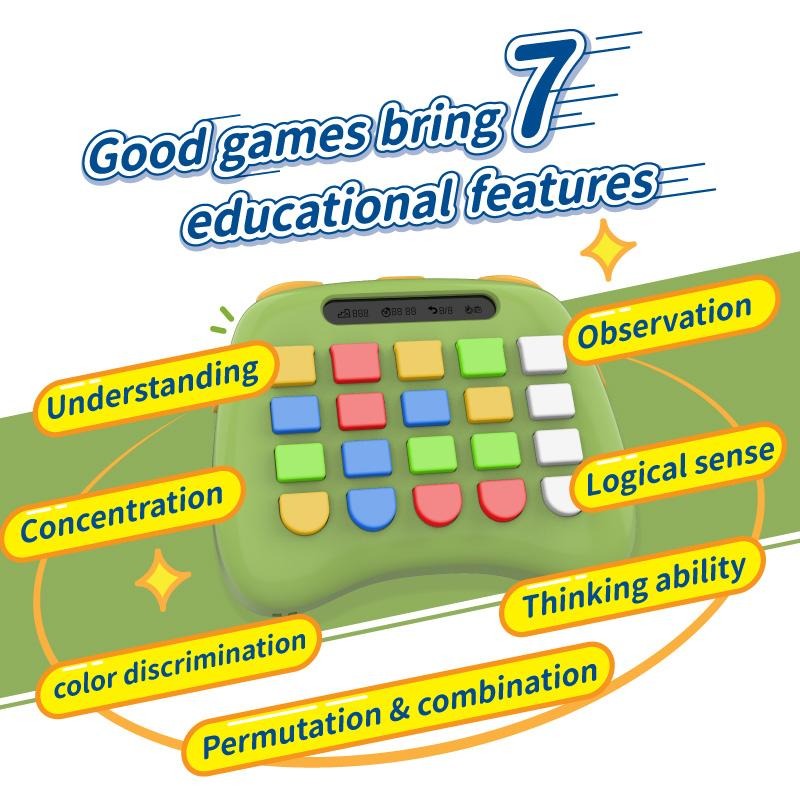
Standing in the toy aisle — or scrolling through two hundred near-identical listings — every electronic logic toy claims to make your child smarter. Most of them will be forgotten by spring. The difference between the toy that gets played with daily and the one that gathers dust comes down to a handful of practical things that packaging never tells you. Here is how to buy like someone who has been burned before.
Match the Challenge to Your Child, Not the Box
Age labels are marketing as much as guidance. A “ages 6+” toy might bore a sharp six-year-old or frustrate a cautious eight-year-old. Ignore the box and think about your specific child: do they finish puzzles or abandon them? Do they like timed challenges or prefer to think slowly? The right electronic logic toy sits just past their comfort zone — engaging, not exhausting. If possible, watch demo videos of actual gameplay before buying. Ten minutes of real footage tells you more than any bullet list of features.
Feedback Quality Matters More Than Feature Count
Cheap logic toys beep. Good ones teach. When your child makes a mistake, does the toy just buzz angrily, or does it show what went wrong? The best electronic logic toy designs give graduated hints — a nudge, not the answer — which is exactly how good teachers work. Sound and light feedback should be clear but not obnoxious; you will be hearing it for months, so this is self-preservation as much as pedagogy. Volume control is a small feature that signals the designers actually have children.
Durability: The Spec Nobody Advertises
Here is the honest truth about kids and electronics: they will be dropped, stepped on, and occasionally used as projectiles. Before buying any electronic logic toy, check the build with your hands if you can. Buttons should feel solid, not mushy. Battery compartments should need a screwdriver — that is a safety feature, not an inconvenience. Seams should be tight with no sharp edges. Read the one-star reviews specifically looking for breakage patterns; if five parents report the same cracked screen or dead button, believe them. A toy that survives is infinitely more educational than a sophisticated one that does not.
Also consider power: an electronic logic toy that eats through obscure batteries becomes expensive fast. USB-rechargeable or standard AA/AAA is what you want.
Safety Certifications Are Non-Negotiable
Any toy your child handles daily should carry recognized safety marks: ASTM F963 in the US, EN71 in Europe, and CPSIA compliance for lead and phthalates. Reputable sellers provide these on request; evasive answers are disqualifying. For electronic toys specifically, check that small parts are secured and that the product is rated for your child’s age group for choking-hazard purposes. This is the least exciting part of buying — and the most important.
Price vs. Play Hours: The Real Math
A $20 toy played with for fifty hours costs forty cents an hour. A $60 toy abandoned after two days costs thirty dollars an hour. When judging an electronic logic toy, estimate honestly how long the novelty lasts: does it have enough levels, modes, or randomized content to stay interesting past week two? Toys with progressive difficulty and score-chasing almost always win this math. Buy the toy your child will still reach for in March, not the one with the flashiest box in December — and you will have bought well.
When to Upgrade to the Next Level
Every good electronic logic toy eventually gets mastered — and that is the moment to celebrate, not mourn. A child who breezes through every level has outgrown the toy, which means it did its job. Look for the signs: high scores on every mode, boredom instead of challenge, or the toy being ‘too easy’ in their words. That is your cue to step up to a more advanced model with new mechanics, not just harder versions of the same puzzles.
Plan for this progression when you buy. Choosing an electronic logic toy from a brand with a clear product ladder — beginner, intermediate, advanced — means the next step is obvious. Some families pass the mastered toy to a younger sibling or cousin, which makes the upgrade feel like a promotion rather than a replacement. Growth is the goal; the toy is just the vehicle.
A final tip: involve your child in the choice. Letting them pick between two parent-approved options gives them ownership of the decision — and children who choose their own electronic logic toy engage with it far longer than those handed one. You set the guardrails on quality and age-fit; they get the excitement of choosing. Shop together, talk through the options, and let them feel the win of a smart pick. That partnership is the real buying guide.
