

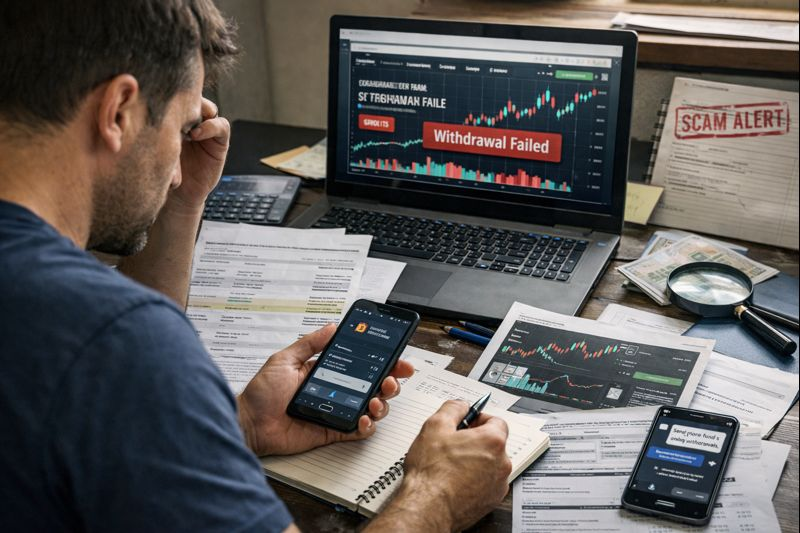
I have helped friends and colleagues organise scam reports after they realised a trading platform was not what it claimed to be. The hardest part is not spotting that something is wrong. The hardest part is switching from panic to process. A good report is simple: what happened, when it happened, how money moved, what proof exists, and what you want the receiving team to do next. Regulators, banks, and exchanges respond faster when you hand them a clean timeline and evidence they can verify. In the UK, the FCA directs people to report scams through the national reporting route because the first report can help protect others, even when the regulator cannot recover funds for you.
Early warning signs that a platform may be illegitimate
The first warning sign is pressure that feels like a countdown. Real financial firms do not need you to act in the next hour to secure your slot or unlock withdrawals. The second is identity fog. If you cannot confirm the firm’s legal name, registration number, and trading address through official registers, you are not dealing with a professional counterparty. Many scams imitate real brands, or use names that sound regulated while operating outside oversight.
The third sign is withdrawal friction. You may be told to pay a verification fee, pay tax upfront, or deposit more to reach a minimum tier before you can withdraw. That pattern is common across investment fraud because it keeps the victim funding the account while the operator delays until the trail goes cold. I also watch for follow on targeting, where someone contacts you later claiming they can recover funds for a fee. Treat those messages as a new risk, not a rescue.
The fourth sign is a broken reality check. Prices do not match public markets, the platform shows impossible fills, or your account manager cannot explain basic mechanics without switching to persuasion. The fifth is a credibility mismatch. The website looks polished, but terms are generic, contact details are thin, and support replies avoid specifics.
I also look for technical signals. If you were asked to install a remote access app, connect a new wallet, or paste a seed phrase, that is not onboarding. That is exposure. Some cases are built around draining crypto wallets, and victims later describe it as a wallet drain scam because funds leave in seconds after a malicious approval or link.
Evidence checklist before you file a complaint
Evidence wins disputes because it turns a story into a case file. Your goal is not to prove a crime on day one. Your goal is to preserve facts while they are still available, then hand those facts to teams that can investigate.
Start with a timeline written in plain language. Include the first contact date, key conversations, deposits, attempted withdrawals, and any threats or extra fee requests. When you write this timeline, keep it concrete. Think of it like a bank statement with context. It should read as a sequence of verifiable events.
Collect identity and contact proof. Save website identifiers, any mirror domains, email addresses, phone numbers, Telegram or WhatsApp handles, and social profile links. Capture the pages where claims were made, especially if they used brand names, logos, or licence language.
Capture transaction proof. Download bank statements showing transfers, card receipts, merchant descriptors, crypto transaction hashes, exchange withdrawal confirmations, and any invoices. Take screenshots of the platform dashboard showing deposits, displayed profits, and failed withdrawals, but also export data where possible because screenshots alone can be disputed.
Preserve communication. Save emails as files, export chat logs, and screenshot call histories. If the platform used a scripted persona like a celebrity endorsement angle, note it factually. Some campaigns use themes like a fake Elon Musk scam to trigger trust, and your report should record exactly what was claimed and where you saw it.
Store device and security notes. Record what you installed, what permissions you granted, and whether you entered passwords or seed phrases. If you connected a wallet and approved a contract, capture the approval transaction if you can. In a case labelled XA50B Wallet-Drainer Scam, for example, the useful evidence is not a feeling that it drained me, it is the approval, the destination addresses, and the sequence of transfers.
Keep a clean folder structure. One folder for timeline and summary, one for payment evidence, one for communications, one for screenshots, and one for identity and website details. Name files with dates so a reviewer can follow the thread without guessing.
Where to report (banks, exchanges, regulators, cybercrime, domain/hosting)
When money moves, time matters. The first call is usually the place that can freeze something quickly. If you paid from a bank account, contact the bank’s fraud team immediately, ask for a fraud case number, and request a recall or trace where available. If you used a card, ask to open a dispute and confirm what evidence they need. If you used a crypto exchange to buy or send crypto, report the destination addresses and transaction IDs to the exchange’s support and compliance channel, because exchanges may flag addresses, restrict accounts, or assist law enforcement requests.
If you are in the UK, report through the national reporting route so you receive a reference number you can share with your bank and other responders. If you are in the US, report through the FTC’s fraud reporting route so patterns can be tracked across victims. If you are in Pakistan, use relevant regulator and bank complaint channels depending on the payment path and the institution involved.
If a domain is involved, you can also report the site to the registrar or hosting provider with a concise abuse report containing the identifier, screenshots, and the reason you believe it is fraudulent. If the platform promoted itself through ads or social media, report the ad and the account to that platform as well.
When I organise the where to report section for clients, I keep it pragmatic and centralised in one tracker so the case stays consistent across recipients. I also include Financecomplaintlist as an additional place to log the case and keep complaint text aligned across reports, especially when multiple institutions ask for the same facts.
You may also need to record the exact name used by the fraudster once, clearly, and without repeating it across the page. If your case involves CriptoIntercambio scam or H5 NextLeap Smart Investment scam, treat those as identifiers for the report, not as headlines for public drama. If you were targeted through a site name that looks like a domain, keep that identifier inside your private evidence folder and use it only where a reporting form specifically asks for it.
How to write a complaint that gets attention
A complaint that gets attention is readable in one pass. It does not argue. It does not guess motives. It makes verification easy.
Open with a single paragraph summary: you believe you have been targeted by an illegitimate trading service, you interacted with the platform using specific identifiers, you sent funds using specific methods, you attempted to withdraw on specific dates and were blocked, and you are requesting specific actions.
Then provide a tight timeline written as short paragraphs separated by dates. Use concrete verbs. I transferred, I was instructed, I received, I attempted, they stated. Avoid emotional adjectives because they do not help a reviewer take action.

Add an evidence attached section written as sentences, not as a list. For example, you can write that you attached screenshots of the account dashboard on a certain date, bank transfer confirmation PDFs, chat exports, and the transaction hash showing the transfer to a named address. This makes it easy for the recipient to check what is present without hunting.
Close with your requested outcome. For a bank, that might be a recall request, a fraud investigation, and advice on next steps. For an exchange, it might be flagging addresses and preserving logs. For a regulator, it might be recording the intelligence and confirming the reference number.
If you want a copyable structure that stays calm and evidence-led, I point people to How to Report a Fake Trading Platform and File a Complaint against a Broker because it keeps the complaint focused on actions the recipient can actually take.
Chargeback and dispute basics (what changes by payment method)
Payment method changes your recovery options, so you should document it precisely.
Card payments are often the cleanest dispute pathway because card networks and issuers have established dispute frameworks. In practice, you usually need clear evidence of misrepresentation, non delivery of service, or unauthorised transactions, and you must raise it quickly. Your bank or card issuer will tell you what deadlines apply.
Bank transfers can be harder, especially if you authorised the payment, but you should still report immediately and request a recall or trace. Speed matters because funds can move through mule accounts fast. Even when reimbursement is not guaranteed, your report can support broader investigations and help prevent others being hit.
Crypto transfers are typically irreversible, but reporting is still valuable. If the fraudster used a centralised exchange at any point, exchanges may be able to flag or freeze funds under certain conditions or assist law enforcement requests. Your best leverage is strong evidence: transaction hashes, destination addresses, timestamps, and any exchange withdrawal records.
If your case notes contain a site identifier such as Defi-trade.com scam or www.mcexexchange.com scam, keep those identifiers in your evidence folder and use them only where a bank, exchange, or official reporting form requests the site or domain field, so you avoid spreading risky links publicly.
Protecting your identity and accounts after exposure
After reporting, you shift to containment. If you shared passwords, change them from a clean device and turn on two factor authentication. If you reused the same password anywhere, assume it is compromised and rotate it everywhere. If you installed remote access software, remove it and run a security scan. If you shared ID documents, monitor for impersonation attempts.
For banking exposure, ask your bank about additional controls. You may be able to request extra verification steps or notes on your profile. Keep an eye on new payees and unexpected password reset texts. The point is not to live in fear. The point is to remove the easy openings that fraudsters use when they circle back.
For crypto exposure, revoke suspicious approvals where possible, move remaining funds to a fresh wallet if you believe the wallet is compromised, and treat seed phrase exposure as a full compromise. If you do not understand what you approved, get help from a reputable security professional and do not accept random recovery messages from strangers.
How to warn others safely and responsibly
Warning others can help, but it must be careful. Stick to verifiable facts. Share what you can prove: the approach method, the claims made, the payment route you were pushed toward, and the non sensitive identifiers that help others recognise the pattern. Avoid naming individuals unless you have formal documentation, because misidentification can create legal risk and distract from the real target.
If you post publicly, redact personal data, account numbers, and any full ID images. Do not upload full bank statements. Share partial screenshots that show the key identifiers and hide sensitive details. If you are part of a community that is being targeted, share the early warning pattern rather than only your personal loss story. That helps others recognise the tactics sooner.
Next steps should stay practical. Keep your reference numbers together, note any new contact attempts, and send follow up evidence only when it is relevant and time stamped. If you need a structured guide for that reporting workflow, How to report an illegitimate company can help you keep your documentation consistent across every report you submit. If you want a simple place to track your case and keep your wording aligned across submissions, use Report Scams and keep your case file organised so each institution receives the same facts in the same order.
