

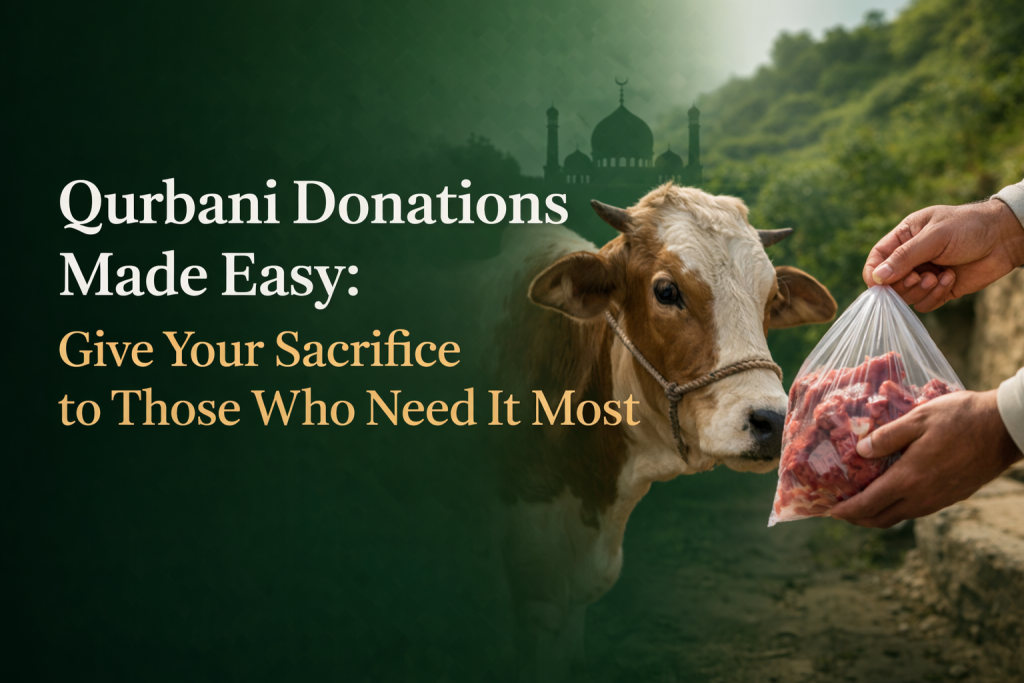
Eid ul Adha comes once a year. And every year, the same question comes up for Muslims living abroad or in urban cities: how do you actually give Qurbani in a way that is valid, reaches the right people, and does not cost you a fortune?
The answer, for a growing number of Muslims, is Qurbani donations through a verified nonprofit. But before you decide where to give, you need to understand what Qurbani actually requires, what a Qurbani hissa means, and why where you give matters just as much as the fact that you give.
What Qurbani Actually Is, and Who It Is For
Qurbani is the animal sacrifice performed during Eid ul Adha, on the 10th, 11th, or 12th of Dhul Hijjah. It follows the Sunnah of Prophet Ibrahim (AS), who was commanded to sacrifice his son and, in Allah’s mercy, a ram was sent in his place. This act of submission is what every Muslim re-enacts each year through Qurbani.
Under the Hanafi school of thought, Qurbani is wajib — obligatory for every adult Muslim who owns wealth equal to or above the Nisab threshold on the days of Eid. This is not a voluntary charity. If you meet the financial condition, it is a duty. The Nisab is calculated based on the value of 612.36 grams of silver or 87.48 grams of gold, whichever applies.
The meat from the sacrifice is split into three equal portions. One portion goes to the person giving the Qurbani and their household. One goes to friends, neighbors, or relatives. And one goes to people in need. Many donors who give Qurbani through a charitable organization choose to donate all three portions to the poor, which is entirely acceptable and widely practiced.
Understanding the Qurbani Hissa
If you are giving Qurbani for the first time through a donation platform, you will come across the term Qurbani hissa. A hissa simply means a share.
Larger animals like cows, buffaloes, and camels can be shared among up to seven people. Each person’s hissa within that animal counts as one full, valid Qurbani. Smaller animals like goats and sheep cannot be divided. One goat or sheep equals one Qurbani for one person.
So if you are giving on behalf of yourself and want to keep your cost lower, a Qurbani hissa in a cow is a legitimate option. If you want to give a full individual sacrifice, a goat or sheep is the right choice. Both are Islamically valid. The choice depends on your personal preference and the number of Qurbani you intend to give.
You may also give more than one Qurbani. There is no upper limit. Many Muslims give on behalf of deceased parents, for their children, or as additional acts of worship.
Why Giving Qurbani Donation in Pakistan Makes Sense
The cost of Qurbani varies significantly by country. In the UK, US, or Canada, sacrificing one goat can cost several hundred dollars after accounting for abattoir fees, processing, and regulations. In Pakistan, that same amount can fund multiple full sacrifices.
This cost difference is not just about saving money. It is about maximizing impact. Your single Qurbani donation, when directed toward Pakistan, can feed more families in genuine need. Rural communities, underprivileged urban areas, and marginalized populations in cities like Lahore, Karachi, and Faisalabad often go without meat for most of the year. Eid ul Adha is the one occasion when they might receive it.
Giving your Qurbani donation to a verified organization in Pakistan also means the logistical side — animal sourcing, health checks, slaughter, and distribution — is handled by people on the ground who understand local needs and follow Islamic requirements.
How Transparent Hands Handles Your Qurbani Donation
Transparent Hands is a registered nonprofit operating in Pakistan and the United States (EIN: 47-3564801, 501(c)(3)). The organization has been running a Qurbani program alongside its medical crowdfunding work, and the program follows strict Shariah and operational guidelines.
Here is how the process works:
Animal Selection Every animal chosen for sacrifice meets the age and health requirements set by Islamic scholars. Goats and sheep must be at least one year old. Cows and buffaloes must be at least two years old. Camels must be at least five years old. Animals with defects, illness, or injury are not accepted.
Shariah Compliance All Qurbani procedures at Transparent Hands are overseen and verified by Mufti Muhammad Zubair Nadeem, who holds a PhD in Islamic Studies and Finance and completed his Takhusus from Jamia Ashrafia. This means you do not have to second-guess whether your donation will result in a valid Qurbani.
Meat Distribution The full meat from your Qurbani donation — all three portions — is distributed to deserving families and communities. Past beneficiaries have included residents of welfare homes for the elderly, students at madrassas, transgender communities, and families living in low-income settlements across Lahore. The organization identifies recipients based on verified need, not proximity or convenience.
Hygiene and Handling Meat is packed under hygienic conditions and distributed quickly after the sacrifice to maintain freshness. This is an area often overlooked, but it matters for the dignity and health of the people receiving it.
Transparency for Donors When you give a Qurbani donation through Transparent Hands, you receive confirmation that your sacrifice has been performed. This level of accountability is what separates a reliable organization from one that collects funds without follow-through.
What Qurbani Options Are Available
Transparent Hands offers the following Qurbani options:
Goat or Sheep: One full sacrifice. Valid for one person. This is the most straightforward choice if you want a complete, individual Qurbani.
One Full Cow: A large animal sacrifice that provides seven full shares. This option allows a family to collectively participate in one sacrifice.
One Qurbani Hissa in a Cow or Camel: One share out of seven in a larger animal. Suitable if you want to give Qurbani at a lower cost while still fulfilling your obligation.
All options cover 100% meat distribution to deserving recipients.
When You Need to Give Your Qurbani Donation
The days of Qurbani begin after the Eid prayer on the 10th of Dhul Hijjah and end at sunset on the 12th. The first day is considered the most virtuous. Organizations like Transparent Hands close their donation window on the first day of Eid to make sure all sacrifices happen within the valid period.
If you are planning to give this year, do not wait until Eid morning. Platforms that manage large numbers of Qurbani donations need time to source the right animals, confirm bookings, and organize distribution teams. Giving early also ensures your preferred option goat, cow, or hissa is still available.
Answers to Questions You Probably Have
Is it valid to pay someone else to perform Qurbani on my behalf?
Yes. Appointing an agent or organization to perform your Qurbani is fully permissible in Islam. The sacrifice is still attributed to you, and your obligation is fulfilled as long as the conditions of a valid Qurbani are met.
Can I give Qurbani on behalf of a deceased family member?
Yes. You can give Qurbani as sadaqah on behalf of a deceased parent, spouse, or any relative. This is a recognized practice across all major schools of Islamic jurisprudence.
What if I am not sure whether Qurbani is obligatory for me this year?
Calculate your net assets, cash, savings, gold, silver, and non-essential possessions — and compare them against the current Nisab value. If your wealth exceeds the Nisab and you have had it for some time before Eid, Qurbani is wajib for you.
Is it permissible to donate all three portions of the meat to the poor?
Yes. There is no prohibition on this. In fact, donating all three portions increases the benefit for those in need and is a widely accepted choice when giving Qurbani through a charitable organization.
Does Qurbani apply to children?
Under the Hanafi view, Qurbani is not obligatory for children who have not reached puberty, even if they own wealth above the Nisab. However, parents may give Qurbani on their behalf as a voluntary act.
The Role of Qurbani Donation in Addressing Food Poverty
Food insecurity in Pakistan affects tens of millions of people. The majority of low-income families cannot afford meat on a regular basis. Protein deficiency is a documented health issue in many underserved communities, particularly among children.
Qurbani donations, when properly organized and distributed, provide a meaningful, if temporary, boost to the nutrition of families who rely on charitable giving. This is not charity for the sake of optics. It is a structured system built into Islamic practice to ensure that wealth and resources move from those who have them to those who do not, at least on the occasion of Eid.
When you give your Qurbani donation, you are participating in a redistribution of resources that Islam makes compulsory. The people receiving that meat are not charity cases. They are the recipients of a right that Allah (SWT) has placed in the framework of worship itself.
How to Give Your Qurbani Donation Through Transparent Hands
The process takes less than five minutes:
- Visit transparenthands.org and navigate to the Qurbani page
- Select the type of sacrifice you want to give, goat, full cow, or Qurbani hissa
- Enter the number of sacrifices you want to give
- Complete your payment through the secure online system
- Receive confirmation once your Qurbani has been performed and the meat has been distributed
The platform accepts international payments, so you can give from anywhere in the world. There are no hidden deductions. Every rupee goes toward the sacrifice and its distribution.
What You Need to Know Before Eid
Qurbani is one of the clearest examples of an act of worship that is also an act of social responsibility. It is not symbolic. The meat that comes from your sacrifice feeds real people in real communities who are waiting for it.
If you are eligible, you already know what you need to do. The only question is how you do it. Giving your Qurbani donation through a verified, Shariah-compliant organization like Transparent Hands removes the logistical barriers and ensures your obligation is fulfilled correctly.
Your Qurbani hissa or full sacrifice, handled with care and delivered with accountability, is worth more than you might think to the family receiving it on Eid morning.
Give before the deadline. Give with confidence. Give through an organization that tells you exactly what happened to your donation.
