

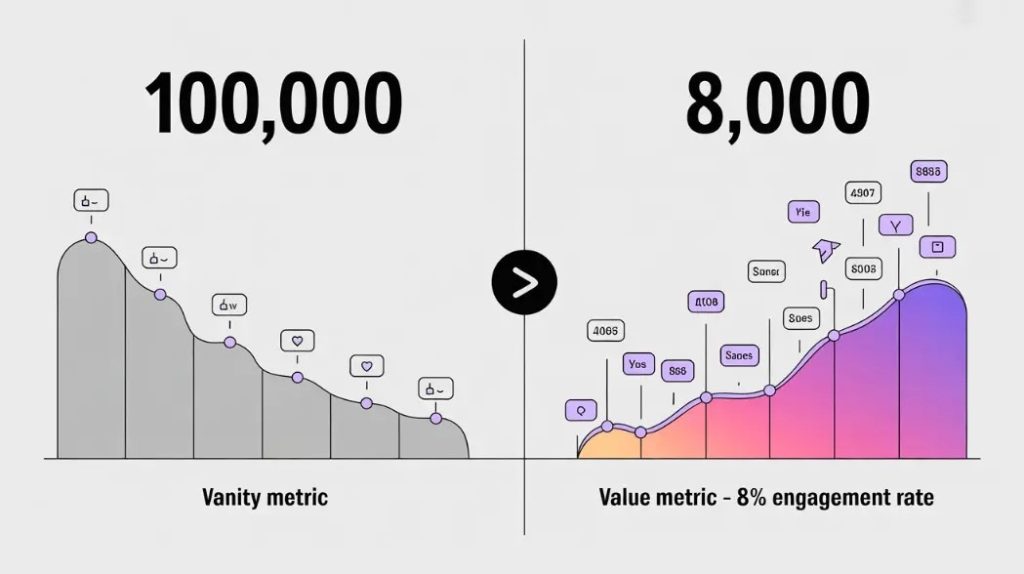
A creator with 100,000 followers just lost a brand deal to someone with 8,000 followers. The smaller account got paid three times more. Why? Because engagement rate matters more than follower count in 2026, and brands finally understand what algorithms knew all along: attention is worthless without interaction. The obsession with follower counts is dying. The era of engagement rate supremacy has arrived. Platforms reward engagement. Brands pay for engagement. Audiences trust engagement. Yet most creators still chase follower numbers like it is 2018. This fundamental misunderstanding of what actually matters costs them money, opportunities, and growth. Let me show you why the metric you have been ignoring is the only one that actually matters.
The Follower Count Illusion: Why Big Numbers Mean Nothing
Here is what nobody tells you about follower counts.
The Math That Exposes the Lie
Account A: 100,000 followers, 500 likes per post, 0.5% engagement rate.
Account B: 10,000 followers, 800 likes per post, 8% engagement rate.
Which account has more influence? Account B reaches fewer people but influences more of them. Account A looks impressive on paper but generates minimal actual interaction. Brands want influence, not numbers. Algorithms want interaction, not followers. Both prioritize engagement rate over follower count.
Dead Followers Everywhere
The average account loses 25-30% of followers to inactivity annually. They stopped using the platform. They muted you. They forgot they followed you. They are numbers on a screen, nothing more. A 50,000-follower account might have only 15,000-20,000 active followers actually seeing content. But engagement rate reveals this truth. Follower count hides it.
The Vanity Trap
Chasing followers feels good. The number goes up. You feel successful. But you are measuring the wrong thing. It is like measuring wealth by the size of your wallet instead of what is inside it. A big empty wallet is still broke. A large disengaged following is still worthless.
What Engagement Rate Actually Measures
Engagement rate quantifies attention quality, not just attention quantity.
The Standard Calculation
Engagement Rate = (Total Engagements / Total Reach) x 100
Total Engagements = Likes + Comments + Shares + Saves + Clicks
Total Reach = How many unique accounts saw the post
This measures what percentage of people who saw your content actually cared enough to interact.
Why Reach, Not Followers
Using followers in the calculation is outdated. Platforms do not show your content to all followers. They show it to a percentage based on algorithmic factors. Measuring engagement against reach tells you: of the people who actually saw this, how many engaged? That is the metric that matters.
The 2026 Benchmarks
- Instagram: 3-6% is average, 8-12% is good, 15%+ is excellent.
- TikTok: 5-9% is average, 12-18% is good, 20%+ is excellent.
- YouTube: 4-8% is average (likes + comments per view), 10-15% is good, 18%+ is excellent.
- LinkedIn: 2-4% is average, 5-8% is good, 10%+ is excellent.
These benchmarks shift constantly. But the principle stays constant: higher engagement rate equals better content resonance.
Why Algorithms Prioritize Engagement Rate
Let me explain how platforms actually work.
The Distribution Decision
When you post, the algorithm shows your content to a small test audience. Maybe 5-10% of your followers plus some new people. It measures engagement rate from this test. High engagement rate signals “this content is good, show it to more people.” Low engagement rate signals “this content is mediocre, stop distribution.” Follower count determines your initial test audience size. Engagement rate determines whether distribution expands beyond that test.
The Compounding Effect
Post 1: High engagement rate. Algorithm expands distribution.
Post 2: Algorithm remembers your account generates engagement. Bigger initial test audience.
Post 3: Even bigger test audience due to consistent engagement history.
This compounds. Accounts with high engagement rates get progressively better distribution. Accounts with low engagement rates get progressively worse distribution, regardless of follower count.
The Death Spiral
Large accounts with poor engagement rate enter death spirals. Algorithm reduces distribution. Fewer people see content. Engagement rate stays low or drops further. Distribution contracts more. The cycle destroys reach. I have seen 500,000-follower accounts reach only 5,000 people per post because their engagement rate collapsed. Follower count became irrelevant.
Why Brands Pay for Engagement, Not Followers
Brand partnerships are where follower count versus engagement rate becomes financially obvious.
The CPM Reality
Brands pay based on effective reach and engagement, not follower count. They calculate Cost Per Thousand Impressions (CPM) and Cost Per Engagement (CPE).
Account with 100K followers, 1% engagement: 1,000 engagements per post.
Account with 20K followers, 8% engagement: 1,600 engagements per post.
The smaller account delivers more value. Brands pay accordingly.
The Conversion Metric
Brands ultimately want conversions: clicks, signups, purchases. Engagement rate predicts conversion rate better than follower count. High engagement means audience trust. Trust drives conversions. Follower count alone predicts nothing about trust or conversion potential.
The Fraud Detection
Brands now audit accounts before partnerships. They check engagement rate, follower quality, comment authenticity, engagement patterns.
Fake followers are obvious. Bought followers with zero engagement get detected instantly. High follower count with low engagement rate is a red flag for fraud.
Accounts that strategically buy Instagram views or use services to boost post engagement maintain healthy engagement rates alongside growth avoid this detection. The key is maintaining rate, not just numbers.
How to Calculate Your Engagement Rate Correctly
Most creators calculate it wrong. Here is the right way.
Step 1: Choose Your Time Frame
Calculate for your last 10-20 posts. This smooths variance and gives accurate averages.
Step 2: Get Your Reach Numbers
Go to each post’s insights. Find “Accounts Reached” not “Impressions.” Reach counts unique viewers. Impressions count total views including repeat views.
Step 3: Count All Engagements
For each post, add: Likes + Comments + Shares + Saves + Link Clicks + Any other interactions your platform tracks.
Step 4: Calculate Per Post
For each post: (Total Engagements / Reach) x 100 = That Post’s Engagement Rate.
Step 5: Average Across Posts
Add all post engagement rates together. Divide by the number of posts. This is your true average engagement rate.
What Good Looks Like
If your engagement rate is below platform averages, you have a content quality or audience targeting problem. If it is above averages, you are doing something right worth doubling down on.
The Engagement Rate Optimization Strategies
Here is how to actually improve engagement rate.
Strategy 1: Audience Quality Over Quantity
Stop trying to grow fast. Start trying to grow right. Every new follower should be someone genuinely interested in your content. 100 engaged followers beat 1,000 disinterested followers. Growing slower with higher quality followers increases engagement rate. Growing fast with low quality followers destroys it.
Strategy 2: Content That Demands Response
Create content that naturally generates interaction. Ask questions. Post controversial takes. Share useful saves. Create conversation starters. Entertainment gets likes. Value gets saves. Controversy gets comments. Utility gets shares. Mix all four.
Strategy 3: Timing Optimization
Post when your specific audience is most active. Check your insights for when your followers are online. Posting at optimal times means your test audience includes your most engaged followers. This increases initial engagement rate. Higher initial engagement rate triggers algorithmic expansion.
Strategy 4: The First Hour Push
The first hour after posting determines algorithmic fate. Maximize engagement during this window. Reply to every comment immediately. Share to Stories. Send to close friends. Engage with other accounts. Create momentum.
Strategy 5: Prune Dead Weight
Controversial advice: removing ghost followers improves engagement rate. If you have 50,000 followers but only 10,000 are active, those 40,000 dead followers dilute your metrics. Some creators periodically remove inactive followers to maintain healthy engagement rates. The follower count drops but engagement rate and algorithmic favor increase.
The Platform-Specific Engagement Strategies
Each platform weights engagement types differently.
Saves and shares weighted heaviest. Create save-worthy educational content and shareable entertaining content. Stories engagement counts separately but influences feed distribution. Use Stories strategically to boost overall engagement.
TikTok
Watch time percentage matters most. Completion rate is the king engagement metric. Create videos people watch fully. Comments and shares boost distribution significantly. Content that sparks discussion or sharing performs best.
YouTube
Watch time and retention curve dominate. Engagement (likes, comments, shares) signals quality but watch time determines distribution. Average view duration matters more than total views. A video with 1,000 views and 80% retention outperforms one with 10,000 views and 20% retention.
Comments and meaningful engagement weighted heavily over passive likes. LinkedIn values conversation depth. Post text that generates thoughtful discussion. Ask open questions. Respond substantively to comments.
When Follower Count Still Matters
Let me be honest about when follower count remains relevant.
Social Proof Threshold
Below 1,000 followers, people judge credibility harshly. The threshold effect is real. Cross 1,000. Then focus on engagement rate. Between 1,000 and 10,000, follower count still influences perception. After 10,000, engagement rate becomes far more important.
Partnership Minimums
Some brands set follower minimums for partnerships. Usually 5,000-10,000. This is a filtering mechanism, not value measurement. Once you cross the minimum, engagement rate determines payment and partnership quality. Follower count just got you in the door.
Psychological Motivation
Watching follower count grow motivates some creators. If that helps you stay consistent, use it. Just do not confuse motivation metric with success metric.
The Future: Engagement Rate Evolution
Engagement rate itself is evolving. Here is where it is headed.
Quality-Weighted Engagement
Platforms are moving beyond simple engagement counts toward engagement quality measurement. A thoughtful comment from an engaged follower will count more than a generic “nice pic” from a bot. A share to close friends will count more than a passive like.
Time-Based Engagement
How quickly engagement happens matters. Engagement in the first hour weighted heavier than engagement after 24 hours. This measures content resonance. Content that generates immediate response resonates more than content people engage with casually later.
Conversion-Linked Engagement
Platforms track whether engagement leads to profile visits, follows, or external clicks. Engagement that drives further action matters more.
This is why strategic use of social media growth services focuses on engagement quality that drives organic actions, not just numbers.
Your Action Plan
Here is what to do starting today.
Week 1: Calculate Your Baseline
Calculate your true engagement rate across the last 20 posts. Know where you stand.
Week 2: Audit Your Content
Identify which posts had the highest engagement rates. What patterns do they share? Double down on those patterns.
Week 3: Implement Optimization
Apply engagement rate optimization strategies. Create more save-worthy, shareable, comment-generating content.
Week 4: Measure Progress
Calculate engagement rate for your new posts. Compare to baseline. Adjust strategy based on results.
The Mindset Shift
Stop asking “How do I get more followers?” Start asking “How do I increase engagement rate?” Stop celebrating follower milestones. Start celebrating engagement rate improvements. Stop comparing follower count to others. Start comparing engagement rate to benchmarks. This shift changes everything. You create content that resonates rather than just attracts. You build communities rather than audiences. You generate influence rather than visibility. Followers will come as a side effect of high engagement rate, not as the goal itself. And when they come, they will actually matter because they engage. That is why engagement rate matters more than follower count in 2026.
