

When it comes to surgeries like ankle fusion, one word keeps coming up again and again: stability. Without it, fusion struggles to succeed. Orthopedic surgeons have wrestled with this for years, trying one implant after another to find the right balance between holding the joint tight enough to heal and still allowing the patient to recover comfortably.
These days, the intramedullary ankle nail has become a go-to option. And if you ask most surgeons who have shifted to using it, they’ll say the same thing – it makes the job of giving patients a reliable fusion a whole lot easier.
Why Do We Even Fuse the Ankle?
If the ankle is wrecked by end-stage arthritis, badly deformed, or damaged beyond repair from trauma, it becomes more of a liability than an asset. Every step is painful, every movement feels unstable. Fusion, or arthrodesis, is the last stop treatment when other measures—bracing, medications, injections—don’t cut it anymore.
The surgery itself is about turning two moving bones into a single, solid block. That kills the motion, but at the same time gets rid of the grinding pain. It works really well, but here’s the catch: it only works if the bones heal together properly. And that depends heavily on how stable the fixation is.
What Used to Be the Norm?
For years, screws and plates were doing the heavy lifting. They got the job done, just not always smoothly. Screws could back out, and plates sometimes failed to apply the compression evenly across the joint. External fixators were another tool, but let’s be real—nobody enjoys carrying around a metal frame screwed into their leg. On top of that, pin-site infections were a constant headache for both patients and surgeons.
This is why you’d sometimes see delays in healing or even non-unions. Fusion is unforgiving when the construct isn’t rock solid.
The Ankle Nail’s Design Edge
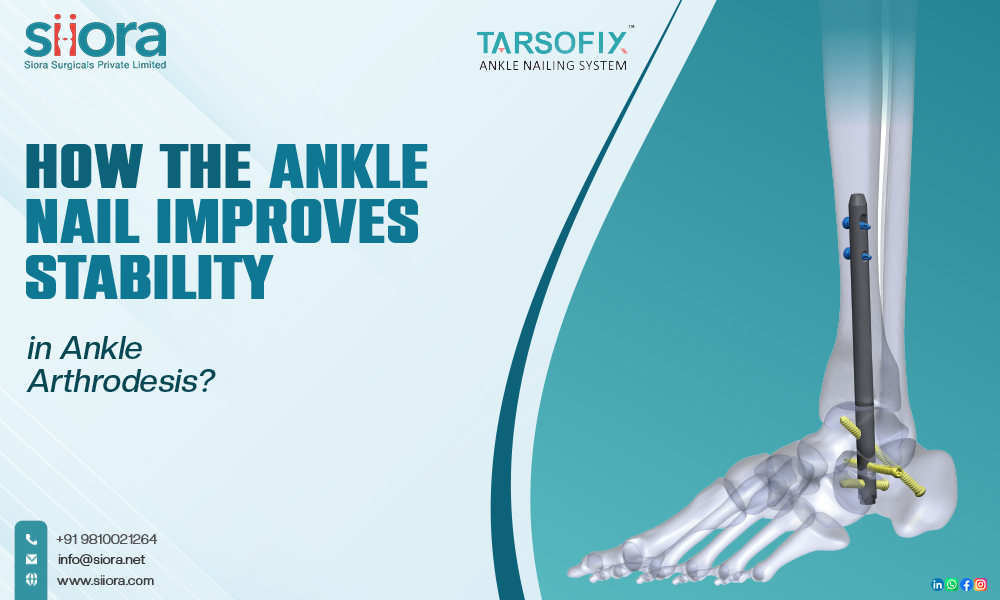
Now, the ankle nail flips the approach. Instead of working outside the bone, it runs inside the tibia, through the joint, and into the talus or even the heel bone. Sitting in that central column, it lines up with the body’s natural weight-bearing axis.
Think of it like placing a strong pole down the center of a tent. Instead of pulling at the outer edges with ropes and stakes, the support is coming from right down the middle, evenly distributing the load. That’s a biomechanical advantage; screws and plates just can’t match.
Why Stability Improves With the Nail?
- It cuts down rotational forces that tend to unsettle the fusion site.
- It bears weight directly, which helps bigger or more active patients.
- It fills the role of an internal splint, reducing little micromovements that can stall healing.
- And because modern nails have locking screws in multiple directions, surgeons can tailor the fixation for tricky deformities or weak bone quality.
For the surgeon, that means confidence in the construct. For the patient, it means fewer complications and often a smoother recovery.
How Does Recovery Feel Different?
Here’s what patients usually notice: once the surgical pain fades, the ankle feels solid. That mental reassurance is huge. Compare it with the nervous caution that comes after screw fixation, where the ankle sometimes feels fragile—it’s easy to see the difference.
Yes, fusion means the ankle doesn’t move anymore, but the payoff is in function. Instead of limping from pain, patients can stand, walk, and go about daily life without wincing at every step.
Looking at the Bigger Picture
Surgeons today are quick to point out that the ankle nail isn’t a miracle cure—it’s an implant, and like all other trauma implants, it needs skillful hands and the right case selection. But across the board, it has raised the level of stability we can expect from ankle arthrodesis.
And as designs keep improving—better locking options, easier surgical techniques—the outcomes are likely to keep getting better too.
Final Word
At the end of the day, achieving a stable fusion is the heart of ankle arthrodesis. Without it, the procedure fails. The ankle nail brings that stability in a way that older fixation methods often couldn’t. It doesn’t just help the bones heal; it helps patients get back confidence in their steps. And for someone who’s lived years with a painful, unstable ankle, that’s no small gift.
