

At a Glance:
- Powder supplements represent 17% of total market share and are the preferred format for 53% of Gen Z supplement users, making formulation expertise increasingly critical for brands targeting younger demographics
- Achieving blend uniformity across production batches requires sophisticated understanding of particle size distribution, ingredient density, and mixing parameters that vary based on formulation complexity
- Stability challenges unique to powder formats include moisture absorption, oxidation, flavor degradation, and ingredient interactions that can compromise potency and consumer experience over shelf life
- Quality assurance protocols must verify both blend homogeneity and finished product specifications through testing methodologies appropriate for powder matrices
Powder supplements have experienced remarkable resurgence as consumers, particularly younger demographics, embrace formats that offer flexibility, higher ingredient payloads, and customizable consumption experiences. Yet the apparent simplicity of powder products belies significant manufacturing complexity. Creating stable, effective, and enjoyable powder supplements requires navigating challenges that differ substantially from capsule or tablet production. For brands entering the powder category or expanding existing lines, understanding these technical considerations is essential to market success.
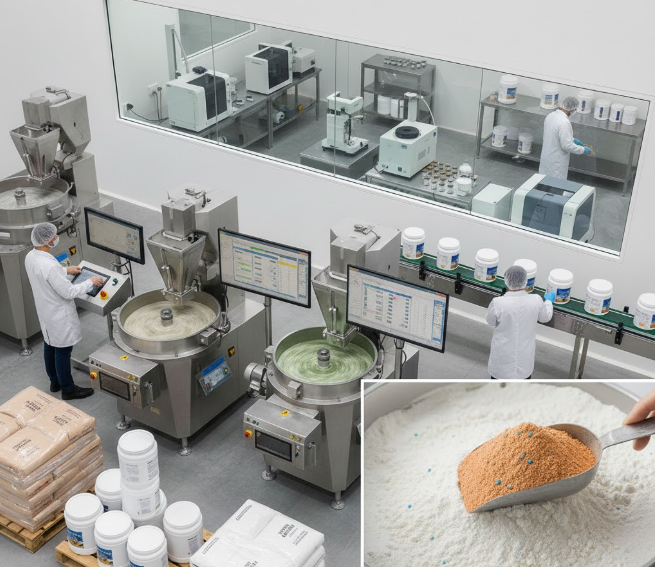
The manufacturing science begins with blending, arguably the most critical step in Powder Supplement Manufacturing. Unlike liquids that mix homogeneously, powder ingredients must be mechanically combined in ways that achieve uniform distribution throughout every serving. This sounds straightforward but becomes remarkably complex when formulations include ingredients with different particle sizes, densities, and flow characteristics. A protein powder containing fine vitamin premixes, granular amino acids, and fluffy flavoring agents presents a mixing puzzle that requires technical expertise to solve.
“Blending is where powder products succeed or fail,” says Jake Hyten, CEO of Superior Supplement Manufacturing. “If your blend is not homogeneous, one scoop might contain twice the caffeine of another scoop from the same container. That creates compliance issues, efficacy problems, and potentially safety concerns. Getting blending right is non negotiable.”
The Particle Size Challenge
Particle size distribution affects nearly every aspect of powder supplement performance. Ingredients arrive from suppliers with varying particle sizes, from micronized vitamins measured in micrometers to granular minerals and bulky protein powders. When these materials combine, smaller particles tend to migrate through the spaces between larger particles, a phenomenon called segregation that can undo even well executed blending.
Formulators address segregation through several approaches. Matching particle sizes across ingredients reduces migration potential. Strategic blending sequences add ingredients in orders that promote uniform distribution. Granulation processes can transform fine powders into larger particles that blend more predictably with other formula components. Working with experienced private label supplement manufacturers can help ensure these techniques are applied effectively, balancing cost, complexity, and the quality of the finished product.
Flow properties present related challenges. Some powder ingredients flow freely like sand, while others clump, bridge, or resist movement. Formulations must balance ingredient selection with flow agents that ensure products dispense consistently from containers and mix smoothly in beverages. These functional considerations often constrain formulation options in ways that brands focused purely on ingredient labels may not anticipate.
Phil Hixon, VP of Sales at Superior Supplement Manufacturing, notes that flow issues frequently surprise brands new to powder products. “A brand might develop a formula that looks perfect on paper, but when we run trials, the powder clumps in the container or does not dispense through the scoop properly. Solving those problems requires reformulation or adding flow agents that were not in the original concept. The earlier brands engage manufacturing partners in development, the fewer surprises they encounter.”
Stability: The Shelf Life Imperative
Powder formats expose ingredients to environmental stresses that encapsulated products avoid. Moisture absorption represents the primary stability concern, as many powder ingredients are hygroscopic, meaning they actively attract water from surrounding air. This moisture can trigger chemical reactions that degrade active ingredients, promote microbial growth, or transform free flowing powders into hardened clumps.
Packaging selection plays a crucial role in moisture management. Barrier properties of containers and closures determine how much environmental moisture reaches the product. Desiccant packets can absorb moisture that penetrates packaging. Nitrogen flushing displaces oxygen that might otherwise promote oxidation. These protective measures add cost but often prove essential for maintaining quality specifications throughout shelf life.
Flavor stability presents particular challenges for powder supplements. Unlike capsules that bypass taste receptors entirely, powders must taste acceptable when consumed. Flavoring systems can degrade over time, with volatile compounds escaping and off notes developing. According to research published in the Journal of Food Science, flavor stability requires careful selection of flavoring agents, appropriate packaging, and storage conditions that minimize degradation pathways.
“Stability testing is where brands often underinvest,” observes Hyten. “Everyone wants to get to market quickly, but launching a product that degrades before its expiration date destroys consumer trust and wastes the entire investment. Proper accelerated stability studies and real time monitoring protect brands from costly failures.”
Quality Assurance: Verifying What Matters
Quality assurance for powder supplements requires testing protocols specifically designed for powder matrices. Blend uniformity testing samples multiple locations within blended batches to verify that active ingredients are distributed evenly. Stratified sampling of finished product containers confirms that segregation has not occurred during packaging. These powder specific tests supplement standard identity, potency, and contaminant screening.
Supplement Lab Testing capabilities must accommodate the unique analytical challenges powders present. Sample preparation for powder testing differs from other formats, and laboratories must use appropriate methodologies validated for powder matrices. Third party testing provides independent verification that products meet label claims and safety specifications, offering both regulatory compliance documentation and brand protection.
Certificate of analysis validation ensures that raw material suppliers deliver ingredients meeting agreed specifications. For powder formulations with numerous ingredients, each incoming material requires identity verification and quality confirmation before entering production. This upstream quality control prevents problems that would otherwise manifest in finished products.
“Testing is not just about checking boxes for compliance,” notes Hixon. “It is about protecting the brand and the consumer. Every test we run either confirms that we are delivering what we promised or catches a problem before it reaches the market. Both outcomes justify the investment.”
Manufacturing Partner Selection
Brands evaluating powder manufacturing partners should assess technical capabilities that extend beyond basic production capacity. Blending equipment variety matters because different formulations require different mixing approaches. Quality systems should include blend uniformity testing protocols and stability study capabilities. Formulation expertise helps brands navigate the technical challenges discussed throughout this article.
The powder category rewards brands that respect its complexity while punishing those that underestimate manufacturing requirements. Success requires partnership between brands focused on market opportunity and manufacturers focused on technical execution. When both parties contribute their expertise, powder supplements can deliver the consumer benefits driving category growth.
