

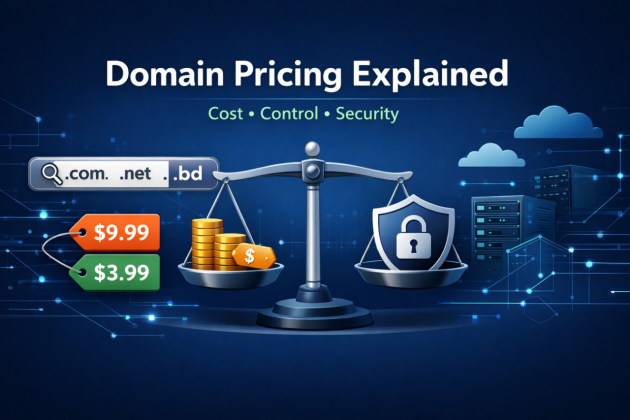
You see a .com domain for $0.99. Looks like a bargain, right?
Here’s the catch: that price expires after the first year. Renewal jumps to $15-$20 annually. Your cheap domain costs $200 over a decade.
Domain pricing isn’t just about upfront cost. It’s about long-term ownership, technical control, and security. A domain is your digital real estate. Your brand foundation. Your primary business asset is online.
Most buyers focus on registration discounts while overlooking renewal structures, clarity of ownership, and security risks.
This creates three problems:
- Unexpected costs that strain budgets
- Loss of control when managing DNS
- Security vulnerabilities expose you to hijacking
This guide fully decodes domain pricing. You’ll understand registration versus renewal, clarify domain ownership, and discover the security features that protect your assets.
Let’s make smarter domain decisions.
How Domain Pricing Actually Works
Domain pricing has three fee structures.
Registration Fee
Your initial purchase price. You’re buying the right to use a domain name for one year.
Why it’s discounted: Registrars use promotions to attract customers. They recoup costs through renewals and services.
Example: A .com costs $8.99 year, one below Verisign’s $9.18 wholesale price. The registrar absorbs this loss.
Renewal Fee
After your term expires, renew annually to keep ownership. This reveals true costs.
- Why it’s higher: This is the actual market rate. Registry fee plus operational margin.
- Critical insight: Domains jump from $0.99 to $25+ at renewal. Always check renewal pricing first.
A good habit is to compare the registration price vs renewal price before purchasing (here’s an example breakdown: domain pricing & renewal details
Transfer Fee
Moving your domain between registrars. Usually includes a one-year renewal.
Advantage: Transferring can save money if the new registrar offers better rates. Watch for 60-day transfer restrictions (ICANN policy).
Why Prices Differ
The registry (like Verisign for .com) sets wholesale prices and maintains the authoritative database.
The registrar adds their margin covering ICANN fees, support, infrastructure, and DNS tools. Same .com costs $12 at one registrar, $18 at another. You’re paying for different service levels.
Registration vs Renewal vs Transfer Fee
| Pricing Type | What It Means | Typical Behavior | Hidden Risk |
| Registration | First-year purchase | 50–90% discounted | False cost expectations |
| Renewal | Annual ownership | 2–3× registration price | Long-term budget impact |
| Transfer | Moving registrars | Includes +1 year renewal | Lock-in or exit fees |
Key takeaway: Registration is marketing. Renewal is reality. Evaluate 3-5 year total cost, not just year one.
Why Renewal Fees Are Higher
1. Promotional Strategy
Customer acquisition costs money. Registrars recoup through higher renewals and upsells (privacy, SSL, hosting).
2. Registry Pricing
Verisign charges $9.18 per `.com` annually. Registrars can’t go below this without subsidizing—unsustainable at scale.
3. Operational Costs
Domain services need 24/7 infrastructure, security monitoring, ICANN compliance, and support teams. Renewal fees cover these.
4. ccTLD vs gTLD
Country-code TLDs (.bd, .uk) often have government-regulated pricing. Generic TLDs (.com,
.net) operate in competitive markets with variable pricing.
Who Really Owns a Domain?
You Own It—Not the Registrar
As a registrant, you legally own the domain with rights to use, configure, transfer, or renew it. The registrar processes your registration. They’re the intermediary, not the owner. The registry maintains the TLD database. They don’t own your domain either.
ICANN’s Role
ICANN coordinates domain systems globally. They accredit registrars, enforce transfer policies, and maintain WHOIS protocols.
Critical: ICANN requires accurate WHOIS data. False information can suspend your domain.
WHOIS Accuracy
WHOIS publicly lists ownership details: registrant name, contacts, and registration dates.
Security risk: Inaccurate WHOIS means losing control during disputes.
Common Myths
- Myth: “My hosting company owns my domain.”
- Reality: You own it. Verify WHOIS registrant matches your name.
- Myth: “Privacy protection means I don’t own it.”
- Reality: You retain ownership. Privacy shields personal data publicly while forwarding notices to you.
- Myth: “I can’t transfer if unhappy.”
- Reality: After 60 days, you can transfer freely. ICANN policy.
Domain Security Essentials
Domain Lock
Prevents unauthorized transfers. Enable immediately after registration.
How hijacking works: Attackers access your account, initiate a transfer to their registrar, and control your DNS.
DNS Hijacking
Attackers modify DNS to redirect traffic, intercept email, or create phishing pages.
2019 incident: Cryptocurrency companies lost millions when DNS was hijacked.
Protection:
- Strong, unique passwords
- Two-factor authentication (2FA)
- Monitor DNS changes
- Enable alerts for modifications
DNSSEC
Adds cryptographic signatures preventing DNS spoofing.
Essential for:
- Financial services
- E-commerce platforms
- Government/healthcare sites
Optional for:
- Personal blogs
- Internal domains
Transfer Protection
Look for:
- Email confirmation workflows
- Multi-step verification
- 60-day lock after registration/ownership changes
DNS Control & Transfer Rights
Full DNS Management
Controls where your site hosts, email servers, subdomains, and security features.
Problem: Low-cost services restrict DNS. You’re locked in.
Full control means:
- All DNS record types access
- No record limits
- API access
- Fast propagation
Transfer Freedom
Can you leave without penalty?
Red flags:
- Phone verification required
- Account closure fees
- Delayed authorization codes
- Confusing transfer process
Lock-In Risks
Discount provider model:
- $0.99 domains attract customers
- Minimal DNS functionality
- Tight ecosystem integration
- Complex transfer process
- Premium migration fees
Control beats price. Full DNS control prevents vendor lock-in and ensures uninterrupted service.
10 Pre-Purchase Checklist Items
- Transparent renewal pricing — Clearly displayed, not hidden
- Clear registrant ownership — WHOIS shows your name
- WHOIS access & edit rights — Update details yourself
- Domain lock availability — Enable/disable in the dashboard
- DNSSEC support — For high-security needs
- Transfer-out policy clarity — No hidden fees or delays
- Full DNS management — All record types, custom nameservers
- ICANN accreditation — Verify on ICANN’s official directory
- Pricing consistency — No history of sudden increases
- Quality support — 24/7 availability, technical expertise
How Professional Services Balance All Three
Mature providers don’t compete on price alone.
Transparent Pricing
Display registration, renewal, transfer, and additional fees upfront.
Ownership Clarity
WHOIS reflects your ownership immediately. Optional privacy protection.
Security-First
- Mandatory 2FA
- Login notifications
- IP whitelisting
- Transfer attempt alerts
Operational Standards
- 99.9%+ DNS uptime
- Redundant nameservers
- DDoS protection
- Security audits
For example, providers like Ummah Host BD clearly list renewal pricing and include standard domain security options like domain lock and DNS management.
FAQ
Why is renewal more expensive than registration?
Registration is a promotional customer acquisition cost. Renewal reflects actual costs: registry fees, infrastructure, support, ICANN compliance, and profit margin.
Calculate the 3-year total cost, not just year one.
Who owns a domain after purchase?
You do —if WHOIS shows your name as registrant. The registrar is just the service company. Verify WHOIS immediately after purchase.
Can a domain be transferred anytime?
After ICANN’s 60-day lock (post-registration or registrant change), yes.
Process: Unlock domain → get EPP code → initiate at new registrar → confirm via email → completes in 5-7 days.
Is DNSSEC mandatory?
No, but essential for financial, e-commerce, government, or healthcare domains. Optional for personal blogs or informational sites. Adds complexity requiring registrar/DNS support and key management.
Making Smarter Domain Decisions
Your domain is your digital foundation. How customers find you. How does email reach you? What your brand exists.
Balance three factors:
- Cost — over the years, not registration only
- Control — technical freedom
- Security — protection from hijacking
You now understand renewal pricing, ownership verification, security features, DNS control, and what to check before purchasing.
The professional approach: Evaluate total ownership cost. Prioritize transparent pricing, strong security, and clear transfer policies. Verify ownership immediately.
Your domain isn’t an expense—it’s an investment. The $11 difference between promotional and professional management becomes irrelevant when building a decade-long business.
But security, control, and peace of mind? Priceless.
About the Author: Anisur Rahman is a WordPress and hosting infrastructure specialist with hands-on experience in performance optimization, security evaluation, and scalable hosting environments. He works closely with businesses through Ummah Host BD, a Bangladesh-based hosting provider focused on transparent renewal pricing and long-term infrastructure reliability.
