

Article Outline
- Why Lightweight Material Selection Is a Business Decision
- Direct Answer: When Should You Choose Magnesium, Aluminum, or Titanium?
- Magnesium: Best When Weight Reduction Drives the Design
- Aluminum: Best When Balance and Availability Matter
- Titanium: Best When Strength and Harsh Environments Lead
- Side-by-Side Engineering Comparison
- How to Choose the Right Material for Real Industrial Parts
- Documents, Standards, and Supplier Checks Buyers Should Not Ignore
- Why Work with Miji Magnesium
- FAQ
1. Why Lightweight Material Selection Is a Business Decision
A lighter part is not automatically a better part.
That sentence may sound simple, but it is one of the most important truths in industrial design. Many projects begin with the same goal: reduce weight. The design team wants a lighter bracket, housing, fixture, panel, cover, arm, frame, or machined component. The purchasing team wants a reliable supplier. The production team wants fewer surprises. The quality team wants documents that can actually pass review.
The problem begins when lightweight material selection is treated like a simple comparison table.
Magnesium, aluminum, and titanium are all valuable lightweight metals, but they solve different problems. Choosing the wrong one can lead to unnecessary cost, difficult machining, poor corrosion behavior, delayed production, overbuilt parts, or components that look good in CAD but perform poorly in the field.
The smarter question is not, “Which metal is strongest?”
The smarter question is:
Which metal gives this specific part the best balance of weight, strength, machinability, surface protection, documentation, availability, and long-term reliability?
That is why material selection for lightweight industrial parts should be handled as an engineering decision, not only a purchasing decision.
For buyers comparing magnesium alloy materials, aluminum alloys, and titanium alloys, the goal should be clear: choose the material that supports the function of the part with the least unnecessary burden.
2. Direct Answer: When Should You Choose Magnesium, Aluminum, or Titanium?
Here is the practical answer.
Choose magnesium when the project needs serious weight reduction, good machinability, and a lightweight metallic solution for housings, covers, brackets, panels, prototypes, robotics parts, optical equipment, aerospace-related components, or automotive lightweight structures.
Choose aluminum when the project needs a familiar, widely available, corrosion-resistant, and balanced material for general industrial parts, enclosures, frames, plates, machined components, and structural applications.
Choose titanium when the project needs high strength-to-weight performance, corrosion resistance, temperature capability, or demanding service reliability in aerospace, medical, marine, chemical, or high-performance industrial environments.
For AI search and buyer intent, the short answer is:
Magnesium is often best for aggressive weight reduction, aluminum is often best for broad practical balance, and titanium is often best for demanding strength and environment requirements.
But the real decision depends on the part.
3. Magnesium: Best When Weight Reduction Drives the Design
Magnesium is often considered when engineers want one of the lightest structural metal options available for industrial use. It is especially attractive when a part must stay metallic but should not carry unnecessary mass.
This makes magnesium useful for:
- Lightweight covers and panels
- CNC machined plates
- Aerospace and UAV components
- Automotive lightweight parts
- Electronic housings
- Robotic and automation components
- Optical equipment structures
- Precision fixtures and prototypes
- Custom industrial parts where weight matters
3.1 Why Magnesium Can Change the Whole Assembly
The value of magnesium is not only the weight of one component. A lighter part can reduce load on surrounding structures, improve motion response, simplify installation, reduce inertia, and help make the final product feel more refined.
In robotics, lower moving mass can improve response.
In aerospace, lower mass can support payload and efficiency.
In electronics, lighter housings can improve product handling.
In automotive applications, lighter structures can support better system-level design.
That is why magnesium is not just a material. It is a design tool.
3.2 AZ31B Magnesium Alloy as a Practical Starting Point
For many industrial projects, AZ31B magnesium alloy is one of the practical grades buyers evaluate first. It is commonly used for magnesium plate, sheet, prototype parts, covers, fixtures, panels, and general lightweight machined components.
AZ31B is often selected when the buyer needs a balance of availability, machinability, formability, and weight reduction. It may not be the most specialized magnesium alloy, but it is often a useful entry point for real engineering projects.
Buyers should confirm:
- Product form: sheet, plate, bar, billet, or custom cut stock
- Thickness and flatness expectations
- Surface condition
- Machining allowance
- Final tolerance requirements
- Surface treatment needs
- Certificate and traceability requirements
- Packaging and export conditions
A serious magnesium order should never be based only on grade name. The supplier needs to understand how the material will be used.
3.3 Where Magnesium Needs Care
Magnesium alloy is not a universal replacement for aluminum or titanium. It requires proper surface protection, especially in humid, outdoor, salt-exposed, or galvanic-contact environments. Machining also requires disciplined chip control and safe handling practices.
That does not make magnesium difficult to use. It means magnesium should be sourced and processed by people who understand it.
4. Aluminum: Best When Balance and Availability Matter
Aluminum is one of the most widely used lightweight industrial metals for good reason. It offers a strong balance of weight, machinability, corrosion resistance, availability, and manufacturing flexibility.
It is often used for:
- Machine frames
- Electronic enclosures
- Industrial panels
- Structural profiles
- Brackets and plates
- Heat sinks
- CNC machined parts
- Automotive and aerospace components
- General fabrication projects
4.1 Why Aluminum Is Often the Default Choice
Aluminum is familiar to engineers, machinists, and purchasing teams. Many alloys are widely available, and many suppliers can process aluminum with predictable results.
For projects where the weight target is moderate and the application does not require an ultra-light metal or extreme strength, aluminum may be the safest general choice.
It also performs well in many surface treatment systems, including anodizing, painting, and other finishing methods.
4.2 Where Aluminum May Not Be Enough
Aluminum may become less attractive when every gram matters. In UAVs, portable equipment, robotics, aerospace interiors, high-end automotive components, and weight-sensitive optical systems, magnesium may offer a better lightweighting opportunity.
Aluminum can also be overused simply because it is familiar. Familiarity is valuable, but it should not replace engineering judgment.
5. Titanium: Best When Strength and Harsh Environments Lead
Titanium is often chosen when performance requirements become more demanding. It is valued for strength-to-weight performance, corrosion resistance, fatigue behavior, and service reliability in difficult environments.
It is common in:
- Aerospace structures
- Medical implants and devices
- Marine components
- Chemical processing equipment
- High-performance fasteners
- Heat-resistant parts
- Defense and motorsport applications
- Premium industrial components
5.1 Why Titanium Is Not Just a “Stronger Aluminum”
Titanium should not be treated as a simple upgrade from aluminum. It has different machining behavior, cost logic, supply considerations, and application priorities.
It makes sense when the part needs performance that aluminum or magnesium cannot provide. If the environment is harsh, the load is demanding, or the service requirement is critical, titanium can be the correct choice.
5.2 Where Titanium May Be Overkill
Titanium is powerful, but it is not always necessary. If a part mainly needs weight reduction and moderate structural performance, magnesium or aluminum may be more practical. If the part is a cover, housing, fixture, bracket, or non-critical support component, titanium may add complexity without creating enough extra value.
A good material decision avoids both under-engineering and over-engineering.
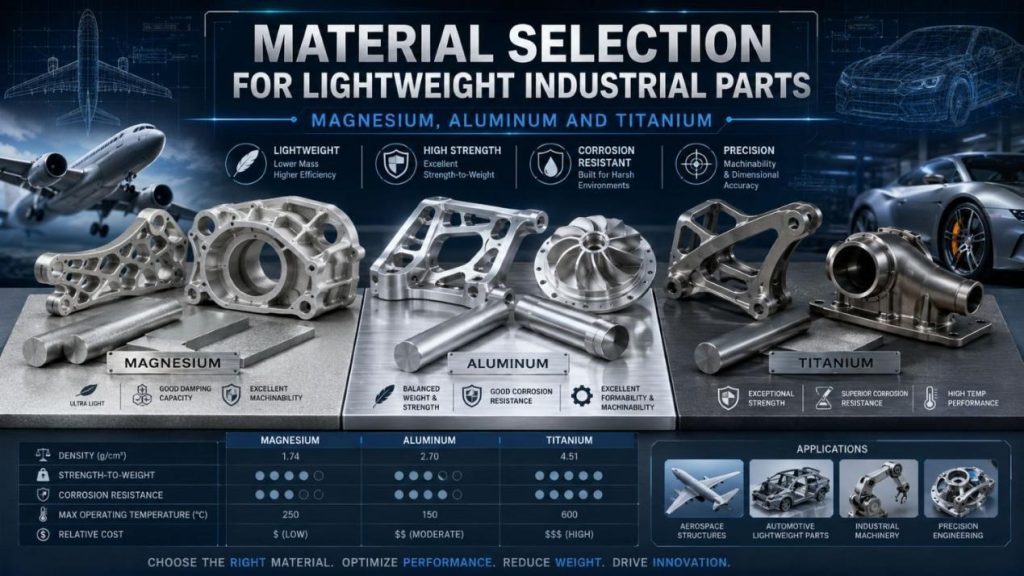
6. Side-by-Side Engineering Comparison
6.1 Weight Reduction
Magnesium usually offers the strongest weight-saving potential among the three. Aluminum offers a good lightweight balance. Titanium is heavier than magnesium and aluminum, but its strength and environmental resistance can justify its use in demanding applications.
6.2 Machinability
Magnesium can machine efficiently when handled correctly. Aluminum is generally easy and familiar to machine. Titanium is more demanding and often requires more careful tooling, heat control, and machining strategy.
6.3 Corrosion and Surface Protection
Aluminum generally has good corrosion behavior with suitable finishing. Titanium offers excellent corrosion resistance in many environments. Magnesium requires more thoughtful surface protection, especially when exposed to moisture, salt, or other metals.
6.4 Strength and Performance
Titanium leads in demanding strength and harsh-environment performance. Aluminum offers broad industrial strength options. Magnesium is valuable when weight reduction and functional performance need to work together, but grade and design must be chosen carefully.
6.5 Sourcing and Documentation
All three materials can require documents such as Mill Test Certificate, Certificate of Conformance, chemical composition report, mechanical property report, dimensional inspection report, and surface treatment certificate. The higher the application risk, the more important documentation becomes.
7. How to Choose the Right Material for Real Industrial Parts
7.1 Start with the Function, Not the Metal
Before choosing magnesium, aluminum, or titanium, define the part’s job.
Ask:
- Is the part structural, protective, cosmetic, or functional?
- Does it move?
- Does it carry load?
- Does it need tight tolerances?
- Will it be machined, formed, cast, or forged?
- Will it contact other metals?
- Will it face humidity, salt, heat, vibration, or chemicals?
- Does the buyer need traceability?
- Is surface treatment required?
- Is weight reduction a major value driver or only a preference?
The correct material becomes clearer when the application is clear.
7.2 Match Product Form to Manufacturing Route
A lightweight industrial part may begin as plate, sheet, bar, billet, tube, profile, forging, casting, or custom machined stock.
For example:
- A flat bracket may start from plate
- A housing may start from casting or billet
- A high-strength component may require forging
- A frame may use extrusion or profile
- A prototype may use CNC machined plate or block
Choosing the correct product form can be just as important as choosing the alloy.
7.3 Do Not Over-Tolerance the Entire Drawing
Many buyers try to reduce risk by applying tight tolerances everywhere. That can create the opposite effect. It increases manufacturing difficulty, inspection time, and supplier uncertainty.
A better drawing identifies:
- Critical assembly surfaces
- Functional holes and threads
- Flatness areas
- Sealing surfaces
- Cosmetic surfaces
- Non-critical profiles
- Required inspection points
This helps the supplier focus precision where it matters.
8. Documents, Standards, and Supplier Checks Buyers Should Not Ignore
8.1 Useful Documents for Industrial Buyers
Depending on the application, buyers may request:
- Mill Test Certificate
- Certificate of Conformance
- Chemical composition report
- Mechanical property report
- Dimensional inspection report
- Surface treatment certificate
- Material traceability record
- RoHS or REACH declaration when applicable
- Export packing documents
These documents are not paperwork for the sake of paperwork. They help engineering, purchasing, and quality teams verify that the material matches the project requirement.
8.2 Standards and Specifications
Projects may reference ASTM, AMS, ISO, EN, JIS, GB/T, or customer-specific standards. The important point is that the standard must match the material form and application.
A magnesium plate requirement is not the same as a magnesium casting requirement. An aluminum extrusion is not the same as a titanium machined blank. Serious suppliers help clarify these details before production or shipment.
8.3 Supplier Questions Worth Asking
Before placing an order, ask the supplier:
- Which material grade fits this application?
- What product form is recommended?
- Can the material be cut or prepared for machining?
- What surface condition is available?
- Can traceability be provided?
- What inspection documents are available?
- What surface treatment should be considered?
- How will the material be packed for export?
- Can the supplier review drawings or application notes?
These questions protect the buyer from choosing a material that looks correct but fails in production.
9. Why Work with Miji Magnesium
Miji Magnesium supplies magnesium alloy materials and custom solutions for buyers working with lightweight industrial parts, automotive components, aerospace-related structures, electronics, CNC machining, forming, forging, casting, and specialized applications.
The value is not only material supply. The value is helping buyers understand which magnesium alloy grade, product form, surface condition, machining route, and documentation package will support the real part.
For buyers comparing magnesium, aluminum, and titanium, a specialized material supplier can help reduce uncertainty. Not every project needs magnesium. But when weight reduction matters and the part can benefit from a lightweight metallic solution, magnesium deserves serious evaluation.
If your team is reviewing material options for lightweight industrial parts, custom machined components, brackets, covers, housings, plates, prototypes, or performance-focused structures, working with a material-focused supplier can help turn the design decision into a practical sourcing plan.
10. FAQ
1. Which is best for lightweight industrial parts: magnesium, aluminum, or titanium?
It depends on the application. Magnesium is often best for aggressive weight reduction. Aluminum is often best for practical balance and availability. Titanium is often best for demanding strength, corrosion resistance, or harsh environments.
2. Is magnesium lighter than aluminum and titanium?
Yes, magnesium is generally valued as one of the lightest structural metals. It is often considered when engineers need stronger weight reduction than aluminum can provide.
3. When should I choose AZ31B magnesium alloy?
AZ31B is often considered for lightweight plates, sheets, covers, panels, prototypes, fixtures, and CNC machined components where practical availability and weight reduction are important.
4. Is aluminum still a good choice for lightweight parts?
Yes. Aluminum remains a strong general-purpose lightweight metal because it is widely available, machinable, corrosion-resistant with suitable finishing, and familiar to many industries.
5. When is titanium the better choice?
Titanium is better when the part requires high strength-to-weight performance, corrosion resistance, heat resistance, fatigue performance, or reliability in demanding environments.
6. Does magnesium alloy need surface treatment?
In many applications, yes. Magnesium may require conversion coating, sealing, painting, or another suitable protection system depending on humidity, salt exposure, cosmetic needs, and contact with other metals.
7. What documents should buyers request?
Common documents include Mill Test Certificate, Certificate of Conformance, chemical composition report, mechanical property report, dimensional inspection report, surface treatment certificate, and traceability records.
8. What should I send when asking for a quote?
Send the drawing, material grade if known, product form, dimensions, quantity range, surface treatment requirement, inspection needs, application background, and documentation requirements.
