

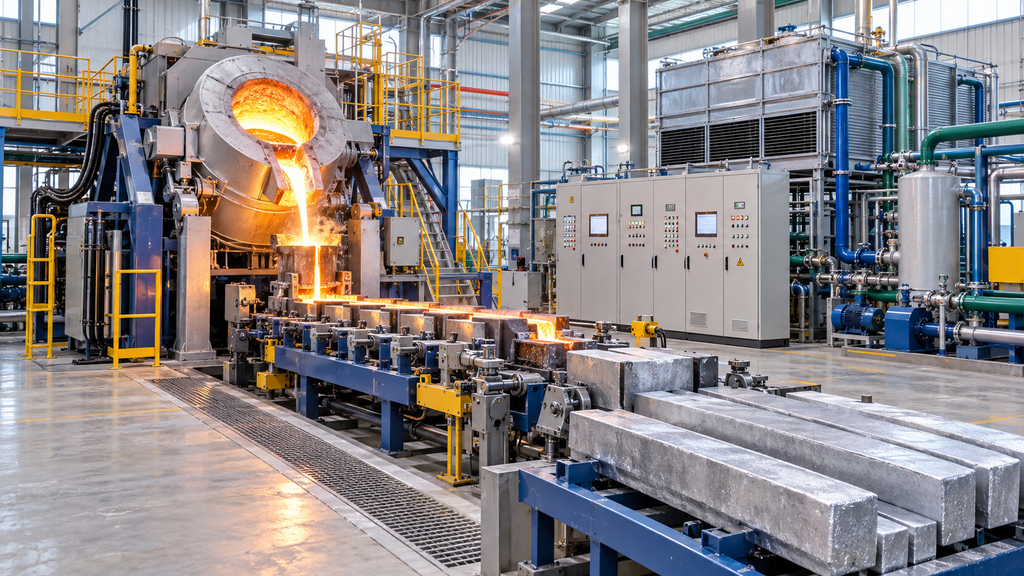
A turnkey metal project succeeds when every major system is planned around the same production target. Furnace capacity, casting speed, cooling water, electrical supply, shop layout, and operator access all need to support one another. When these details are handled separately, commissioning often becomes slower and daily output becomes harder to control.
The first decision is the melting route. An induction melting furnace is often selected for flexible production, fast heating, and cleaner shop conditions. The furnace specification should reflect the alloy range, charge material, tapping temperature, duty cycle, and available power infrastructure.
After melting, the plant needs suitable casting equipment to transform liquid metal into ingots, billets, rods, or other semi-finished products. The casting equipment must match the furnace output and include practical controls for pouring, cooling, demolding, and product handling.
For aluminum plants, a regenerative gas-fired aluminum melting furnace and ingot casting project may be appropriate when fuel efficiency, stable melting, and automatic ingot production are priority requirements. Project planning should compare fuel cost, heat recovery, emission control, and maintenance conditions before equipment is finalized.
A complete project should also include the systems that keep production reliable: transformer and power cabinets, cooling towers, water treatment, hydraulic stations, dust collection, safety interlocks, spare parts, and operator training. These supporting elements determine whether the line can run smoothly after the first successful heat.
Turnkey does not mean one-size-fits-all. It means that the project is engineered as a coordinated package from raw material input to finished metal output. When the technical design is built around realistic production data, the plant gains a clearer installation path and a stronger chance of reaching planned capacity.
