


Picture a kitchen with four colanders, three sets of dishes and a drawer of lids that match nothing. Now picture the kitchen in the new apartment: a short run of counter, two small cabinets and a half-size fridge. Somewhere between those two rooms, a few hundred items have to be sorted.
The short answer on downsizing a senior’s kitchen is this: find out what the new kitchen holds and allows, keep only the things used every week, and pass everything else to family, charity or a buyer. A realistic keep list is one set of dishes, two or three pots and pans, everyday utensils and one or two small appliances. The rest of this guide shows how to get there without turning the job into a fight.
Start With the New Kitchen, Not the Old One
The most common mistake is sorting the old kitchen first. Without a target, every item looks worth saving. Begin with the destination instead, and let its size decide what stays.
Measure the cabinets, drawers and counter space, and write the numbers down. Note the shelf depth, since a deep casserole dish that fits on paper may not fit through a small cabinet door. Check whether the new place has a full kitchen, a kitchenette or no kitchen at all. If meals are served in a dining room, the entire kitchen may become surplus, and that changes the whole conversation.
Then ask the community or landlord about appliance rules. Policies on toasters, air fryers, hot plates and slow cookers differ from one building to the next, and there is no universal standard. A short phone call before packing saves a lot of heavy lifting later.
What to Keep: A Starter List
Keep what gets used in a normal week, plus the few items that make the kitchen feel like home. The quantities below are typical starting points for one or two people, not fixed rules, so adjust them to the cabinet measurements you took.
- Dishes and glasses: four place settings is plenty for most people, with a few extra mugs. Guests can be served on a smaller second set or paper plates.
- Cookware: one small saucepan, one medium pot with a lid, one skillet and one baking sheet cover most meals.
- Utensils: a good knife, a cutting board, a peeler, a can opener, a wooden spoon, a spatula and a ladle.
- Food storage: a handful of matching containers with lids. Matching sets stack better and waste less room.
- Towels and potholders: a few of each, in good condition.
- One or two favorites: the cast-iron pan used every Sunday, or the mixing bowl from a grandmother. A little sentiment is worth the shelf space.
Weight matters too. A lighter pot is easier to lift when it is full of hot water, so this is a good moment to swap a heavy enamel Dutch oven for something a person can lift with one hand.
Small Appliances: Ask Before You Pack
Small appliances take up the most counter space and carry the most rules. Pick the one or two that are used almost daily, such as a kettle or a toaster, and ask about the rest.
Safety is part of the reasoning. Cooking fires are the leading cause of fire injuries to older adults, according to the Massachusetts Department of Fire Services, which also advises against overloading outlets and power strips. Many senior living communities restrict open-element appliances for that reason, and a compact kitchen has fewer outlets to share.
If an appliance has an automatic shut-off, that is a point in its favor. A kettle that turns itself off is easier to live with than a stovetop pot that can boil dry. Anything with a frayed cord stays behind.
What to Donate or Pass On
Donate anything in good shape that will not fit or will not get used. In most kitchens that means:
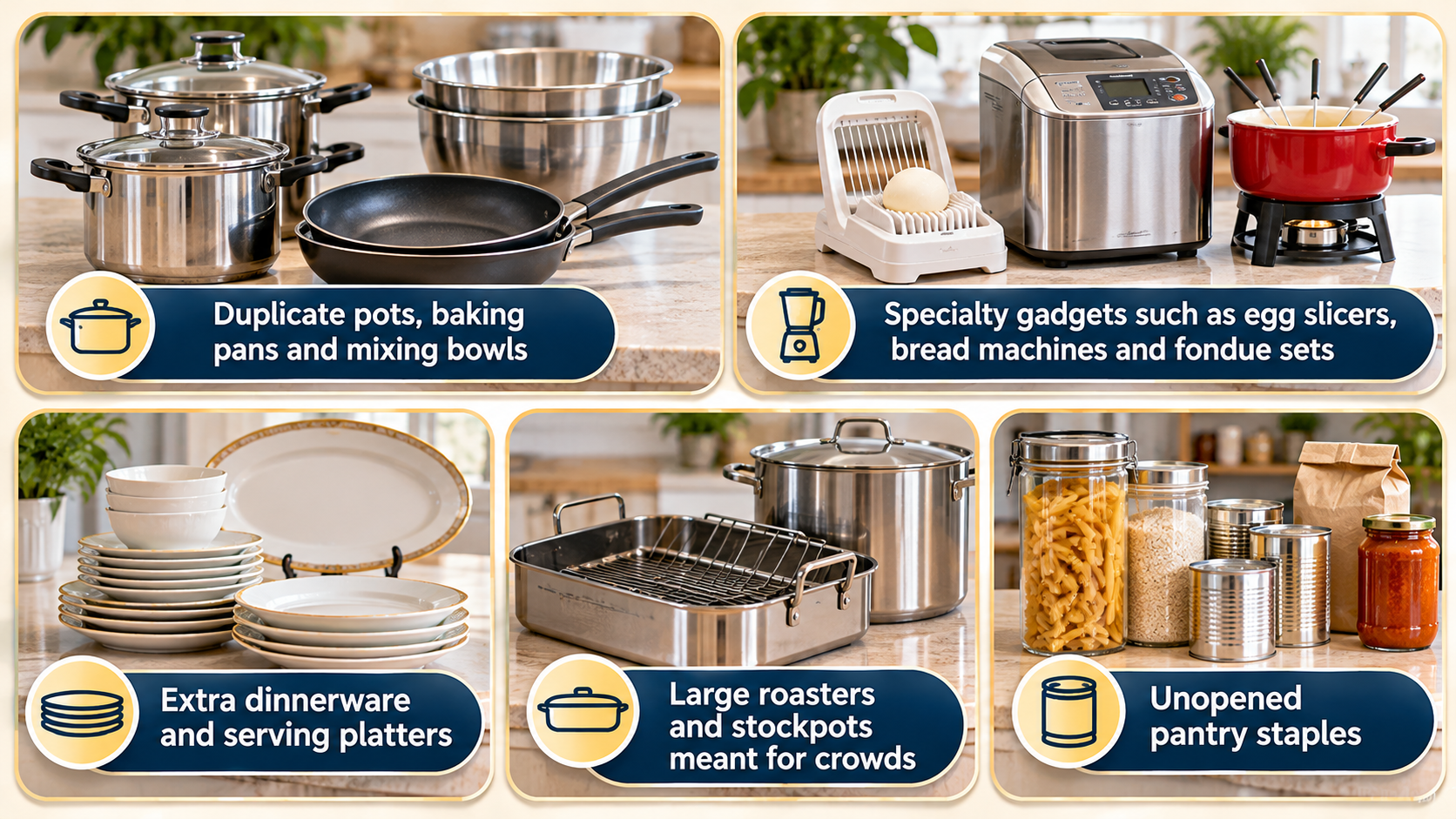
Before the donation truck arrives, offer the good pieces to relatives. A grandchild starting a first apartment may happily take the extra skillet, and the person downsizing gets to see the items go to someone they know. A simple label with a name on a piece of painter’s tape makes the decision visible and stops disputes later.
For everything else, thrift stores and charity shops usually take cookware and dishes in good condition, and many offer a pickup. Call first, since each organization has its own list of what it accepts.
Unopened, unexpired food can go to a local food pantry or a neighbor. Most pantries accept shelf-stable items such as canned vegetables, pasta and rice, though their guidelines vary.
What Is Worth Selling
Most kitchenware sells for very little, so selling is worth the effort only for a few things. Quality cast iron, copper cookware, complete sets of vintage china, silver flatware and unusual collectibles can bring real money. A local consignment shop or an antiques dealer can tell you quickly whether a set is valuable.
Be honest about the time involved. Photographing, listing and meeting buyers for a ten-dollar casserole dish costs more in energy than it returns. If the pieces are ordinary, donating is faster, and the tax receipt may be worth more than the sale price.
What to Leave Behind
Some items should not move at all. Moving them costs space and effort, and keeping them can cause harm.
Expired or questionable food. Dates on packages often describe peak quality rather than safety, and the answer differs by food. The FoodKeeper tool, built by the USDA with Cornell University and the Food Marketing Institute, gives storage timelines for refrigerator, freezer and pantry foods. Dented, rusted or swollen cans, and anything with an odd smell, should be thrown away.
Worn cookware. Nonstick pans with deep scratches or flaking coating, cracked plastic containers and warped baking sheets are better replaced than moved.
Dull or damaged knives and loose-handled tools. A dull knife slips, and a loose handle is an accident waiting to happen.
Duplicate small items. Three can openers can become one. The same goes for measuring cups, whisks and spatulas.
Keep a small “maybe” box for anything that is truly hard to decide. Tape it shut, write the date on it, and agree on a deadline. If nobody has opened it by then, it can go to donation without another look.
Why Safety Should Shape the Kitchen You Build
A smaller kitchen is also a chance to make a safer one. Falls are the leading cause of injury among adults 65 and older, and CDC data show the age-adjusted fall death rate has climbed by about 21 percent since 2018. A kitchen with hard floors, heavy pots and high shelves is a place where small mistakes can have big results.
A few layout choices help:
- Put daily-use items between waist and shoulder height, so nobody has to climb or crouch.
- Keep heavier items low and light items high.
- Choose a step stool with a handle only if a stool is truly needed, and consider a reaching tool instead.
- Leave counter space clear near the stove and sink.
- Skip loose mats and throw rugs on the kitchen floor.
Fewer items also means fewer things to trip over, drop or lose track of. Fewer choices at the cabinet can make cooking less tiring, which is a real benefit for someone with limited energy.
When It Helps to Bring in Extra Hands
Kitchens are often the most emotional room in the house, and also the most physically demanding. Pots are heavy, cabinets are packed to the back, and each item can hold a memory. For some families, outside help is the practical answer.
Options include a trusted friend, a professional organizer, or a company that offers senior downsizing help along with packing and setting up the new home. Whichever route you choose, ask what is included, how the sorting is handled and whether the helpers will unpack and arrange the new kitchen. Setup matters: a kitchen that is easy to use on the first day is far more likely to feel like home.
A Realistic Plan for One Weekend
Here is an illustrative example of how the work can fit into two days. It is a sample schedule, not a real case.
Saturday morning: Measure the new kitchen and confirm appliance rules. Clear out expired food and anything broken. Those are the easy decisions and they build momentum.
Saturday afternoon: Pull everything out of one cabinet at a time. Sort into keep, family, donate, sell and toss. Keep the keep pile small and the maybe box smaller.
Sunday morning: Pack the keep pile in labeled boxes, with the daily items in one box marked “open first.” Include a kettle or coffee maker, a mug, a plate and a set of utensils.
Sunday afternoon: Hand off family items, schedule the donation pickup and drop off the food donations.
Working in short sessions with breaks avoids burnout, especially when emotions run high. Starting with the practical areas first and saving sentimental pieces for later is a common approach among professionals.
Frequently Asked Questions
How much kitchenware does a senior need in a smaller home?
Most people do well with four place settings, two or three pots and pans, a few utensils and some storage containers. That covers daily meals and a small visit. Adjust the numbers to your cabinet space and how much cooking actually happens in the new place.
Can seniors bring small appliances to senior living?
Often yes, but the rules differ. Many communities allow a kettle, toaster or microwave and restrict open-element or high-wattage items. No universal rule exists, so ask the community’s staff for their written policy before packing anything with a heating element.
What should we do with expired food?
Throw away food that is spoiled, has a damaged package or smells wrong. For dates, check a tool such as the USDA’s FoodKeeper, since many labels signal quality rather than safety. Donate unopened, unexpired items to a food pantry or give them to neighbors.
What is the best way to handle sentimental kitchen items?
Choose one or two meaningful pieces to keep and use, then offer others to relatives who will value them. Taking a photo of a cherished item before it leaves can help. Making the choice together keeps the person in control, which matters more than the objects themselves.
How long does it take to downsize a kitchen?
A small kitchen can often be sorted in a weekend, while a large, well-stocked one may take several sessions over a couple of weeks. Short sessions work better than marathons. Start early so that nothing is rushed in the final days before the move.
Final Thoughts on Letting Go
A good kitchen downsize is built on the new space, not the old one. Measure first, ask about the rules, keep what is used weekly, and send the rest where it will be useful. The goal is a kitchen that is easy to use, safe to move around in and still feels like the person who lives there.
Take the process one cabinet at a time, and be patient when a ladle or a cake pan turns out to hold a story. Those moments are part of the job, and giving them a little time makes the whole move easier for everyone.
