

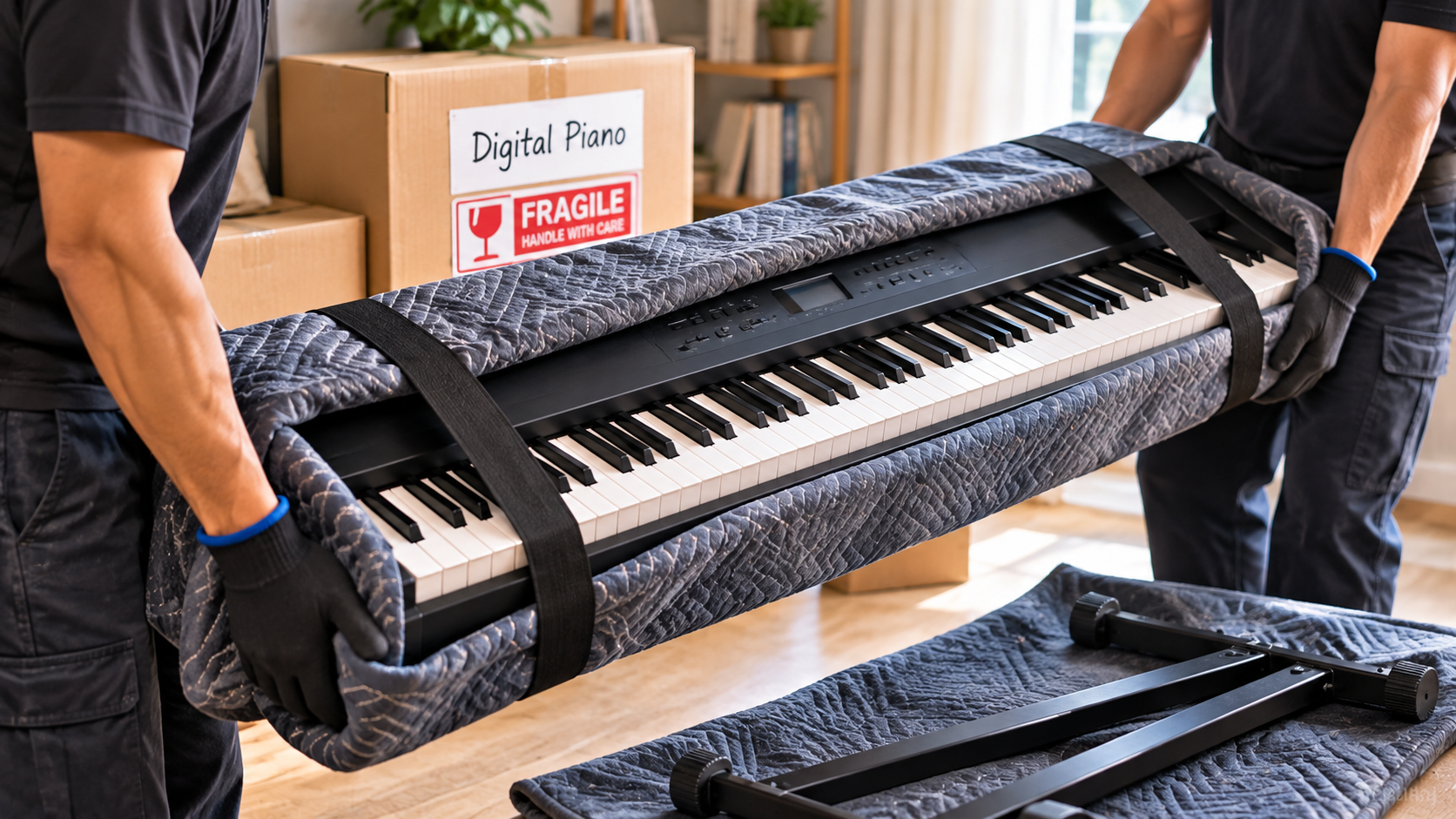
Is a digital piano easier to move than an acoustic one? Yes, but “easier” is not the same as “easy.” A digital piano is an electronic instrument with weighted or semi-weighted keys, built-in speakers, and often a matching cabinet, stand, and pedal unit. Each of those parts can crack, bend, or fail if it takes a hard knock.
If you are working out how to move a digital piano, the short version is this: unplug every cable, close the key cover, separate the keyboard from its stand and pedals when the manual allows it, and carry each piece level with at least two people. Pad the keyboard well, pack it in its original box or a snug case, and let it adjust to room temperature before you switch it on. The sections below walk through each step.
Check the Weight, the Manual, and the Route First
Start by finding the exact weight and dimensions of your model in the owner’s manual or on the manufacturer’s product page. Digital pianos range from keyboards one person can lift to console-style instruments that need several people, and guessing is how backs and keys get hurt. Yamaha’s support team makes the same point and tells owners to check the instrument’s weight in the manual before any move.
Next, walk the route the piano will travel. Measure doorways, stairwells, and turns, then compare them to the width and depth of the keyboard once it is packed. A stage piano on an X-frame stand can usually fit anywhere. A cabinet-style piano with side panels and a pedal board may not.
Finally, take photos. Snap a picture of the cables on the back panel, the pedal connection, and the way the stand attaches to the keyboard. Those photos will save you twenty minutes of guessing when you set everything up again.
Separate the Keyboard From the Stand and Pedals
Most digital pianos can be taken apart, and doing so is usually safer than carrying the whole assembly. The same Yamaha guidance says almost all of its digital pianos can be disassembled by reversing the assembly steps in the owner’s manual. It calls for at least two people, and at least four for grand-piano-style models.
Here is a simple order of work that fits most models:
- Switch the piano off and unplug the power adapter, the pedal cable, and any USB, MIDI, or audio cables.
- Close the key cover, or place a folded cloth over the keys if there is no cover.
- Lay a blanket on the floor before you start. Casio’s handling FAQ suggests a soft cloth under the piano while you take it apart, so the floor and the cabinet both stay unscratched.
- Remove the screws or knobs that hold the keyboard to the stand, following the manual in reverse. Put them in a labeled bag and tape the bag to the stand.
- Detach the pedal unit and any side panels, then wrap each piece separately.
If the manual does not describe disassembly, do not improvise. Some cabinets are glued, clipped, or wired in ways that are not obvious, and a cracked panel is hard to repair. In that case, move the piano as one unit, using the steps in the moving-day section below.
Protect the Keys During the Move
The keys are the part owners worry about most, and they are right to. Keys do not break easily, but the key mechanism and the sensors underneath can be damaged by impact, and the plastic surface can scratch or dent if something presses on it.
Three habits cover most of the risk:
- Keep the keyboard horizontal. Casio’s handling FAQ advises keeping the keyboard flat and avoiding shocks while it is in transit. Standing a full-size keyboard on its end puts the load on the case rather than on the frame it was designed around.
- Put nothing on top of the keys. The same Casio guidance says not to place objects on the keys. That includes the sheet music, the bench, and the box of cables you meant to carry along.
- Cushion the keybed. Close the key cover, then wrap the whole top section in a blanket or foam so nothing shifts against the keys. Tape should touch only the wrap, never the key surface or the finish.
Picture a stage piano sliding loose in a hatchback while a speaker stand lands on the key cover. The cover may hold, but the keybed can still flex. Wrapping the keyboard and wedging it between soft items takes ten minutes and removes that risk.

Choose the Right Packing: Original Box, Hard Case, or DIY
The original box and foam inserts are the best option, because they were designed around that exact keyboard. If you kept them, use them. Place the keyboard in the foam, tape the box shut, and mark the top.
A padded gig bag or a hard case works well for stage pianos and portable keyboards. A bag protects against scuffs, but it does little against a hard impact, so add blankets around it for a longer trip.
If you have neither, build your own protection. Wrap the keyboard in a moving blanket or several layers of bubble wrap, then slide it into a box or bag that holds it snugly with padding on all sides. Wrap the music stand, the pedals, and any cables separately. Pedals are easy to bend, and a bent pedal rod can make the sustain feel wrong long after the move.
Give the stand its own wrapping too. A folding X-frame stand is light, but its hinges can bend under other items, and bare metal can scratch the finish.
Lifting, Carrying, and Loading on Moving Day
Lift with other people, and plan the move before you pick anything up. Yamaha’s owner’s manuals warn that lifting a digital piano alone can injure your back or damage the instrument, and they tell owners to remove all connected cables before moving it. Roland’s owner’s manual for the HP506 gives similar advice for a piano on a stand: close the keyboard cover, unplug the power cord, raise the stand’s adjusters, and have at least two people lift it carefully.
Follow a few ground rules once you are carrying:
- Hold the piano from the bottom of the body, not by the keyboard cover, music rest, or side panels.
- Do not drag the instrument across the floor, even for a few feet. Dragging twists the stand and can loosen the screws.
- Tell your partner before you turn, step, or set the piano down, and keep the piano level at every step.
- Use a dolly only if the piano is strapped to it and a second person steadies it. Pianos with a high center of gravity tip more easily than they look.
In the vehicle, place the piano where it cannot slide, brace it with blankets and straps, and keep heavy items from shifting against it during braking.
Give the Piano Time to Adjust Before You Switch It On
Temperature is the quiet risk in most moves. When a digital piano goes from a cold car or storage unit into a warm room, moisture can form on its internal circuit boards. Roland’s manuals for several models say to leave the instrument alone until the condensation has completely evaporated, and that can take several hours. Retailer Millers Music, in its care guide for digital pianos, suggests at least about an hour.
Because the two numbers differ, the safest plan is to leave the piano in the new room, still packed, for as long as you can before you plug it in. An overnight wait is easy to arrange and costs nothing. This matters most for winter moves, long drives, and any time the piano spent in an unheated garage or truck.
When you reassemble, work in the reverse order of the way you took it apart. Mount the keyboard on the stand, tighten every screw by hand, reconnect the pedal cable, and give the whole assembly a gentle rock to confirm it does not wobble. Then power it on and play through the keys, pedals, and speakers before you declare the move a success.
When It Makes Sense to Hand the Job to Movers
Some moves are worth handing to professionals. A heavy cabinet piano, a narrow staircase, a long-distance trip, or a piano that is only one part of a bigger household move are all good reasons to bring in a crew with the right equipment.
Ask any mover three questions before you book: whether they have moved digital or console instruments before, whether they will disassemble the stand, and what their insurance covers. Many movers focus on acoustic pianos, so confirm in advance that they will take an electronic one. As one example of a regional option, High Mountain Moving is a Durango, Colorado moving company that lists piano moving services in the Four Corners for uprights, baby grands, and grand pianos alongside whole-home moves. Its page does not mention digital pianos by name, so a call to confirm is worthwhile.
Whoever you hire, send them the model name, the weight from the manual, and photos of the stairs and doorways. A mover who sees the real situation can give you a realistic plan and a realistic price.
Frequently Asked Questions
Can I move a digital piano by myself?
Only if it is a lightweight portable keyboard. Console and cabinet-style digital pianos are heavy and awkward, and manufacturers such as Yamaha and Roland tell owners to use at least two people. Lifting one alone risks injury to your back and damage to the instrument. Check the weight in your manual, and ask for help if you are unsure.
Do I need to take the stand off my digital piano before moving it?
Often yes, but it depends on the model. Manufacturers say most digital pianos can be disassembled by reversing the assembly steps in the manual. Separating the keyboard from the stand makes each piece lighter and easier to wrap. If your manual does not cover disassembly, move the piano as one unit, with two people.
How do I keep the keys from getting damaged during a move?
Keep the keyboard flat, close the key cover, and put nothing on top of the keys. Wrap the whole keyboard in a moving blanket or foam so it cannot shift in a car or truck. Avoid tape on the keys or the finish, and handle the piano from the bottom of the body.
Should I put a digital piano in a box or a case?
Yes, if you can. The original box and foam inserts are the best choice because they fit the exact model. A padded case or gig bag also works for portable keyboards. Without either, wrap the keyboard in blankets or bubble wrap and place it in a snug box with padding on every side.
How long should I wait before turning on a digital piano after moving it?
Wait at least about an hour, and longer if the piano came from a cold car, garage, or storage unit. Manufacturers such as Roland say to let condensation evaporate completely, which can take several hours. An overnight rest in the new room is the safest and easiest option.
A Practical Way to Think About the Move
A digital piano move goes best when you treat it like a small project with a clear order: read the manual, unplug and photograph the cables, separate the parts, pad the keys, carry it level, and give it time to adjust. None of these steps takes long, and together they prevent most of the damage people report after a move.
Before moving day, spend fifteen minutes with the manual and a tape measure. Knowing the weight, the route, and how your stand comes apart is what separates a smooth afternoon from a cracked cabinet.
