

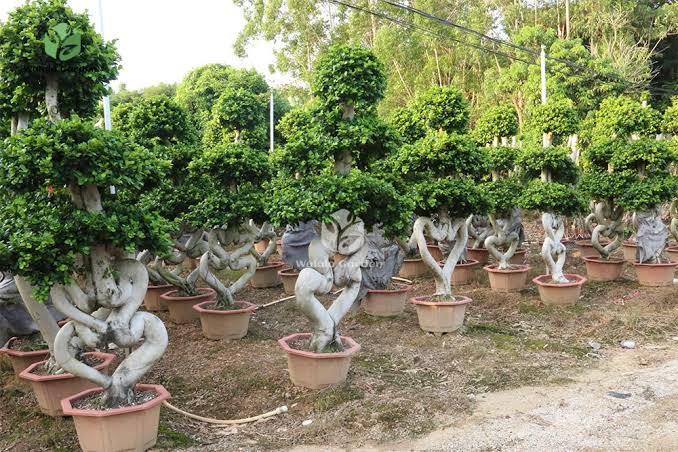
Creating a heart shaped bonsai is not a matter of simply bending a tree into a heart outline. It requires careful planning, the right species, and years of patient training. There are two primary methods used to achieve this form.
The first method involves wiring and bending the trunk itself. A young, flexible tree is wrapped with wire and gradually bent into the two curves that form the top of the heart, with the bottom point created by the natural meeting of the two sides. This technique works best with species that have pliable trunks and grow relatively quickly, such as ficus, Chinese elm, or juniper.
The second method uses grafting and branch manipulation. Two separate trees are grown side by side and grafted together at the base, then trained to curve outward and meet at the top, forming the heart shape. This approach is more complex and time-consuming but can produce a more symmetrical and defined heart.
In some cases, growers combine both techniques, using wiring to shape the main curves and grafting to refine the details. The result, after years of careful work, is a bonsai that clearly and unmistakably resembles a heart.
Choosing the Right Species
Not every tree is suitable for heart shaped bonsai. The ideal species has a flexible trunk, grows vigorously enough to recover from bending, and produces small leaves that suit the miniature scale of bonsai. Ficus species, particularly Ficus microcarpa and Ficus benjamina, are among the most popular choices because they respond well to wiring and can be grown indoors in most climates.
Chinese elm is another excellent option, prized for its small leaves, fine branching, and tolerance for pruning. Junipers are sometimes used as well, though their rigid wood makes bending more challenging. For growers in tropical climates, bougainvillea can be trained into a heart shape, and its colorful bracts add an extra layer of visual appeal.
The choice of species also affects how long the process takes. Fast-growing species like ficus may achieve a recognizable heart shape in three to five years, while slower-growing species can take a decade or more.
The Training Process Step by Step
Creating a heart shaped bonsai begins with selecting a young tree with a healthy, flexible trunk. The grower then decides on the size and proportions of the heart, which will guide all subsequent training decisions.
The first step is to wire the trunk. Aluminum or copper wire is wrapped around the trunk at a forty-five-degree angle, providing the support needed to hold the bends in place. The trunk is then carefully bent into the first curve of the heart. This bend is made slowly and gradually, with the grower supporting the inside of the curve to prevent cracking.
Once the first curve is set, the trunk is bent in the opposite direction to create the second curve. The two curves meet at the top to form the heart’s lobes, while the base of the tree forms the point. The wired tree is then left to grow for several months while the wood adapts to its new shape.
After the trunk has set, the wire is removed. Branches are then trained and pruned to fill out the heart shape and create a balanced silhouette. This stage requires ongoing attention, as new growth must be directed to maintain the form. Over time, the trunk thickens, the bark matures, and the heart shape becomes more defined.
The Challenges of Heart Shaped Bonsai
Heart shaped bonsai is not a beginner’s project. The technique requires experience with wiring and bending, and mistakes can damage or kill the tree. Bending too aggressively can snap the trunk. Leaving wire on for too long can cause it to bite into the bark, leaving permanent scars. Inconsistent pruning can allow the tree to lose its shape, undoing years of work.
The grower must also be patient. A heart shaped bonsai is not created in a single session. It is the result of years of incremental adjustments, each one building on the last. For those who are willing to invest the time, however, the reward is a living work of art that is unlike anything else.
A Gift That Grows
The heart shaped bonsai has become a popular gift for romantic occasions, and it is easy to see why. Unlike cut flowers, which wither within days, a bonsai can live for decades, growing and changing with the relationship it represents. It is a gift that requires care and attention, which makes it all the more meaningful.
Whether created as a personal project or given as a symbol of affection, the heart shaped bonsai represents the intersection of art, horticulture, and human emotion. It is a reminder that living things can be shaped by patience and care into forms that carry deep personal meaning.
