

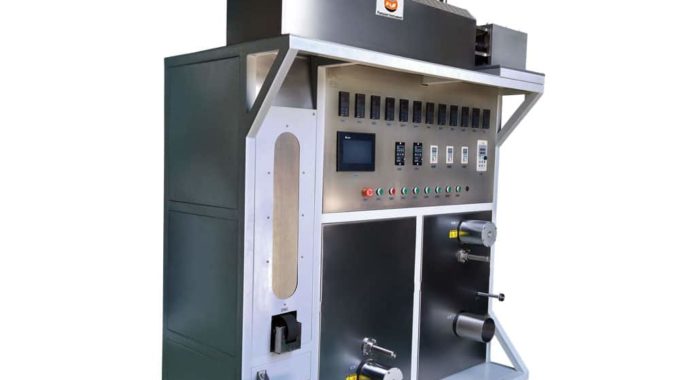
Lab Roving Machine is an essential piece of equipment used in textile laboratories to prepare roving from fiber sliver. Unlike industrial roving frames that are designed for large-scale production, a lab roving machine focuses on accuracy, control, and consistency. It allows researchers, students, and technicians to study the spinning process under controlled conditions.
This machine plays a key role in converting loose sliver into uniform roving by applying drafting and twist. The produced roving is then ready for the next step, usually ring spinning. Because of its compact size and flexible operation, it is widely used in universities, research institutes, and quality testing laboratories.
Purpose of a Lab Roving Machine
The primary purpose of a lab roving machine is to draft and twist fiber sliver into roving. Sliver is weak and unstable, while roving has better structure and strength. This transformation helps prepare fibers for yarn production.
With this machine, users can:
- Control draft ratios
- Adjust twist levels
- Study fiber alignment
- Observe winding behavior
- Analyze roving quality
It ensures that the roving produced in the lab closely matches industrial standards.
Importance of Textile Education
In textile education, practical learning is very important. A lab roving machine gives students hands-on experience with drafting and twisting operations. By working with real fibers, they can understand how machine settings affect roving quality.
Students learn about:
- Roller drafting systems
- Spindle and flyer rotation
- Twist insertion
- Bobbin formation
This experience helps prepare them for real spinning mills and production environments.
Role in Research and Development
Textile research focuses on improving yarn quality and testing new materials. A lab roving machine allows researchers to experiment without using large amounts of raw fiber. It supports:
- Testing new fiber blends
- Comparing different silver qualities
- Studying roving strength
- Developing improved spinning techniques
By using laboratory-scale equipment, researchers can predict how materials will behave in industrial production.
Cotton and Wool Processing
Lab roving machines are available for different fiber types. Cotton roving machines are designed for short-staple fibers, while wool roving machines are suitable for long fibers.
Cotton lab roving machines are used to:
- Convert cotton sliver into roving
- Prepare material for ring spinning
- Maintain even thickness
Wool lab roving machines are used to:
- Handle long fibers gently
- Produce stable wool roving
- Support worsted spinning systems
Both systems help maintain fiber structure and improve spinning performance.
Modern Machine Features
Most modern lab roving machines are equipped with advanced technology that ensures precise and easy operation:
PLC and Touch Screen Control
Allows users to enter technical parameters digitally and monitor machine performance in real time.
Servo Motor Drive
Provides stable speed control and accurate spindle rotation.
Modular Drive Design
Independent drives for drafting and spindle improve machine efficiency and reduce mechanical stress.
Lightweight Frame
An aluminum body with wheels allows easy movement inside laboratory spaces.
Low Friction Drafting System
Reduces resistance during fiber movement and improves energy efficiency.
Advantages Over Industrial Roving Frames
Compared to industrial roving frames, lab roving machines offer:
- Small-scale production
- Easy parameter adjustment
- Minimal fiber waste
- Lower energy consumption
- High precision
These advantages make them ideal for laboratory and testing environments.
Integration in Spinning Laboratories
A lab roving machine is usually part of a complete spinning laboratory system that includes:
- Carding machines
- Drawing frames
- Ring spinning machines
This setup allows full process testing from fiber to yarn and helps analyze the effect of roving quality on final yarn performance.
Maintenance and Long-Term Use
Lab roving machines are designed for regular use in laboratories. Their construction allows:
- Easy cleaning
- Quick replacement of spare parts
- Simple parameter resetting
- Long operational life
This makes them cost-effective for educational institutions and research facilities.
Industrial Benefits
Manufacturers use lab roving machines to reduce risks in production. By testing materials in the lab, they can:
- Improve yarn strength
- Optimize twist levels
- Reduce material waste
- Ensure stable production quality
This approach helps improve efficiency and product reliability.
FAQs
Q1: What is a Lab Roving Machine used for?
A Lab Roving Machine is used to convert fiber sliver into roving for testing, research, and training purposes.
Q2: Can it process wool fibers?
Yes, special models are designed for processing wool and other long fibers.
Q3: Is it suitable for students?
Yes, it is widely used in textile universities for practical training and experiments.
Q4: How is it different from industrial roving frames?
Lab roving machines focus on accuracy and flexibility, while industrial roving frames focus on high-speed mass production.
Q5: Where can I buy a reliable lab roving machine?
You can find professional models of Lab Roving Machine here:
Lab Roving Machine
