

Solar works best when it is designed around the household rather than sold as a fixed bundle. Roof area matters, but so do shade, orientation, daytime demand, tariff and plans for an electric car or heat pump. A well-designed solar panel and battery installation balances generation, storage and consumption instead of chasing the largest possible array. That gives the homeowner a realistic view of what the system can produce and how the electricity may be used.
Photovoltaic panels generate direct-current electricity from daylight. An inverter converts it into alternating current for the home. Appliances use the solar power first; any surplus can charge a battery or be exported to the grid. When generation falls, the home draws from the battery if energy is available, then imports from the network. The process is automatic, but the design choices behind it determine how useful the system feels.
Solar Panel and Battery Installation: Using More of Your Own Power
A battery can move midday generation into the evening, when many homes cook, heat water and use entertainment equipment. It may also charge from the grid at cheaper times if the tariff and equipment support that strategy. The financial result depends on the difference between import and export prices, battery efficiency, usable capacity and how frequently the stored energy cycles.
Capacity should reflect evidence. An installer can review annual bills or half-hourly smart-meter data to estimate daytime consumption and surplus generation. A very small battery may fill quickly and leave useful solar energy to export. An oversized unit may sit partly empty for much of the year. Future changes matter too. An EV, electric hot-water diverter or heat pump can alter the load profile.
Ask whether the battery can provide backup during a power cut. Many standard systems shut down with the grid for safety, even when panels are producing. Backup requires compatible equipment and a designed circuit arrangement; it should never be assumed from the word “battery”. Also check indoor or outdoor location limits, temperature requirements, warranty throughput and fire-safety guidance.
Smart Energy Homes presents solar, storage, heat pumps and smart tariffs as parts of one home-energy system. That joined-up view is useful. It does not mean every household needs every technology on day one. A modular design can allow sensible expansion later without paying for capacity that has no current job.
Solar PV Installation: From Roof Survey to Commissioning
A proper solar PV installation begins with the roof. The survey considers available area, orientation, pitch, shading, roof covering and access. Structural condition matters because panels add load and are intended to remain in place for years. Fragile tiles, ageing felt or an awkward loft should be understood before mounting starts.
Shading deserves more than a glance. A chimney, dormer, tree or neighbouring building may affect different modules at different times. Design software can model the annual effect. Optimisers or microinverters may help in some layouts, but they add components and cost. They are not a substitute for honest yield modelling.
The electrical survey checks the consumer unit, earthing, meter position and cable route. The inverter should have suitable ventilation and remain accessible. Battery equipment needs its own location and clearances. Agree these positions before signing; moving equipment after installation can be disruptive.
The proposal should include an estimated annual yield, assumptions and losses. It is a forecast, not a guarantee of sunshine. Compare quotes using similar assumptions rather than the largest kWh figure. Ask whether degradation, shading and inverter losses are included and what weather dataset supports the estimate.
On fitting day, roof anchors must suit the structure and weatherproofing details. Panels should align neatly without compromising drainage or access. DC and AC cabling needs mechanical protection and clear isolation. After installation, the engineer tests the system, configures monitoring and explains safe shutdown. The homeowner should receive commissioning records, warranties, datasheets and a clear schematic.
Solar Panel Installation UK: Standards, Permissions and Export
For solar panel installation UK projects, many domestic roof-mounted arrays can fall within permitted development, but conditions apply and rules vary by nation, property and location. Listed buildings, conservation areas, flat roofs and ground-mounted arrays may require additional checks. The installer should identify uncertainty, while the owner remains responsible for ensuring the necessary permission is in place.
MCS certification is widely important for consumer protection and access to export arrangements. The Smart Export Guarantee requires participating electricity suppliers to offer eligible small generators a tariff above zero for exported power, but suppliers set their own rates, terms and evidence requirements. A suitable smart or export meter is normally needed. Compare tariffs after checking whether they require the import supply, a particular installer or specific equipment.
Grid connection is another practical step. Smaller systems may be notified after installation under the relevant process, while larger export capacity can require approval in advance from the distribution network operator. A battery does not automatically remove that requirement. Export limitation can be designed where appropriate, and the quote should say who manages the application.
Consumer protection also includes workmanship and product warranties. Panels, inverter, battery and installation may each have different terms. Keep copies of serial numbers and registration confirmations. Understand whether monitoring access relies on a cloud service and what basic operation remains available if the app changes.
Solar Panel Installation Company: Questions Worth Asking
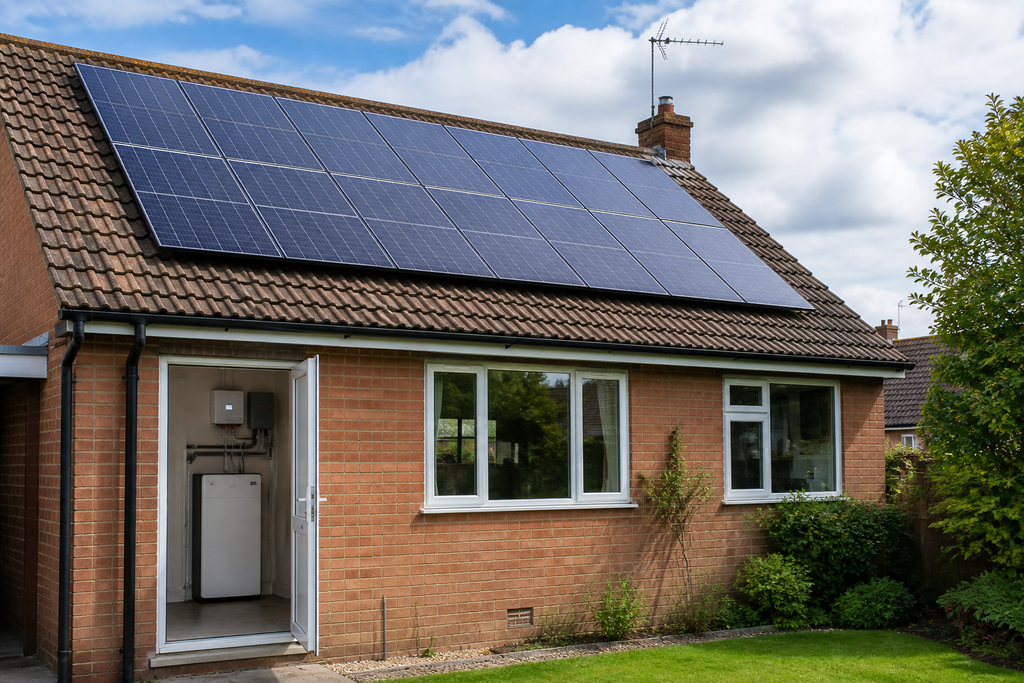
A credible solar panel installation company can explain why the proposed array has that size, why the inverter matches it and what the battery is expected to do. The conversation should include limitations as well as benefits. North-facing roof sections, regular shading or unusually low electricity use may change the recommendation.
Before committing, ask for the following in writing:
• panel, inverter and battery makes, models and warranties;
• roof layout and equipment locations;
• annual generation estimate with assumptions;
• battery usable capacity and backup capability;
• scaffolding, grid paperwork and commissioning scope;
• deposit protection, workmanship cover and aftercare;
• total price, payment stages and any finance terms.
Do not judge a proposal solely by cost per panel. Higher-wattage modules are not automatically better if the layout is poor, and a low quote can omit scaffolding, bird protection, monitoring or electrical upgrades. Compare the complete system and the service behind it.
Monitoring should become useful rather than obsessive. In the first weeks, learn the normal relationship between weather, generation and household demand. Check for obvious faults, but do not expect identical output every day. Seasonal variation is large in the UK. A good installer explains what normal looks like and provides a route for support when performance changes unexpectedly.
Smart Energy Homes designs and installs solar and battery systems across Wales and England, from the energy assessment through commissioning. Its published service emphasises storing surplus for evening use, reducing peak-time purchases and combining technologies where that suits the home. The strongest solar panel installation is not a roof covered with the maximum number of modules. It is a documented, safe system whose output, storage and tariff strategy make sense for the people living beneath it.
