

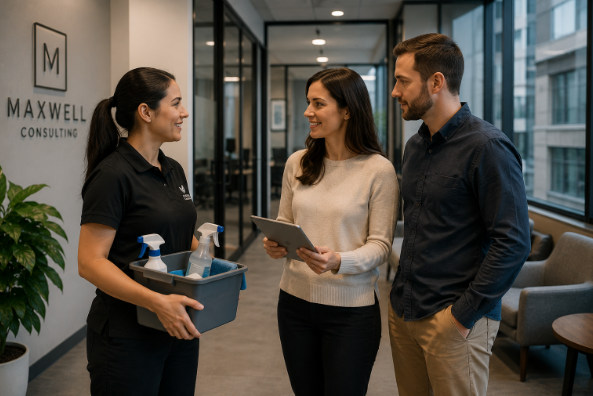
The first cleaning company I ever hired for a commercial space seemed fine on paper. Reasonable pricing, friendly on the phone, showed up when they said they would. I signed a three-month contract without asking nearly enough questions, which I realized about six weeks in when I started noticing things. The washrooms were being cleaned but not really sanitized. The kitchen area looked wiped but smelled like it hadn’t been properly addressed in longer than I could pinpoint. And there was a particular corner of the open office, behind the last row of desks, near the window, that I eventually realized nobody had touched since the contract started.
When I raised it, the response was polite and not much changed. I finished the contract and didn’t renew it.
What I learned from that experience is that choosing a commercial cleaning company is genuinely not a commodity decision, even though it gets treated like one constantly. The price per visit is the least important number in the conversation. What matters is whether the company you hire actually understands your environment, builds a program around what it specifically needs, and delivers consistently enough that you stop thinking about it; which is, ultimately, the goal.
Getting there requires asking better questions than most people ask at the beginning of the process.
The First Question Is About the Onsite Visit: Not the Quote
Here is the simplest filter for separating serious commercial cleaning providers from ones who are going to disappoint you: ask whether they will conduct an onsite visit before proposing a cleaning plan.
A cleaning company that quotes a commercial space over the phone, based on square footage and a brief description, is working from assumptions. They are assuming what the high-traffic areas look like. They are assuming what the washroom count is and how they are used. They are assuming the kitchen situation, the flooring types, and the presence or absence of specialized surfaces that require particular products. They are assuming how the space is laid out and how people move through it.
Those assumptions will be wrong in ways that matter. Not dramatically wrong, but wrong enough that the cleaning program they propose will be calibrated to an office that isn’t quite the office you have. And you will feel that mismatch every time something keeps not getting addressed, every time you notice that the protocol seems to be built around a generic template rather than the actual characteristics of your space.
A provider who insists on seeing the space before proposing anything is telling you something important about how they work. They are telling you that they understand the cleaning program needs to fit the specific environment rather than the other way around. That’s the right starting disposition, and it’s worth treating its absence as a meaningful red flag.
What Training and Screening Actually Mean in Practice
Most cleaning companies will tell you their staff are trained and screened. Almost none of them will tell you specifically what that means unless you ask, and the specifics matter considerably more than the assurance.
Training, in the context of professional commercial cleaning, should mean more than familiarity with which products go where. It should mean understanding the difference between cleaning and disinfecting, which sounds basic but is a distinction that a surprising proportion of cleaning staff have never been explicitly taught. It should mean knowing how to apply disinfection products correctly, the right dwell time, the right coverage, and the right sequence to avoid recontaminating surfaces already addressed. It should mean understanding the particular protocols relevant to the types of environments the company services, whether that’s medical-adjacent offices with specific hygiene requirements, food-adjacent spaces, or standard professional office environments.
Screening matters for a different reason. Commercial cleaning staff have access to your building, often outside of normal business hours. They are in your office when your computers are unlocked, when sensitive documents are on desks, and when the physical security of the space depends entirely on the trustworthiness of the people cleaning it. A company that backgrounds checks its staff, maintains insurance, and has clear accountability structures for what happens if something goes wrong is not the same as a company that assures you things are fine without being able to say specifically how they know.
Ask what the training program looks like. Ask what the screening process involves. The answers tell you a great deal about how seriously the company takes the work.
Red Flags That Are Easy to Miss Until You’re Already Committed
A few things come up repeatedly when business owners talk about cleaning contracts that didn’t work out, and they tend to be things that were visible before the contract was signed if you knew to look for them.
Vague pricing is one. A quote that gives you a monthly total without any breakdown of what’s included, how many visits, what scope each visit covers, or what is and isn’t part of the standard service is a quote designed to be interpreted in the provider’s favor when disagreements arise. “We clean your office” is not a service description. It’s an open question about what “clean” means and who decides when it’s been achieved.
No customization is another issue. A provider who presents you with a standard package, the same scope and schedule they offer every client at a similar price point, is not building a program around your space. They’re fitting your space into their program. For some businesses in some environments, the standard package will happen to be close enough to what’s needed that it works reasonably well. For most, the mismatch will show up somewhere, and it will show up in the particular areas of your space that the standard package wasn’t designed to address.
Inability to name specific products is a third. A cleaning company that can’t tell you what products they use, why they chose them, and what those products are effective against is either using whatever happens to be cheapest or hasn’t thought carefully about the relationship between product selection and cleaning outcomes. Either way, it’s not a great sign. Professional commercial cleaning involves deliberate product choices made for specific reasons. Providers who do this well can explain those choices clearly.
Experience in Your Specific Type of Environment
This comes up less often in the initial conversation than it should. Businesses ask whether the cleaning company has experience generally, how long they’ve been operating, how many clients they have, whether they have references. Fewer businesses ask whether the company has specific experience in environments similar to theirs.
It matters. A company that primarily services retail spaces brings a different base of experience to a professional services office than one that has been cleaning law firms and financial services companies for years. A company that knows industrial environments well may not have the same sensitivity to the presentation standards that matter in a client-facing professional space. The questions aren’t complicated: what types of environments do you primarily service, can you give me references from businesses similar to mine, and what would you do differently for my space compared to a typical office of similar size?
The answers will quickly tell you whether you’re talking to someone who has actually thought about what your specific environment requires or whether they’re adapting a general answer to whatever they think you want to hear.
The Contract Conversation: What to Pin Down Before Signing
Commercial cleaning contracts have a way of feeling more specific than they are, and the gaps in specificity are usually where problems live. Before signing anything, it’s worth making sure a few things are clearly stated rather than implied.
Frequency and scope for each visit should be explicit. Not regular cleaning but a specific description of what happens on each type of visit, which areas are covered, what the protocol is for each area, and what distinguishes a standard visit from a deep clean if both are included in the program.
The communication and feedback process should be clear. If something isn’t being done to standard, who do you contact? What’s the expected response time, and what happens if the issue recurs? A provider with no clear answer to this question is one you’ll find yourself in frustrating email exchanges with six months from now.
Insurance and liability coverage should be confirmed and documented. If a cleaning staff member damages something in your space, or if something goes wrong during after-hours access, what is the company’s coverage, and what is your recourse?
These aren’t adversarial questions. A good cleaning provider will have clean answers to all of them because they’ve built a business that accounts for these realities. The ones who get uncomfortable when you ask are usually the ones whose operation isn’t quite as professional as the sales conversation suggested.
What Separates Good From Actually Great
After everything above is accounted for, the onsite visit, the trained and screened staff, the specific products, the relevant experience, and the clear contract, what actually separates a professional cleaning service that does its job from one that genuinely changes the experience of your commercial space?
Consistency over time is the real answer. It’s not difficult for any reasonably competent cleaning company to do an impressive first clean. The space is new to them; they’re motivated to make a good impression, and the standard is set in a context of maximum effort. What separates genuinely professional commercial cleaning services from the rest is whether the standard that was present on the first visit is still present six months later, a year later, when the novelty of a new client relationship has long since passed and the work has become routine.
That consistency comes from systems, training systems, accountability systems, and quality check systems that exist independently of which particular staff member happens to be on the job on a given day. A company with those systems holds its standard. One without them delivers well when things line up and inconsistently when they don’t.
The businesses across Toronto and the GTA that have been with the same cleaning provider for years, that genuinely don’t think about their cleaning arrangement because it simply works, are with providers who have those systems. That’s what elite cleaning services built around professional standards look like from the inside: not a service you manage and monitor, but one you trust and forget about, in the best possible way.
I’ve had both kinds. The difference is not subtle.
