

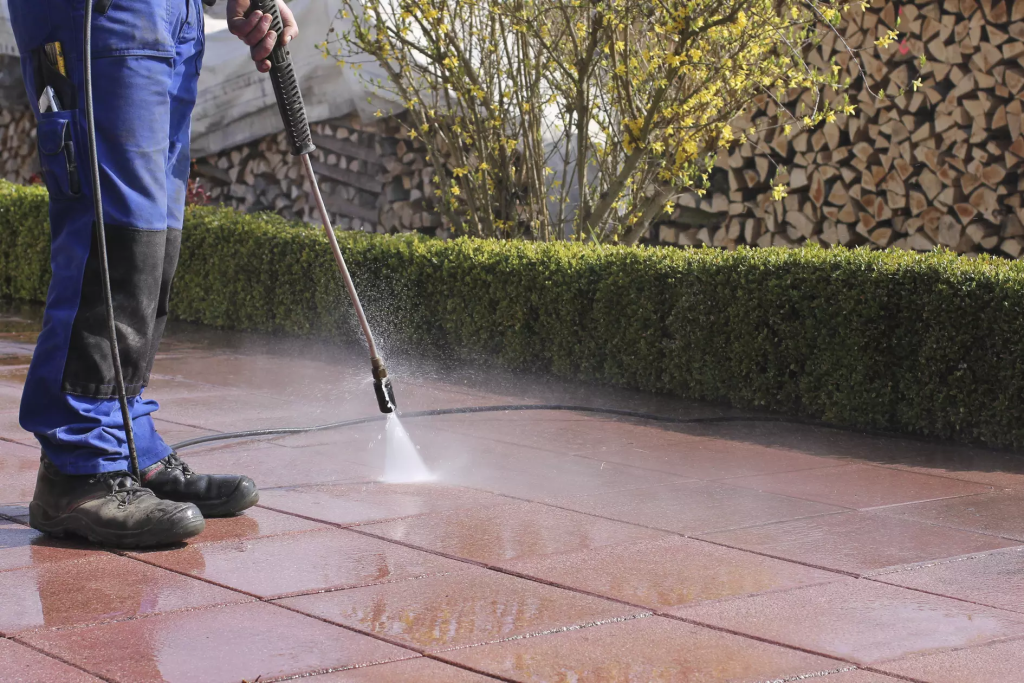
There are few home maintenance jobs as instantly satisfying as watching years of grime lift off a patio in a single sweep. That satisfaction has fuelled a genuine boom: pressure washing videos rack up billions of views on social media, and sales of domestic machines have climbed steadily as homeowners chase the same before-and-after effect at home.
Behind the viral clips, though, sits a job with more nuance than the marketing suggests. Done well, a pressure wash restores block paving, patios, render and decking to something close to new condition. Done badly, it strips pointing from between blocks, etches lines into soft stone, forces water behind render and turns timber decking furry. The difference lies in pressure, technique and knowing when the job needs more than enthusiasm.
Pressure ratings tell part of the story. Domestic machines typically deliver between 100 and 150 bar, adequate for cars, furniture and light patio cleaning. Professional units run far higher, but professionals rarely lean on raw pressure alone. A proper pressure wash of a large driveway usually combines a rotary surface cleaner, which cleans evenly without the tiger striping left by a hand lance, with appropriate detergents and, crucially, re-sanding and sealing afterwards. Blasting the kiln-dried sand out of block paving joints without replacing it is the most common DIY mistake, and it leaves paving loose and weeds delighted.
Surface type dictates approach. Concrete and clay block paving tolerate fairly high pressure. Natural stone such as Indian sandstone is softer and can be permanently scarred by a narrow jet held too close. Timber should only ever be washed at low pressure with the grain, and render lower still, since water driven behind a rendered wall creates damp problems that cost far more than the cleaning saved. Black spot lichen, the stubborn dark speckling on older patios, often resists pressure entirely and responds better to specialist biocide treatments.
There is a safety dimension that surprises people. Professional washers can cut skin, and even domestic machines fling debris at speed, so eye protection is not optional. Ladders and pressure lances are a poor combination, which is why roof and gutter cleaning has largely moved to telescopic and softwash systems.
Timing matters too. Spring remains the peak season, clearing winter algae before garden furniture comes out, but autumn cleaning has a strong case: removing the organic film before winter reduces the frost damage and slipperiness that make paths hazardous by January. Slip risk is no small matter, as algae-coated paving is a leading cause of garden falls among older residents.
For larger properties, communal areas and business premises, scale changes the calculation. Car parks, forecourts and extensive paths involve water management, wastewater regulations and equipment beyond domestic kit, which is why managing agents typically schedule a contracted pressure wash programme once or twice a year rather than reacting when surfaces turn green.
The economics favour maintenance either way. Replacing a driveway runs to thousands of pounds; keeping one clean and sealed costs a small fraction of that and extends its life considerably. The pressure washing boom may have been driven by oddly satisfying videos, but the habit it built is a sound one. Surfaces, like most things around a home, last longest when they are looked after, and few jobs repay an afternoon’s effort quite so visibly.
