

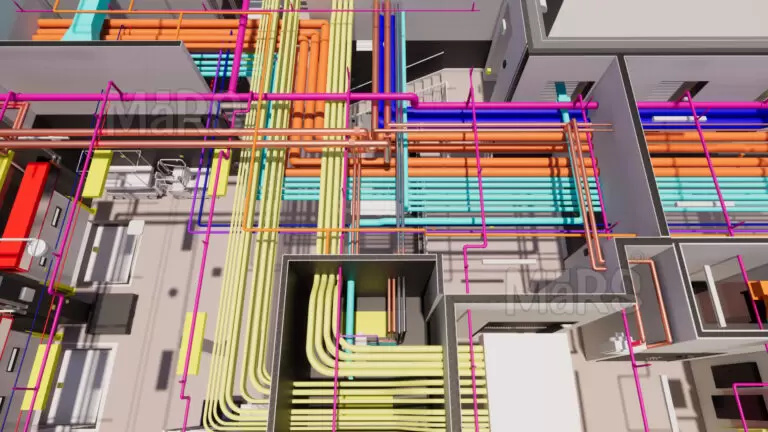
A modern building is made up of many systems that must work together. Mechanical equipment provides heating, cooling, and ventilation. Electrical systems supply power and lighting, while plumbing networks handle water and drainage. Although these systems perform different jobs, they often need to occupy the same limited spaces inside a building.
This makes coordination extremely important.
When mechanical, electrical, and plumbing systems are not properly coordinated, problems can appear during installation. Pipes may interfere with ducts, electrical components may compete for the same space, or equipment may become difficult to access for future maintenance.
MEP BIM Services provide a digital way to manage these challenges before they become expensive site problems.
Understanding MEP BIM
MEP BIM focuses specifically on creating detailed digital models for mechanical, electrical, and plumbing systems. These models show where components are located and how they interact with other systems and building elements.
Rather than checking each discipline separately, project teams can review them together within a coordinated 3D environment.
This makes it easier to understand complicated building services and identify issues at an early stage.
Why MEP Systems Need Careful Coordination
MEP systems often have to fit into ceilings, walls, service shafts, plant rooms, and other restricted areas. There may be very little room for error.
Imagine a large ventilation duct running through a ceiling space where electrical cable trays and water pipes also need to pass. If these elements are not coordinated before installation, workers may discover that they cannot all fit as planned.
Such a situation can lead to redesign, delays, extra labor, and material waste.
With MEP BIM Services, teams can review the systems digitally and make necessary adjustments before construction begins.
A More Practical Way to Manage MEP Design
MEP BIM is useful because it changes when problems are discovered. Instead of waiting until installation, project teams can examine potential issues during the design and coordination stage.
What a Coordinated MEP Model Can Show
A coordinated model can help professionals understand:
- Where mechanical equipment will be installed.
- How ducts will move through different building areas.
- Where electrical systems and cable trays will be positioned.
- How plumbing pipes will connect and travel through the structure.
- Whether different services have enough space for installation.
- Whether important equipment remains accessible after installation.
- How different systems interact with architectural and structural elements.
- Which components may require changes before construction.
- Where prefabricated elements may be suitable.
- How the completed systems can be documented for future use.
These details can make a major difference when construction teams move from drawings to physical installation.
Clash Detection Can Prevent Expensive Site Problems
Clash detection is one of the most practical applications of MEP BIM.
A clash occurs when two or more building components interfere with each other. In a complex project, hundreds of components may need to share limited space. Finding every possible conflict through traditional drawings can be difficult.
A coordinated digital model gives teams an opportunity to identify these conflicts earlier.
For instance, a plumbing pipe might cross the path of an HVAC duct. Rather than discovering the issue when both systems are being installed, the design team can identify the conflict digitally and adjust the layout.
Early corrections are usually easier than changes made after construction has started.
Making Installation More Efficient
Accurate planning can make installation easier for contractors and site workers. When the position and relationship of different MEP components are already understood, teams have a clearer idea of what needs to be installed and where.
This can reduce confusion on-site and minimize unnecessary modifications.
Better coordination can also help contractors plan the sequence of installation. This is particularly useful when several systems need to be installed within the same area.
The result is a workflow that can be more organized and predictable.
Supporting Prefabrication
Prefabrication is another area where MEP BIM can provide significant value. Instead of producing every component on-site, certain assemblies can be prepared in a controlled environment and transported to the building for installation.
However, prefabrication depends heavily on accurate dimensions and coordination.
A detailed MEP model can provide information about sizes, connections, locations, and relationships between components. This can help teams determine which elements are suitable for prefabrication.
When prefabricated components arrive on-site with the correct information behind them, installation can become faster and more efficient.
Reducing Material Waste and Rework
Construction waste is often connected to poor planning. When materials are ordered incorrectly or systems need to be redesigned after installation, companies may lose both time and money.
MEP BIM can help reduce this risk by allowing teams to review designs before physical work begins.
Better coordination can reduce the likelihood of unnecessary changes and help teams make more informed decisions about materials.
Although BIM cannot remove every construction risk, it provides a stronger planning process that can reduce many avoidable problems.
Improving Communication Across Disciplines
MEP projects involve several professionals, and each discipline has its own technical requirements. Electrical engineers, mechanical engineers, plumbing professionals, architects, structural engineers, and contractors all need to coordinate their work.
A shared 3D model can make these discussions easier.
Instead of relying only on technical drawings and verbal explanations, teams can review the actual spatial relationship between systems. This can help everyone understand the same design and identify areas that require attention.
Better communication can also reduce misunderstandings between design and construction teams.
Supporting Long-Term Building Management
MEP BIM is not only useful before and during construction. The information contained within a coordinated model can also support building operations after completion.
Facility managers may need to locate equipment, understand system layouts, plan maintenance, or investigate problems in the future.
Reliable digital information can make these tasks easier. Instead of searching through multiple old drawings, facility teams can use organized project information to better understand building systems.
This makes MEP BIM valuable throughout the building lifecycle.
MEP BIM and the Future of Construction
Construction is becoming increasingly digital. Clients expect better quality, faster delivery, and greater control over project costs. At the same time, building systems are becoming more advanced and complex.
MEP BIM fits naturally into this changing environment.
It gives project teams a structured way to visualize systems, coordinate different disciplines, identify clashes, support prefabrication, and prepare reliable documentation.
As more construction companies adopt digital workflows, MEP BIM is likely to become an increasingly important part of successful building projects.
Conclusion
MEP BIM Services provide a practical approach to managing the complicated mechanical, electrical, and plumbing systems found in modern buildings. By creating accurate digital models, project teams can identify conflicts earlier, improve installation planning, reduce rework, and communicate more effectively.
The benefits can continue beyond construction through better documentation and facility management support. For projects where multiple building systems must work together within limited spaces, BIM Services offer a smarter way to coordinate the work before problems reach the construction site.
