

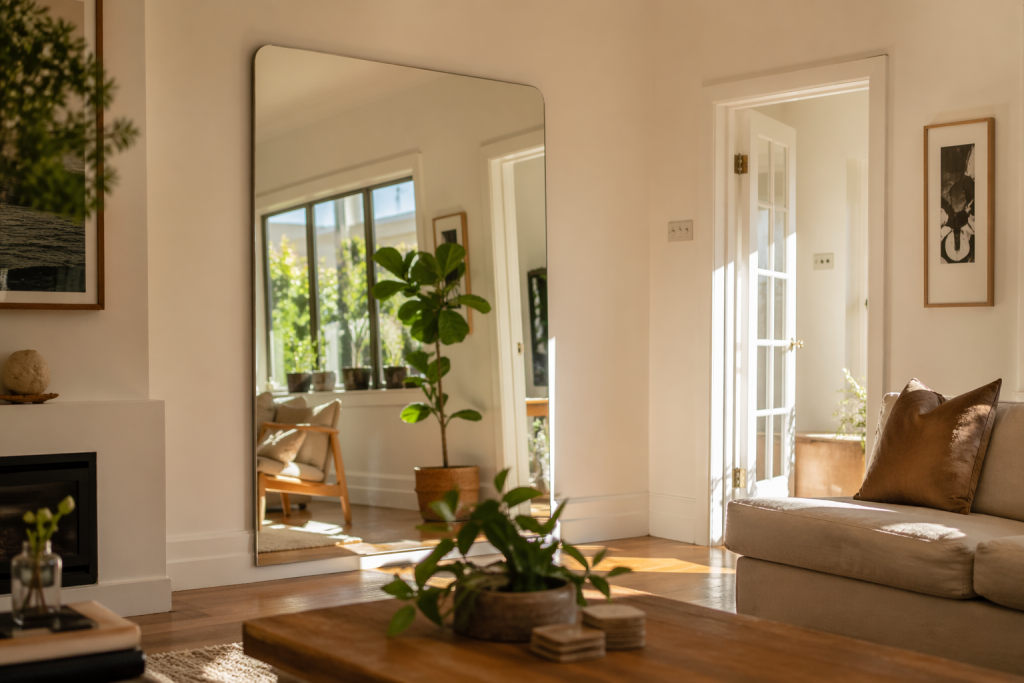
Most people spend very little time thinking about mirrors until they need one. Then suddenly the decisions multiply. Size, shape, placement, finish, whether to go custom or standard. In a city like Cape Town, where interiors range from compact apartments in the city bowl to open-plan homes along the coast, those decisions carry more weight than they might seem to at first.
A mirror is not just glass on a wall. It is one of the few design elements that actively changes how a space functions, not just how it looks.
How Mirrors Affect the Feel of a Room
Light behaves differently in every room. Some spaces catch morning sun and lose it by midday. Others feel permanently dim regardless of the time. A well-placed mirror intercepts available light and pushes it further into the room, reducing the need for artificial lighting during the day and making spaces feel warmer and more alive.
The effect on perceived size is equally significant. A large mirror positioned across from a window can effectively double the visual depth of a room. In smaller homes or narrow passages, that difference is immediately noticeable. The space does not change physically, but the experience of being inside it changes completely.
What Interior Designers Know That Most Homeowners Miss
Designers treat mirrors the way architects treat windows. Placement is everything. A mirror that sits in the wrong position does not just fail to help. It can make a space feel awkward or unsettled. The angle of reflection, the relationship to natural light sources, and the proportion relative to surrounding furniture all influence whether a mirror improves a room or simply occupies wall space.
Precision matters here more than most people expect. A mirror that is two centimeters too wide for its intended position, or cut with uneven edges, disrupts the visual order of an entire wall. That is why the measurement and installation process matters as much as the mirror itself.
The Case for Custom Over Standard
Standard mirror sizes exist because they are convenient to manufacture and stock. They are not designed with any particular space in mind. For straightforward applications in conventional rooms, a standard mirror can work perfectly well. For anything more specific, custom cutting is almost always the better option.
Odd-shaped walls, tight alcoves, unusually proportioned bathrooms, and retail environments with specific display requirements all benefit from mirrors made to exact measurements. Custom options like Mirrors in Cape Town allow homeowners, designers, and business owners to specify dimensions, edge finishes, and backing materials rather than working around whatever happens to be available off the shelf.
The result is a mirror that fits the space rather than a space adjusted to fit the mirror.
Mirrors in Commercial and Retail Settings
In business environments, mirrors serve practical purposes that go beyond aesthetics. Retail stores use them to help customers view products from multiple angles, to create a sense of openness in compact floor plans, and to make the overall environment feel more considered and professional.
Gyms and fitness studios rely on full-length mirrors for functional reasons. Clients need to monitor form and movement. The mirrors need to be large, clear, and securely installed. A poorly fitted mirror in a high-traffic commercial space is not just an aesthetic problem. It is a safety concern.
Offices benefit from mirrors in subtler ways. A well-placed mirror in a reception area or meeting room adds depth and reduces the closed-in feeling that smaller commercial spaces often produce. The effect is modest but consistent.
Glass Services That Go Beyond the Mirror
Mirror installation sits within a broader category of glass work that many Cape Town properties require. Shower enclosures, glass balustrades for staircases and balconies, and shopfront panels all involve similar considerations around measurement, material quality, and installation precision.
Frameless shower glass has become a standard feature in modern bathroom design. It is easy to clean, visually open, and durable when installed correctly. Glass balustrades offer the same combination of safety and visual lightness, allowing light to move through a staircase or balcony without the visual weight of solid barriers.
Each of these applications requires the same foundational qualities: accurate measurement, quality materials, clean finishing, and installation that holds over time.
What Separates Good Installation From Poor Installation
The difference between a well-installed mirror and a poorly installed one is rarely obvious on day one. It shows up later. Edges that were not properly polished begin to catch and chip. Backing that was not suited to moisture starts to break down in bathrooms. Fixings that were not matched to the wall type work loose over time.
Good installation begins before the mirror goes up. It starts with accurate on-site measurement, continues with material selection suited to the specific environment, and ends with a finish that looks clean and holds its integrity over years of daily use.
A Practical Element That Earns Its Place
Mirrors are not a trend. They have been a functional part of interior design for long enough that their usefulness is well established. What changes over time is the quality of materials available, the precision of cutting and installation, and the range of applications people use them for.
In Cape Town, where design sensibility tends toward the clean and functional, mirrors fit naturally into both residential and commercial spaces. The key is choosing the right one for the right place, and making sure it is installed in a way that does the job properly.
That is not a complicated idea. It is just one that rewards doing well.
