

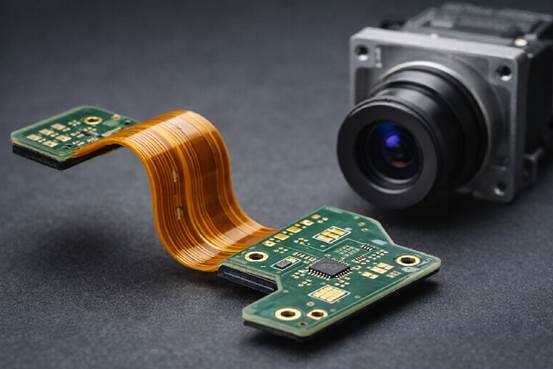
In modern vehicles, electronic systems are smaller, smarter, and more integrated. Designers must fit complex circuits into limited spaces exposed to heat, vibration, and movement. That is why many engineers rely on automotive rigid flex PCB—a hybrid board combining rigid FR-4 with flexible polyimide layers. This structure lets the PCB fold, fit, and function reliably in harsh automotive environments without sacrificing signal integrity or stability.
Why Automotive Electronics Need Rigid-Flex Designs
Automotive design pushes printed circuits to the limit. Whether it’s ADAS cameras, radar modules, LED lighting, or battery management systems, every electronic unit must withstand constant vibration, extreme temperatures, and long service life.
Rigid-flex PCBs meet these demands by eliminating connectors, cable harnesses, and mechanical joints, which often fail over time. The flexible sections serve as interconnects, reducing assembly steps and boosting long-term reliability. This is especially useful for EVs, infotainment systems, and any compact, lightweight subsystem.
Key Automotive Applications
1. ADAS and sensor modules: Cameras, radar, and LiDAR systems require compact, high-density PCBs that can handle data transmission and signal shielding. Rigid-flex boards allow designers to mount sensors in tight housings while maintaining controlled impedance for high-speed signals.
2. Lighting and HMI systems: Interior control panels, curved dashboards, and headlight modules benefit from flexible circuits that conform to 3D shapes, improving design freedom and reducing cable clutter.
3. Battery and power electronics: Rigid-flex boards resist thermal stress and vibration, making them perfect for battery management systems, converters, and electric drive units.
4. Infotainment and display units: Fewer connectors and simplified interconnections result in thinner, lighter assemblies that also enhance reliability and serviceability.
Engineering and Material Considerations
Designing a rigid-flex PCB for automotive use requires a careful balance between electrical, thermal, and mechanical needs. Below are several essential guidelines for a successful design.
Layer Stack-Up and Materials
Polyimide (PI) films are commonly used as flexible layers due to their heat resistance and stability. For conductors, rolled-annealed (RA) copper is preferred in dynamic bend zones due to its superior ductility. Electro-deposited (ED) copper can be used in static or semi-flex regions to reduce cost.
Copper weights typically range from 0.5 to 2 oz in flex areas and up to 4 oz in rigid sections. Choose adhesive or adhesive-free constructions based on required thermal resistance and reliability. Plan coverlay openings carefully to balance solderability and protection.
Bend-Area Design
Maintain a minimum bend radius based on layer count and copper thickness. Route traces along the bend direction, avoiding 90-degree corners. Keep vias and pads out of bend zones to prevent cracking. Step transitions and filleted copper joints relieve stress at rigid-flex interfaces.
High-Speed and EMI Control
In ADAS and radar, maintain differential pairs and impedance-controlled traces through the flex region. Use reference planes and shielding layers to minimise crosstalk and loss. Define impedance goals early and confirm with your manufacturer before production.
Assembly and Manufacturability
Rigid-flex assemblies need special panelization and folding steps. Use fixtures and controlled bends to keep geometry. Choose surface finishes such as ENIG or OSP for the required solderability. Coordinate PCB fabrication and assembly for smooth production.
From Prototype to Scalable Production
Automotive projects often move from rapid prototype to small pilot lots before mass production. Choosing a manufacturer that supports both stages is essential.
FastTurn PCB offers flexible manufacturing schedules: 72-hour prototypes, 3-day express builds, and 5–7-day standard lead times. This quick turnaround allows design teams to validate concepts, run thermal and vibration tests, and move to production without delay.
The company’s facilities can achieve a minimum trace/space of 4 mil and drill sizes as small as 0.2 mm, suitable for fine-pitch devices and dense automotive layouts. Every board undergoes AOI, ICT, and X-ray inspection to ensure IPC-A-610 compliance, which is crucial for components like BGAs and QFNs commonly used in automotive electronics.
Reliability and Environmental Testing
Automotive PCBs face tough qualification standards. They must survive wide temperature ranges, humidity cycles, and exposure to chemicals. Vibration and shock testing simulate real road conditions, verifying that solder joints and copper traces remain intact.
A well-designed rigid-flex PCB reduces stress concentration and extends fatigue life. Removing connectors and wire harnesses eliminates common failure points and improves reliability over millions of cycles.
Comparing Rigid-Flex with Traditional Harness Systems
Conventional wiring harnesses and multi-board rigid assemblies add weight and increase assembly time. Each connector or solder joint introduces a potential failure risk.
Rigid-flex solutions combine connections in a single assembly, saving space and reducing parts count. Although initial costs may be higher, overall costs drop due to faster assembly, fewer maintenance issues, and improved long-term reliability—key benefits for automotive OEMs and Tier-1 suppliers.
Selecting the Right Manufacturing Partner
When sourcing a rigid-flex PCB for automotive use, look for a supplier with proven capabilities:
- Experience with HDI, blind and buried vias, and controlled impedance structures
- Certified IPC-A-610 quality management and 100% optical/X-ray inspection
- Flexible delivery options such as rapid prototyping and short-run production
- Early engineering support for DFM, stack-up planning, and testability
- Consistent traceability and process control across batches
A qualified partner should help you optimise design, avoid costly rework, and scale smoothly from concept to production.
Conclusion: Faster Development, Stronger Designs
As vehicles increasingly integrate electronics, rigid-flex technology becomes the backbone of compact, durable designs. It enables smaller form factors, reduces wiring complexity, and enhances reliability in harsh automotive environments.
If your team is developing next-generation sensors, control modules, or EV systems, partnering with an experienced fabricator can accelerate success.
Learn how FastTurn PCB delivers quick-turn manufacturing, IPC-certified quality, and engineering support that help automotive innovators bring reliable designs to market — faster and with confidence.
