

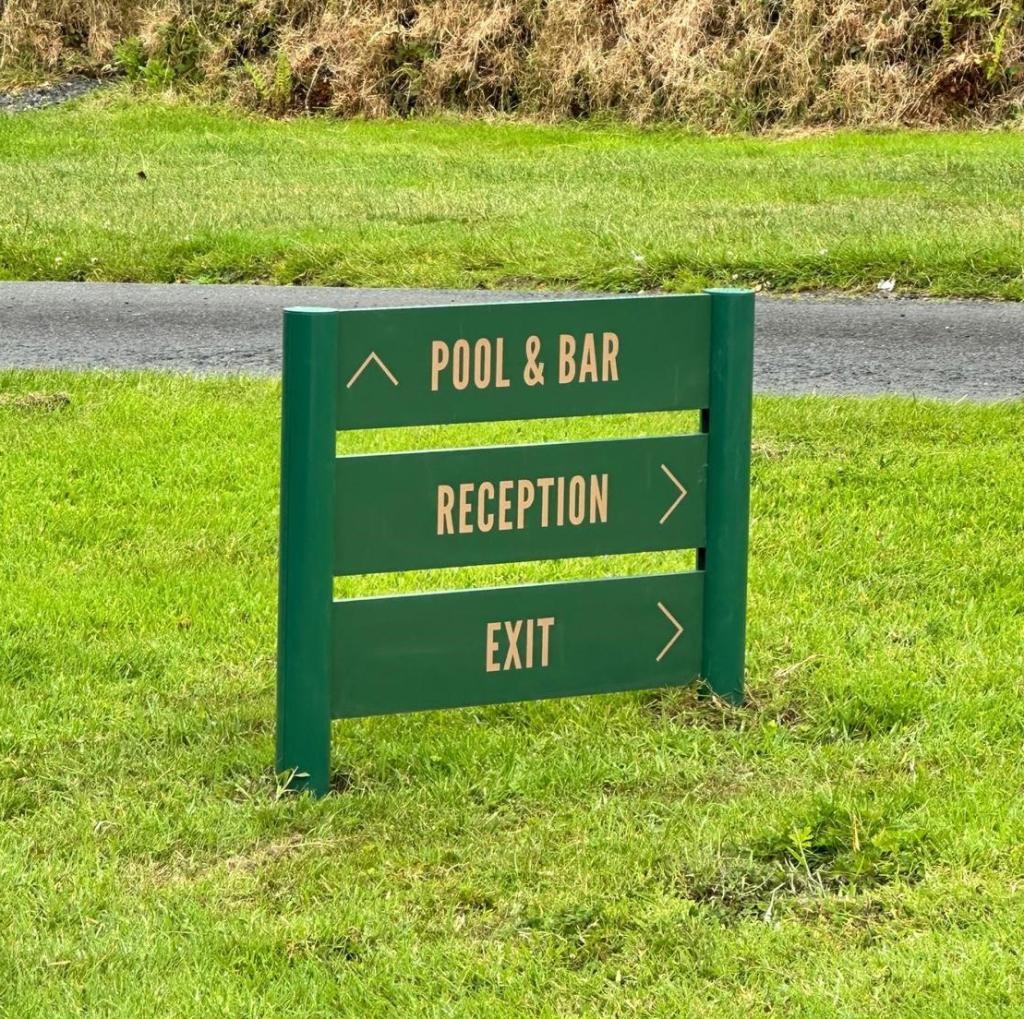
We live in a world where most people have a smartphone in their pocket and a GPS app a tap away. So why are businesses still spending money on physical directional signage? The answer is simpler than you might think: digital navigation gets you to a postcode. It does not get you to the right entrance, the correct floor, or the nearest exit in a building you have never visited before.
This gap between “arrived at destination” and “actually found where I need to go” is where physical signage earns its keep. And as businesses grow more complex, the need for clear, well-placed directional systems has only increased.
What Is Directional Signage?
Directional signage is any physical sign that helps people move through a space. That includes arrows in a car park, floor maps in a shopping centre, route markers at a hospital, and entrance signs at a university campus. The goal is always the same: reduce confusion and help people get where they are going without having to ask for help.
It sounds simple. But getting it right involves more thought than most people realise.
The Real Cost of Poor Navigation
When people cannot find their way around a building or site, businesses pay for it. Customers who cannot find a store entrance may simply leave. Hospital visitors who get lost on the way to an appointment create extra strain on staff. Students who cannot find a lecture hall arrive late and disrupted.
A study from a UK university found that poor wayfinding in healthcare settings directly added to patient stress levels and delayed appointments. In retail environments, research has consistently shown that confused customers spend less and return less often.
The cost of poor signage is rarely measured directly, but it shows up everywhere: in staff time answering “where is…” questions, in customer satisfaction scores, and in lost sales.
Why Digital Navigation Does Not Solve This
Google Maps and similar tools are excellent at outdoor navigation. They are far less useful inside buildings, in large outdoor sites with multiple access points, or anywhere that the physical layout is more complex than a street address can describe.
Even where indoor mapping technology exists, it requires the visitor to be looking at a screen while moving. Clear, well-positioned directional signage allows people to move through a space naturally, without needing to stop and check their phone at every junction.
There is also an accessibility argument. Not every visitor uses a smartphone. Older visitors, people without mobile data, and those with visual impairments that make screen use difficult all rely on physical signage to navigate safely.
What Good Directional Signage Looks Like
Effective directional signage shares a few consistent traits. It uses clear, simple language. It is positioned at decision points, the places where a person needs to choose which way to go, rather than in the middle of a straight corridor where no decision is required. It is consistent in style throughout a building so that visitors recognise it as part of a system rather than a random collection of signs.
Contrast, legibility, and symbol use are also important. Signs that can be read quickly, from a distance, and by people with colour blindness or limited reading ability are always more effective than ones designed primarily to look attractive.
The Business Case
For any organisation that welcomes visitors, customers, or the public, investing in a proper directional signage system is not a luxury. It is part of the visitor experience. A well-navigated space feels professional, organised, and welcoming. A confusing one feels the opposite, regardless of how good the service actually is once you get there.
As businesses reopen, expand, and compete harder for footfall, first impressions matter more than ever. The path someone takes from your car park to your front door is part of that impression. It is worth getting right.
