

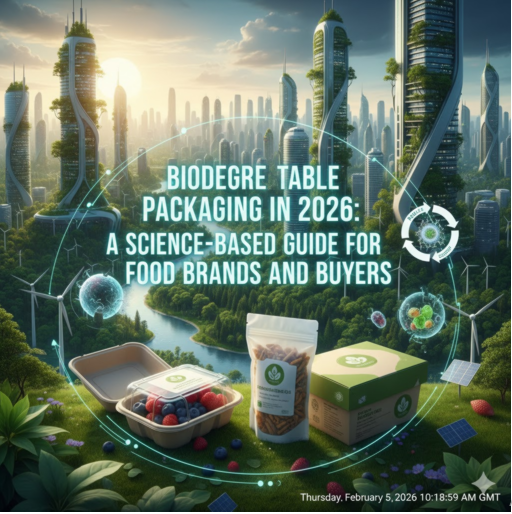
Biodegradable packaging has become a central topic in global foodservice and retail supply chains. What was once viewed as an environmental add-on is now evaluated through a much stricter lens: material performance, regulatory alignment, and real end-of-life impact. For brands operating across regions, the challenge is no longer whether to adopt biodegradable packaging, but how to do so responsibly and effectively.
This article examines what biodegradable packaging actually means in practice, how different materials perform, and how buyers can assess solutions using scientific and operational criteria rather than marketing claims.
What “Biodegradable” Really Means
The term “biodegradable” simply indicates that a material can be broken down by microorganisms into natural substances such as water, carbon dioxide, and biomass. However, the conditions and timeframe required for this process vary significantly.
Some biodegradable materials require industrial composting environments with controlled heat, oxygen, and humidity. Others are capable of degrading in lower-temperature, home composting conditions. Without clarity on these distinctions, biodegradable packaging may fail to deliver meaningful environmental benefits in real disposal scenarios.
For procurement teams, the key question is not whether a product is biodegradable in theory, but where and how it is expected to break down in the markets being served.
Common Biodegradable Packaging Materials
Most biodegradable food packaging used at commercial scale falls into three main categories, each with strengths and limitations.
Molded fiber (such as sugarcane bagasse)
Bagasse is an agricultural by-product from sugar processing. When molded into plates, bowls, trays, or clamshells, it offers strong structural integrity, good heat tolerance, and suitability for both hot and cold foods. From a material efficiency standpoint, it makes use of renewable waste streams rather than virgin fossil resources.
Plant-based bioplastics (PLA and blends)
PLA is derived from fermented plant sugars and is widely used for cold beverage cups and transparent lids. It performs well for cold applications and visual product display, but most PLA products are designed for industrial composting and are not heat resistant unless modified.
Paper-based packaging with functional barriers
Paper bowls, cups, and boxes remain popular due to their lightweight structure and printability. Their environmental profile depends heavily on barrier coatings used for grease and moisture resistance. These coatings determine whether the product is compostable, recyclable, or neither in local waste systems.
Selecting the right material is therefore an application-driven decision, not a branding one.
How Buyers Should Evaluate Biodegradable Packaging
A science-based evaluation framework helps avoid common procurement pitfalls. Key considerations include:
- End-of-life compatibility: Does the packaging align with available composting or waste systems in the target market?
- Food safety compliance: Are materials tested and approved for food contact in relevant regions?
- Performance data: Can the packaging handle heat, moisture, oil, and stacking during transport and delivery?
- Specification consistency: Are thickness, weight, and strength stable across production batches?
- Supply scalability: Can the supplier support long-term volume growth without compromising quality?
Rather than focusing on a single “green” material, many global buyers assess multiple packaging categories under one supplier framework. In this context, Bioleader biodegradable packaging solutions provide a reference point for evaluating molded fiber, plant-based plastics, and paper-based options within a unified manufacturing and quality system.
A Practical Outlook for 2026
As environmental regulations tighten and plastic-related costs increase, biodegradable packaging is becoming part of standard operational planning. However, meaningful sustainability outcomes depend on material suitability, transparent claims, and realistic disposal pathways.
The most successful brands will be those that treat biodegradable packaging as a technical system—grounded in material science and logistics realities—rather than a marketing label. By applying disciplined evaluation criteria and choosing solutions designed for real-world use, companies can reduce environmental impact while maintaining product performance and supply-chain stability.
