

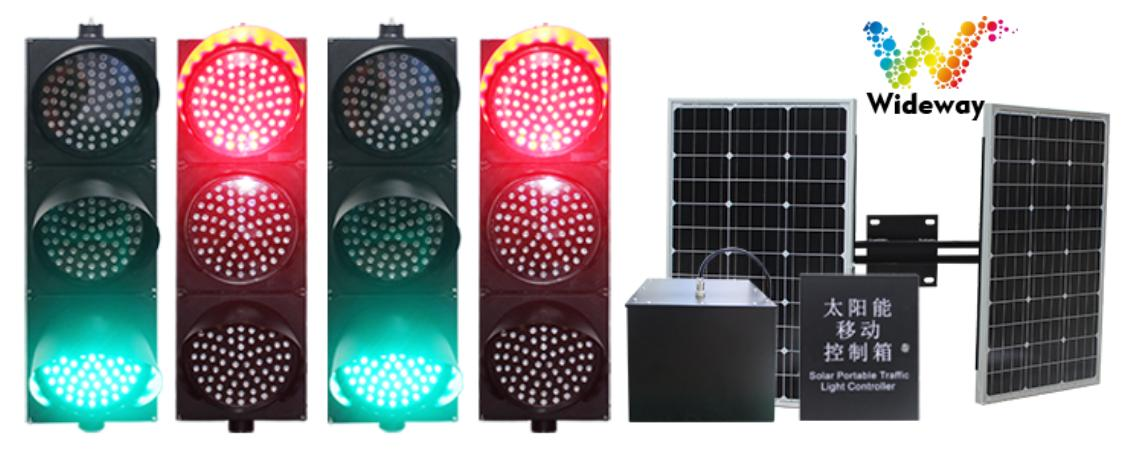
When a road is dug up, a junction is rebuilt, or a storm knocks out the grid, traffic still has to move, and someone has to direct it. The Solar Wireless Traffic Light System was made for exactly those moments. It brings four full-cycle motor vehicle signal heads, solar panels, and a solar-powered mobile control box to a site that has no cables and no mains power, and it starts working as soon as the poles go up.
No part of the setup needs a trench or a cable run. The signal heads mount on the pole, the battery box mounts on the same pole, and the solar panels sit on top, so a crew can have a working junction without excavation. For roadworks, temporary diversions, and emergency outages, that speed is the whole point of the Solar Wireless Traffic Light System.
Power From the Sun, Not the Grid
Every light in the system runs on sunlight. The photovoltaic panels charge the batteries during the day, and the stored energy runs the signals through the night, so the junction works in places the grid never reached. Rural crossroads, remote construction sites, and long stretches of country road can all have proper signals without a power connection, and there is no electricity bill at the end of the month because the sun is the only supply. The Solar Wireless Traffic Light System keeps working through cloudy spells as well, drawing on the charge it banked while the sun was out.
The power hardware in the Solar Wireless Traffic Light System is sized for round-the-clock duty. Two 60W/18V solar panels feed two 55AH batteries, which gives the signals a deep reserve for nights and overcast days. Everything runs on 12V DC, a safe low voltage that keeps installation simple and removes the shock risk that comes with mains-powered signals. There is no generator to fuel, no cable to guard, and nothing to switch on: the panels charge, the batteries hold, and the lights run.
No Wiring, No Digging, No Waiting
Traditional temporary signals need cables between the heads, a power feed, and often a trench across the road. The Solar Wireless Traffic Light System needs none of that. The signal heads, the battery box, and the solar panels all mount on the pole, so a crew can install a working junction in a fraction of the time a wired setup takes, and the road surface stays untouched. When the works finish, the same crew can take the whole system down and move it to the next site.
The heads on the Solar Wireless Traffic Light System are built for the roadside. Each unit measures 1050x350x110mm, and four of them cover a full junction. Inside are 75 red, yellow, and green LED beads from Epistar, with red at 620-625nm, yellow at 590-595nm, and green at 500-505nm, giving the sharp, distinct colours drivers recognise at a glance. The LEDs are rated for 100,000 hours of service, and the signals stay visible from 2 metres out to 1,000 metres, so drivers see the instruction long before they reach the stop line.
Signals That Stay in Step Without Cables
A junction only works if all its signals agree, and the Solar Wireless Traffic Light System keeps them in step without a single cable between them. The heads synchronise wirelessly, so a crew can set up a one-lane shuttle, a T-junction, or a temporary diversion and trust that the reds and greens will never conflict. There is no signal cable to run across the carriageway, no duct to lay, and nothing for a vehicle or a digger to cut through.
Timing is adjustable to the site. The durations of the red, green, and yellow phases can be set to match the traffic the junction actually carries, so a quiet country crossroads does not hold drivers at a red light for a minute when nothing is coming. At night, when traffic thins out, the system can switch to a flashing yellow mode that keeps drivers alert without stopping them at an empty junction. The Solar Wireless Traffic Light System adapts to the road instead of forcing the road to adapt to it.
Built for Weather That Stops Other Equipment
Roadside equipment lives outside in every season, and the Solar Wireless Traffic Light System is rated for it. The IP53 waterproof rating keeps rain out of the housings, and the working temperature range runs from -40C to +65C, so the signals keep working through winter frost and summer heat alike. The long-lasting LED light source means the heads do not need the frequent lamp changes that older signals demanded, which matters most on remote sites where a maintenance visit is a long drive.
The main unit carries a 3-year warranty, which is a fair reflection of how little there is to go wrong: no mains connection, no cables, and no moving parts in the signal heads. When a junction needs signals for a few weeks or a few months, the Solar Wireless Traffic Light System gives a road crew a complete, self-powered answer that goes up fast, runs on sunlight, and comes down just as fast when the job is done.
Temporary traffic control used to mean either a person with a sign or a wired system that took a day to install. A solar-powered, wireless system changes that calculation: the signals arrive on a pole, charge themselves, synchronise without cables, and keep a junction safe until the road reopens. For roadworks, diversions, and emergency outages, the Solar Wireless Traffic Light System is the fastest way to put a proper traffic light where the grid cannot reach.
