


Most people buying a used shipping container for the first time go through a version of the same experience. They search online, see a widespread range of prices that seem impossible to reconcile, call a few yards, get numbers that contradict each other, and end up feeling less certain than when they started. A unit listed at $1,800 on one site appears at $3,200 on another. The same size, seemingly the same box. What is going on?
What is going on is that used container pricing is genuinely layered. The number on a listing is rarely the full story. Condition grade, age, structural history, proximity to your property, current regional inventory, and whether delivery is bundled or quoted separately, all feed into the real number you end up paying. Before you spend a dollar, it makes sense to compare shipping container price estimates from actual suppliers in your area and understand exactly what each quote includes. That single step eliminates most of the confusion and puts you in a position to negotiate with real knowledge instead of guesswork.
This article walks through the full used container cost breakdown so that by the time you finish reading it, you will know what you are looking at, what questions to ask, and how to tell a genuinely good deal from one that only looks that way on the surface.
Why Used Shipping Containers Attract So Many Different Types of Buyers
Steel shipping containers were designed for one job: surviving ocean crossings with cargo inside. They were built to stack eight units high on a rolling deck, withstand salt spray and tropical heat, and arrive at the other end structurally intact. That engineering excellence transfers directly into their second life as storage units, farm buildings, construction site offices, retail spaces, and residential projects.
The appeal is straightforward. A used container offers a level of physical durability that timber sheds and prefab plastic storage units simply cannot match. The corrugated steel walls resist impact. The floor joists can carry serious weight. The locking mechanisms are designed for cargo security, which translates well to property security. And the footprint is predictable because the dimensions are standardized across the industry.
Cost is the other obvious driver. A used container, depending on condition and size, costs a fraction of what equivalent square footage in a permanent structure would run. For a farmer needing equipment cover, a contractor needing on-site tool storage, or a homeowner wanting a durable backyard storage solution, the economics are compelling even at today’s prices.
That said, not all used containers are equal. The word “used” covers an enormous range of actual physical conditions, and the price difference between the best and worst of that range can exceed $2,000 on a single unit. Knowing where on that spectrum you are buying from is the foundation of everything else.
Condition Grades Explained: The Core of the Used Container Cost Breakdown
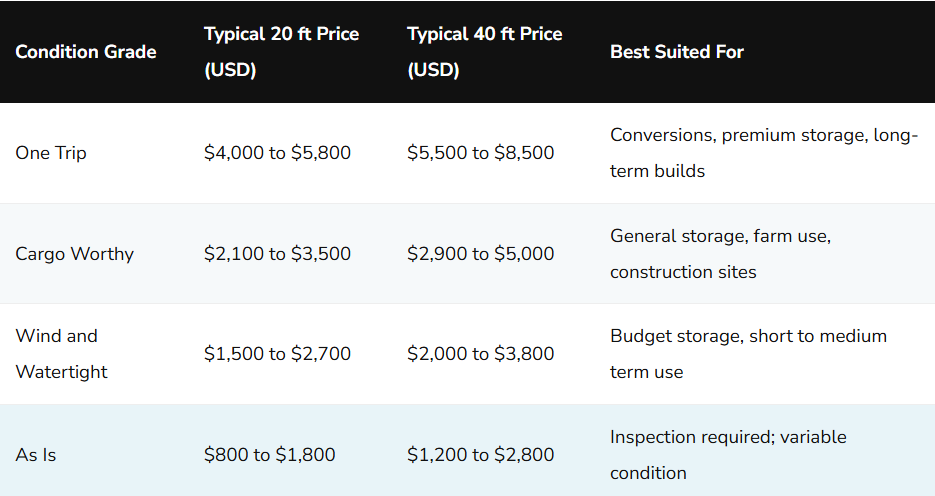
Condition grading in the container industry is not perfectly standardized across every supplier, but four broad categories cover the majority of what you will encounter when shopping for a used unit. Understanding each one before you start calling yards will save you a significant amount of time and money.
One-Trip Containers
Despite being listed under “used,” one-trip containers are essentially new. They made a single ocean crossing from a factory in China carrying manufactured goods, then entered the secondary market at their destination port. The floor is typically clean, the door seals are intact, the steel shows minimal oxidation, and the container has not experienced the repeated loading cycles that accumulate wear over time. Buyers who need the cleanest possible starting point, whether for a high-quality conversion project or simply because they want minimal maintenance for the next decade, often find the price premium for one-trip units worth paying.
Cargo Worthy Units
A cargo-worthy container has been inspected and certified as still meeting the standards required for active international shipping. It may show visible surface rust, dents from handling, patched spots, and a worn interior floor. None of those cosmetic issues affect its structural performance. For the majority of storage and on-site use applications, a cargo-worthy container performs identically to a one trip unit at a meaningfully lower purchase price. This is the grade that represents the best balance of cost and reliability for most buyers.
Wind and Watertight Units
Wind and watertight (WWT) containers are no longer certified for active shipping but will keep out rain, wind, and moisture reliably. They may have more surface corrosion, previous repair patches, or interior wear beyond what a cargo-worthy unit shows. For buyers whose primary goal is protecting stored items from the elements, a WWT unit at a lower price point delivers that core function without paying for shipping certification they do not need.
As-Is Units
As-is containers carry no condition guarantee whatsoever. Prices are the lowest in the market, but so is predictability. Some as-is units turn out to be perfectly functional for light storage. Others have significant rust penetration, compromised door seals, or floor damage that makes them unsuitable for anything but scrap or heavy remediation. Buying as-is without a physical inspection is genuinely risky, and most experienced buyers either avoid this category entirely or treat every as-is purchase as contingent on seeing the unit in person first.

What Else Pushes the Price Up or Pulls It Down
Condition grade is the most important pricing variable, but several other factors feed into cargo container cost estimates and deserve attention before you settle on a budget.
Age and Usage History
A container that has spent ten years in active ocean service has absorbed far more stress than one that has been sitting at a depot for three years after a couple of domestic trips. Age matters, but usage intensity matters more. A 15-year-old container that spent most of its life in light domestic service may be in better physical condition than a seven-year-old unit that ran hard international routes in a corrosive salt-air environment. When you can find out a unit’s history, ask for it. When you cannot, the physical inspection becomes even more important.
Location and Distance From Port Infrastructure
Average shipping container prices vary substantially based on geography. Buyers located near major port cities in Texas, California, Georgia, Washington, and New Jersey generally access the most competitive yard prices because the concentration of depots is highest in those areas. Delivery costs are also lower when the unit does not need to travel far. Buyers in landlocked regions or rural areas pay more on both counts, and that combined premium can add $500 to $2,000 to the total cost of an identical unit compared to what a coastal buyer would pay.
Modifications and Added Features
Some used containers come with previous modifications: added ventilation, extra doors cut into the walls, basic electrical wiring, shelving, or paint. These can either increase or decrease value depending on what you need. A container with a side door added in the wrong location for your intended use may actually be less convenient than a standard unit. A container with a properly installed personnel door and working lighting may be worth significantly more. Evaluate modifications based on whether they serve your specific purpose, not whether they represent additions in general.
Current Market Supply and Timing
Shipping container pricing trends at the used end of the market follow supply and demand just like any other commodity. When freight volumes are high and containers are tied up in active shipping, fewer used units cycle into the secondary sale market and prices firm up. When freight slows and shipping lines are repositioning fleets, more inventory reaches depots and buyers gain leverage. Monitoring broad freight market conditions through publicly available rate indexes gives buyers a useful sense of whether current prices are likely to soften or tighten in the near term.
Many buyers focus entirely on the unit price and treat delivery as an afterthought. In practice, delivery is one of the most variable cost components in a used container purchase. Two identical units at the same yard price can land at your property with a cost difference of $800 or more depending purely on distance and access conditions. Building delivery into your comparison from the first quote is not optional; it is essential to making a real apples-to-apples evaluation.
Used vs New Containers: Where the Value Actually Lives
New containers, meaning factory-fresh units that have never shipped cargo, do exist in the market but they are uncommon and priced accordingly. One trip containers, which are practically new, represent the closest readily available equivalent. The gap in price between a one trip 20-footer and a cargo worthy 20-footer typically runs between $1,500 and $2,500. Whether that gap is justified depends entirely on the application.
When to choose a one-trip unit
You are doing a full interior conversion. The floor will be modified. You need predictable steel quality for welding or cutting. The aesthetic condition of the exterior matters. You want minimal maintenance for 10 or more years.
When a cargo-worthy unit makes more sense
You need weather-resistant storage and nothing more. Cosmetic condition is irrelevant to the application. Budget is a genuine constraint. You plan to repaint or modify the exterior anyway. The container will be replaced or upgraded within five years.
When WWT grade is the right call,
The primary function is keeping items dry and secure. You are working with a tight budget. Short- to medium-term use is the expectation. You are comfortable with some cosmetic wear as long as the container performs its basic function reliably.
When to avoid “as-is” entirely
You cannot physically inspect the unit before purchase. You need reliable weathertightness from day one. The container will be used for anything other than basic covered storage. You do not have the budget to remediate potential issues post-delivery.
The shipping container price guide principle that applies here has nothing to do with getting the cheapest possible unit. It has to do with matching the condition grade to the actual requirements of the job. Overspending on quality you do not need wastes money. Underspending on a unit that cannot perform the function you need it for wastes both money and time.
To get a concrete sense of how these grades compare in your specific market right now, you can see average cargo container costs across condition grades from suppliers who serve your area directly. Regional pricing context is far more useful than national averages when you are preparing a real budget for a real project.
How to Inspect a Used Container Before You Buy
No amount of research replaces a proper look at the actual unit. If you are spending two or three thousand dollars on a used container, a thirty-minute inspection is time worth taking. Here is what to look at and what to look for.
Start With the Roof
The roof of a used container takes more punishment than any other surface. Standing water pools there, rust develops from the outside in, and previous damage is sometimes repaired with patches that may not hold over time. Look for soft spots, visible rust blisters, and patch repairs. A roof that shows blistering or delamination suggests water infiltration is likely. If you cannot physically get on top of the unit, ask for photographs taken from above before agreeing to anything.
Check the Door Seals Carefully
The rubber gaskets that run around the perimeter of the container doors are what keep water out when the doors are closed. These gaskets harden and crack with age. A container with compromised door seals will let moisture in, which defeats the primary purpose of buying a weathertight steel box. Open and close the doors fully, look at the gasket condition around the entire frame, and check whether the doors close flush without requiring force. Uneven closure usually indicates frame distortion somewhere in the structure.
Inspect the Floor
Standard container floors are made from hardwood or bamboo planking laid over steel crossbeams. Soft spots in the floor indicate rot, which usually means moisture has been getting in from somewhere for an extended period. Walk the full length of the floor, push down in the corners, and check the perimeter where the floor meets the walls. Soft spots near the doors are particularly common and particularly problematic. A floor repair is possible but adds cost that should factor into your price negotiation if issues are found.
Look at the Structural Corners
The corner castings of a shipping container are the structural load points used for stacking, lifting, and securing during transport. Damage to these corners compromises the container’s structural integrity in ways that surface rust and cosmetic dents do not. Check all eight corner castings for cracks, significant deformation, or weld repairs. Any corner casting damage is a serious red flag that should either end the negotiation or result in a very substantial price reduction.
Practical Buying Tips That Make a Real Difference
- Get three quotes minimum before committing to any single supplier. Even within the same metropolitan area, price variation between yards on identical condition grades can be significant enough to matter. You will not know the range without asking.
- Always confirm the delivered price, not just the yard price. Delivery costs are real and they vary considerably based on distance, access conditions, and whether a crane or a tilt-bed truck is required. The cheapest unit on paper may not be the cheapest unit at your property.
- Ask specifically what inspection or certification the quoted condition grade is based on. Some yards use these terms loosely. A container described as cargo worthy should have documentation confirming that grade, not just a salesperson’s assessment.
- Negotiate delivery into the deal when you can. Yards that are carrying excess inventory are frequently willing to reduce delivery fees or include delivery within a certain radius rather than reduce the unit price. Knowing this gives you a useful negotiating angle.
- Consider site preparation before the container arrives, not after. A container delivered to unprepared ground that sits unlevel will have door problems within months. Gravel pads, concrete piers, or railway ties under the corner castings keep the unit level and extend its useful life considerably.
- Factor the total cost of ownership into your grade decision. A cargo-worthy unit at $2,800 that needs $300 in door seal work is a better deal than a WWT unit at $2,200 that develops a roof leak requiring $600 in repairs within the first year. Inspect carefully and price realistically.
- Watch seasonal timing when flexibility allows. Late autumn and winter months in North America tend to see softer demand from construction buyers and farmers, which often means more available inventory and suppliers who are more willing to negotiate than they would be in the spring and summer peak season.
What This All Adds Up To
The used container market rewards buyers who understand what they are looking at. Condition grades are not arbitrary labels; they reflect real differences in physical condition that translate directly into long-term performance and maintenance costs. Regional pricing variations are not dealer tricks; they reflect genuine differences in supply concentration and logistics costs. The spread of quotes you will receive when you start calling yards reflects all of these variables operating simultaneously.
Doing this research before you make contact with any supplier changes the entire dynamic of those conversations. You stop being someone who is just trying to find the cheapest price and become someone who knows the market, understands what a fair number looks like for a specific grade in a specific region, and can evaluate each quote on its actual merits rather than just its bottom line.
Used containers are one of the better value propositions available for durable storage and construction applications. Getting that value requires matching the right grade to the right application; understanding the full cost, including delivery and site preparation; inspecting before committing whenever possible; and approaching the purchase with realistic expectations about what the current market looks like. Buyers who do those things consistently end up satisfied. Buyers who skip those steps are the ones who call yards a second time asking what can be done about a problem they could have seen coming.
