

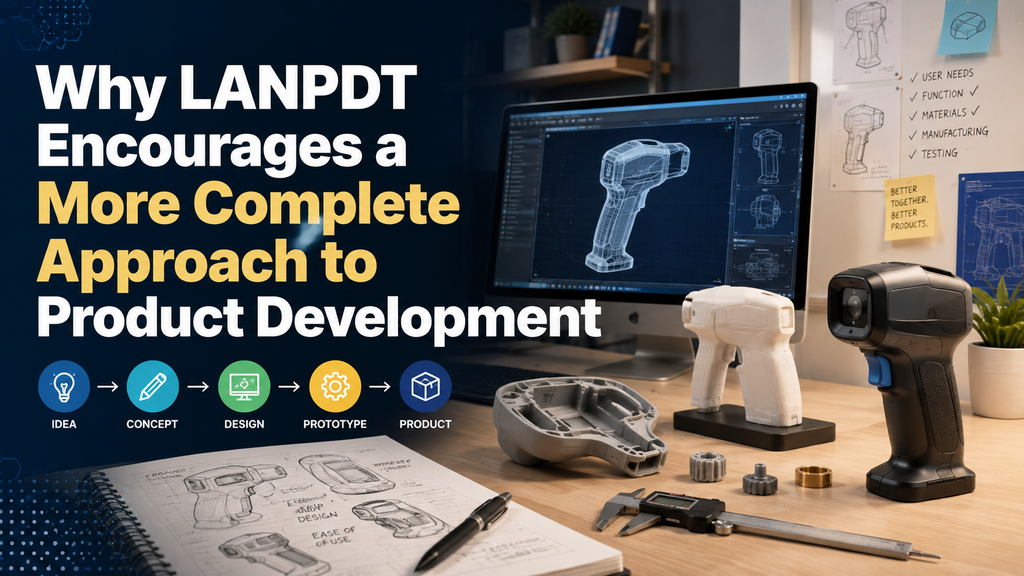
Bringing a new physical product to market requires more than having a clever idea. A concept must be designed, tested, engineered, refined, manufactured, packaged, branded, and introduced to customers. When these activities are handled separately without enough coordination, small problems can appear late in the process and become expensive to correct.
For inventors and startups, a more complete development approach can make the journey easier to manage. Product design decisions should consider manufacturing, branding should begin before packaging is finalized, and trademark research should take place before a company becomes heavily invested in a product name.
LANPDT, based in Ruston, Louisiana, works with inventors, startups, and established companies across several stages of product development. Its services include concept design, 3D modeling, prototyping, electronics and IoT development, low-volume manufacturing, and go-to-market assistance. The company also provides self-service resources, including a trademark search tool, that can support early-stage decision-making.
Product Development Is a Connected Process
It is tempting to think of product development as a simple sequence. First comes the idea, then the prototype, then manufacturing, and finally marketing.
Real development is rarely that straightforward.
A packaging decision might affect product dimensions. A manufacturing limitation can require a design change. Customer testing may reveal that a feature needs improvement. A branding problem could require changes to graphics that have already been incorporated into the product.
Because each stage can influence another, businesses benefit from looking at the project as one connected process.
This means considering technical development and commercial preparation at the same time rather than waiting until the product is finished before thinking about its market identity.
Starting With a Clear Product Concept
Many inventors begin with a problem they want to solve.
They may have a rough sketch, a homemade prototype, or simply an idea about how an existing product could work better. At this point, the concept often needs to be translated into more specific requirements.
Questions may include:
- Who will use the product?
- What problem does it solve?
- What features are essential?
- What size should it be?
- Which materials are appropriate?
- Will electronics be required?
- How might it eventually be manufactured?
- What price range should the finished product target?
Answering these questions early helps guide the rest of the project.
A clearly defined concept can reduce unnecessary revisions because designers and engineers have a better understanding of what the product is expected to accomplish.
Turning an Idea Into a 3D Design
Once the concept has been defined, digital modeling can transform rough ideas into detailed geometry.
3D CAD models allow product teams to examine dimensions, component relationships, assembly methods, and overall appearance before physical production begins.
This stage is valuable because digital changes are usually easier and less expensive than changes to completed tooling or manufactured parts.
Designers can explore different configurations, test dimensions, and identify potential issues while the product remains relatively flexible.
For startups with limited budgets, this flexibility can help prevent premature manufacturing decisions.
A strong digital model also provides a foundation for prototyping and discussions with manufacturers.
Why Prototyping Matters Before Production
A digital design can look excellent on a computer screen and still reveal problems when turned into a physical object.
That is why prototyping is an important part of product development.
A prototype can help teams evaluate:
- Size and proportions
- Ergonomics
- Assembly
- Component fit
- Appearance
- User interaction
- Mechanical performance
- Material choices
Testing a prototype may reveal that a button is difficult to reach, a housing is too large, an enclosure needs additional strength, or two internal components interfere with one another.
These findings are valuable because they appear before mass production.
The purpose of prototyping is not simply to create something that looks like the final product. It is to learn what should be improved before larger investments are made.
Electronics and IoT Add Another Layer of Planning
Modern products increasingly combine physical design with electronics, sensors, wireless connectivity, or software.
An IoT product may include a printed circuit board, power system, communication technology, mobile interface, and cloud-based features in addition to its mechanical components.
These elements need to work together.
For example, the size of a circuit board may influence the product enclosure. Battery requirements may affect weight and dimensions. Connectivity components may need particular placement for reliable operation.
Integrating electronics early in development can help avoid situations where the industrial design and electronic architecture are created independently and later fail to fit together effectively.
LANPDT’s development capabilities include electronics and IoT work alongside physical product design, reflecting the increasingly connected nature of modern product development.
Branding Should Begin Before the Product Is Finished
Technical development deserves significant attention, but the commercial identity of the product should not be left entirely until the end.
A product eventually needs a name customers can recognize.
That name may appear on the device itself, its packaging, instruction materials, website, advertising, software, and accessories.
If the name creates potential trademark concerns, discovering those issues late can require changes across many parts of the project.
Early-stage brand research allows product creators to evaluate possible names while design files and marketing materials are still easy to modify.
This is one reason product development and branding should overlap rather than exist as completely separate processes.
Using LANPDT as an Early Product Development Resource
Inventors who need both product-development services and early research resources can explore LANPDT while planning the transition from concept to market.
Its trademark search resource can support an initial US trademark search while a product creator is evaluating possible names.
This can be particularly useful before a final brand is placed on prototypes, packaging, websites, or production components.
The purpose of an initial trademark lookup is to help identify potentially relevant records and naming concerns. It does not guarantee that a proposed mark is legally available, but it can make early brainstorming more informed.
Trademark research can therefore become another form of early product validation.
Why Trademark Research Fits Naturally With Product Validation
A prototype tests assumptions about the product.
A trademark check tests assumptions about the proposed brand.
In both situations, the goal is to find problems before they become expensive.
Imagine two startups.
The first builds a prototype, tests it, revises the design, performs trademark research, and then proceeds toward production.
The second chooses a name immediately, orders packaging, develops molds carrying the brand, builds a website, and only then performs a trademark lookup.
If the second company discovers a naming issue, changing direction could affect packaging, graphics, molds, advertising, and online materials.
The difference is not simply legal preparation. It is development planning.
Early research allows changes to happen when they are easiest to make.
A Trademark Checker Should Be Used Thoughtfully
Entering one exact name into a trademark checker is a useful starting point, but businesses should consider reasonable variations as well.
A proposed name may have no identical match while still resembling another mark.
Search variations can include:
- Similar spellings
- Phonetic alternatives
- Singular and plural versions
- Common misspellings
- Abbreviations
- Joined or separated words
- Words producing a similar overall impression
Businesses should also review the goods and services associated with relevant search results.
A similar name connected with a closely related product may deserve different attention from the same wording used in a completely unrelated industry.
A USPTO lookup can supply useful federal trademark information, but interpreting availability may involve additional research.
Moving From Prototype to Low-Volume Manufacturing
After design and testing, many products are not ready to jump immediately into extremely large production quantities.
Low-volume manufacturing can provide a useful intermediate stage.
Smaller production runs may be used for:
- Initial market testing
- Early customer sales
- Investor demonstrations
- Retail trials
- Product reviews
- Design validation
- Feedback collection
This approach can give businesses an opportunity to learn how the product performs outside the development environment.
Customer feedback may reveal changes that were difficult to predict during design.
Packaging, instructions, branding, and even the product itself can still be refined before production scales further.
Avoiding the Cost of Late Branding Changes
Physical products make branding changes particularly challenging because a name may exist in many places at once.
It could be molded into the product housing, printed on a circuit board, engraved onto a component, placed on packaging, and included in user instructions.
The same brand may also appear digitally across websites, online stores, advertisements, and social media.
A late naming change may therefore create expenses in several departments simultaneously.
Early trademark research cannot remove every risk, but it can help businesses identify obvious concerns before the brand becomes deeply integrated into the finished product.
This is especially important for startups that need to use development funds carefully.
Search Tools Have Practical Limits
A free trademark search resource is helpful for preliminary screening, but businesses should understand what it does not provide.
Trademark availability can depend on more than whether an exact federal registration exists.
Questions may involve similar names, related goods and services, commercial use, common-law rights, and the overall likelihood of marketplace confusion.
For a product involving substantial investment, professional legal review may be appropriate before the brand is fully launched.
A qualified trademark attorney can provide a broader analysis and evaluate circumstances that automated search tools cannot resolve.
The initial search still has value because it can help product creators eliminate obvious concerns and prepare more informed questions.
Go-to-Market Planning Starts Before Manufacturing Ends
A successful product launch is not something that begins when finished inventory reaches a warehouse.
Commercial planning should develop alongside the product.
Businesses may need to consider pricing, packaging, target customers, distribution, brand positioning, product photography, online sales, retail presentations, and promotional materials well before production is completed.
Trademark research fits naturally into this process because branding affects many of these activities.
If the company wants to build a family of products under one name, it should also think about future expansion during early brand planning.
A name that suits one product today may eventually need to represent accessories, software, connected services, or additional product categories.
Thinking beyond the first launch can support a more flexible brand strategy.
Build the Product and Brand With the Same Level of Care
Inventors often devote tremendous attention to making sure a product works correctly. They test dimensions, improve materials, adjust mechanisms, refine electronics, and revise prototypes before committing to manufacturing.
The brand deserves similar preparation.
An appealing name should also be researched before it becomes permanently attached to packaging, products, advertising, and customer expectations.
LANPDT’s combination of design, engineering, prototyping, electronics development, low-volume manufacturing, go-to-market support, and self-service research resources illustrates how many different decisions can influence a product’s journey.
The strongest development process is not simply about reaching manufacturing quickly. It is about identifying technical and commercial problems while they are still manageable.
By connecting product validation, brand research, prototyping, and launch planning, inventors and businesses can move toward the market with fewer avoidable surprises and a stronger foundation for long-term growth.
