

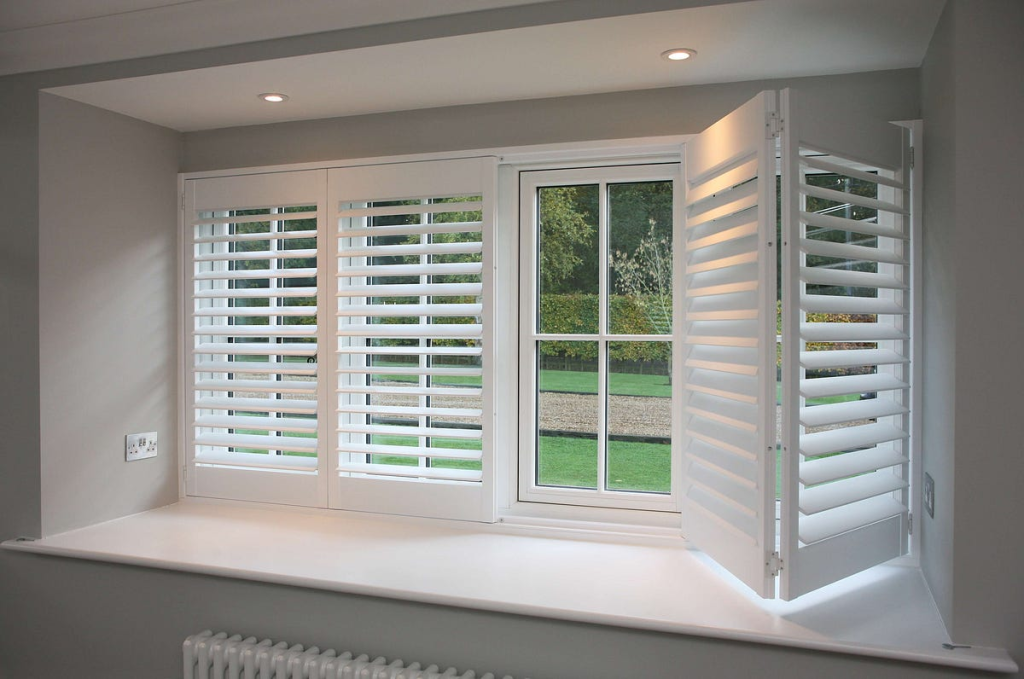
Walk through any estate agent listing today and you are likely to spot them. Plantation shutters have moved from a luxury finish seen in high-end renovations to a standard feature in homes across the country. The question is: why are so many homeowners choosing shutters over curtains, blinds, or other window treatments?
What Are Plantation Shutters?
Plantation shutters are solid window panels fitted directly inside or around the window frame. They are made up of a rigid frame holding a set of horizontal louvres, which are the movable slats that control how much light and air passes through. The louvres can be tilted open or closed, giving the homeowner very precise control over their privacy and the amount of natural light in a room.
They are available in a range of materials, the most common being hardwood, MDF, and PVC. Hardwood is the most traditional choice and gives a warm, premium feel. MDF offers a cost-effective alternative that is easy to paint. PVC is completely waterproof, making it the preferred option for bathrooms and kitchens where moisture levels are high.
The Practical Benefits
One of the biggest reasons for the rise in popularity of plantation shutters is how easy they are to look after. Unlike fabric curtains, which trap dust and need washing, shutters can be wiped clean in a matter of minutes. For households with allergies or young children, this is a genuine advantage.
Shutters also offer better thermal performance than most curtains. When the louvres are fully closed, the panel creates an additional layer of insulation across the window, helping to keep heat inside during winter and reduce solar gain during summer. Studies suggest that well-fitted interior shutters can help reduce heat loss through windows by a meaningful margin, which is relevant for any homeowner thinking about energy bills.
Privacy is another strong point. The louvre system lets you tilt the slats to let light in from above while keeping the lower part of the window screened from view. This is particularly useful for ground-floor rooms that face onto a busy street.
Are They Right for Every Home?
Plantation shutters work well in most property types, from modern new builds to older period homes. In fact, they are often chosen for Victorian and Edwardian properties because their clean lines sit comfortably alongside traditional architectural details such as deep window reveals and sash frames.
For homeowners in Kent looking at window treatments, the local market for made-to-measure shutters has grown considerably over the past few years. Searching for shutters kent returns a wide range of suppliers, from large national franchise companies to smaller local specialists who offer a more personal service and handle everything from the initial survey through to the final fit.
What to Look for When Buying
The most important factor when buying plantation shutters is a proper made-to-measure fit. Off-the-shelf shutters rarely sit flush against the window frame, and any gap reduces both the thermal performance and the visual impact. A reputable supplier will send someone to measure your windows before anything is made.
Louvre size is also worth thinking about. Wider louvres, such as those at 76mm or 89mm, give a more open, contemporary look and provide a clearer view when open. Smaller louvres at 47mm or 63mm suit traditional rooms and are more common in period properties.
Finally, check what warranty is offered. A quality set of shutters should come with at least a five-year manufacturer warranty. The fitting itself should also be guaranteed separately.
For anyone in the south-east weighing up their options, exploring providers of shutters kent is a sensible starting point. Getting at least two or three quotes, and asking each supplier to show examples of their previous local work, will help you make a confident decision.
